Hoi An Old Town: Heritage, Assembly Halls, Tickets
Hoi An old town is a former trading port, inscribed as a UNESCO World Cultural Heritage site on 4 December 1999. It keeps its urban fabric and old houses of the 15th to 19th centuries, about 30 km south of Da Nang. Since 15 May 2023, visitors need a ticket: VND 120,000 for foreigners, VND 80,000 for Vietnamese.
In this guide
- What Hoi An old town is
- A town that escaped urbanisation
- A chessboard of streets: Tran Phu, Nguyen Thai Hoc, Bach Dang
- The tube house of Hoi An: columns and three spaces
- The five Chinese assembly halls
- Living in the old town: worship and festivals
- Ong Pagoda, clan chapels and quieter corners
- The Japanese Covered Bridge
- The full-moon night
- What to eat in the old town
- Tickets and opening hours
- When to go
- How far Hoi An is from Da Nang
- Common questions
What Hoi An old town is
Hoi An old town is a former trading port on the Hoai River in Quang Nam. On 4 December 1999, UNESCO inscribed it, together with the My Son temple complex, on the World Cultural Heritage list. UNESCO treats it as a prime example of a preserved Southeast Asian trading port, with an urban fabric and old-house architecture of the 15th to 19th centuries left intact.
The UNESCO file gives two reasons. First, Hoi An is an outstanding material expression of cultures blending over the centuries in an international trading port. Second, it is an outstanding example of a traditional Asian port town that has been perfectly preserved.
What was recognised is the whole townscape, not any single monument.
The old urban area lies entirely within Hoi An ward and covers about 2 km². It keeps almost intact more than a thousand old architectural monuments, from streets and houses to communal halls, pagodas and temples. A town like Hoi An is unique in Vietnam and rare in the world. It is a living museum of architecture and urban life, its streets wearing the mossy look of age.
Since the listing, nearly 459 works, including old houses, monuments and streets, have been repaired. Of the 1,107 buildings that make up the old town’s look, 844 sit on the World Heritage list.
A town that escaped urbanisation
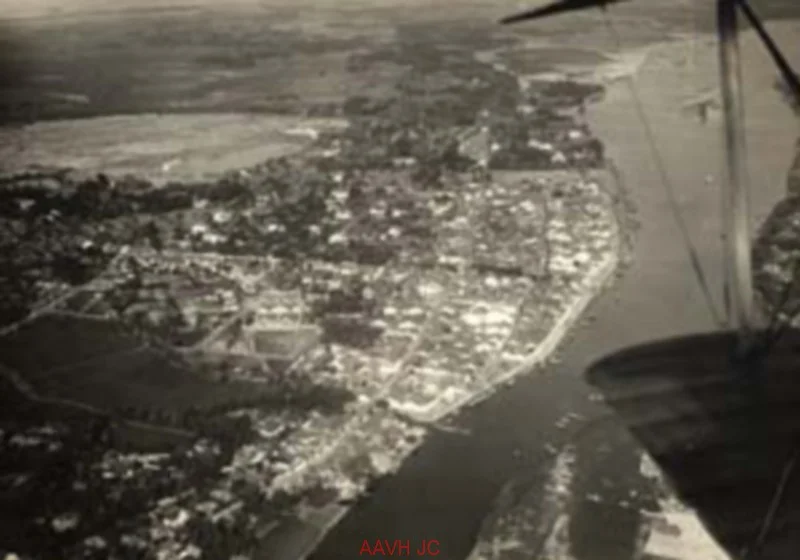
Hoi An escaped the headlong urbanisation of the late 20th century, which many other old towns did not. Westerners of old called the place Faifo. The photo below was taken of Faifo from a Breguet 14 aeroplane in 1925-1930. The town hugs the river, houses packed side by side from the bank inland.
How Hoi An became a port, and why the port died while the town lived on, is told separately in Hoi An history. This page is about what still stands today.
A chessboard of streets: Tran Phu, Nguyen Thai Hoc, Bach Dang
The Hoai River divides the old town. The streets here are short and narrow, some of them winding, running lengthwise and across like a chessboard. Each street has its own age, and reading the ages is the easiest way to see how the old town grew.
Tran Phu (Trần Phú) is the oldest axis. It was once the town’s main road, running from the Japanese Covered Bridge to the Teochew Assembly Hall. Under the French it was called Rue du Pont Japonais, the street of the Japanese bridge.
Nguyen Thai Hoc (Nguyễn Thái Học) appeared in 1840 and was later named Rue Cantonnais, the Cantonese street, by the French.
Bach Dang (Bạch Đằng) came in 1878 and, lying right on the riverbank, was once called the Riverside Road. Both streets formed later, on reclaimed silt. In the stormy rainy season Nguyen Thai Hoc and the area around it often flood, and people go shopping and to restaurants by boat.
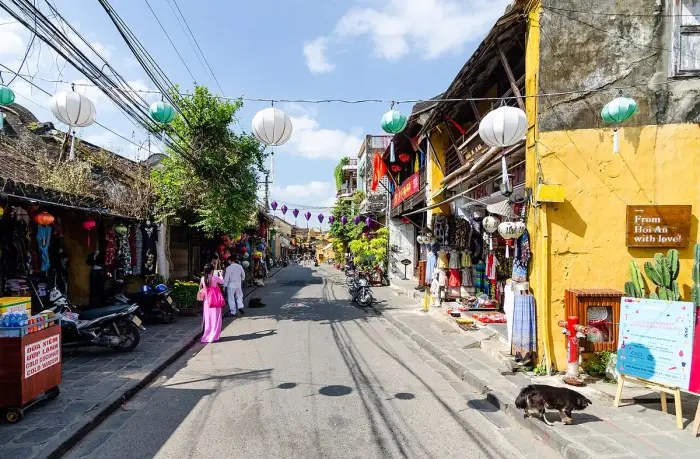
The district is perfectly walkable. The easiest start is the Japanese Covered Bridge, then along Tran Phu, the road linking the bridge to the Teochew Assembly Hall.
The tube house of Hoi An: columns and three spaces
The commonest house in Hoi An is the one- or two-storey town house, narrow in width and very deep, giving the tube-shaped house. The average plot is about 4 to 8 metres wide and about 10 to 40 metres deep.
A tube house holds three spaces: for trade, for daily life and for worship.
In the main house, 16 columns set 4 x 4 form 3 x 3 bays, and the four central columns stand clearly taller than the rest. The first bay from the street is the shop, the next is a warehouse closed off by a partition, and the third holds the ancestral altar facing inward. Between the houses lie stone-paved courtyards with water tanks, miniature rockeries and potted plants.
The roof is of thin, coarsely fired clay tiles, square, about 22 cm a side and slightly curved. Rows of upturned tiles alternate with rows of downturned ones, which Hoi An people call yin-yang roofing (ngói âm dương).
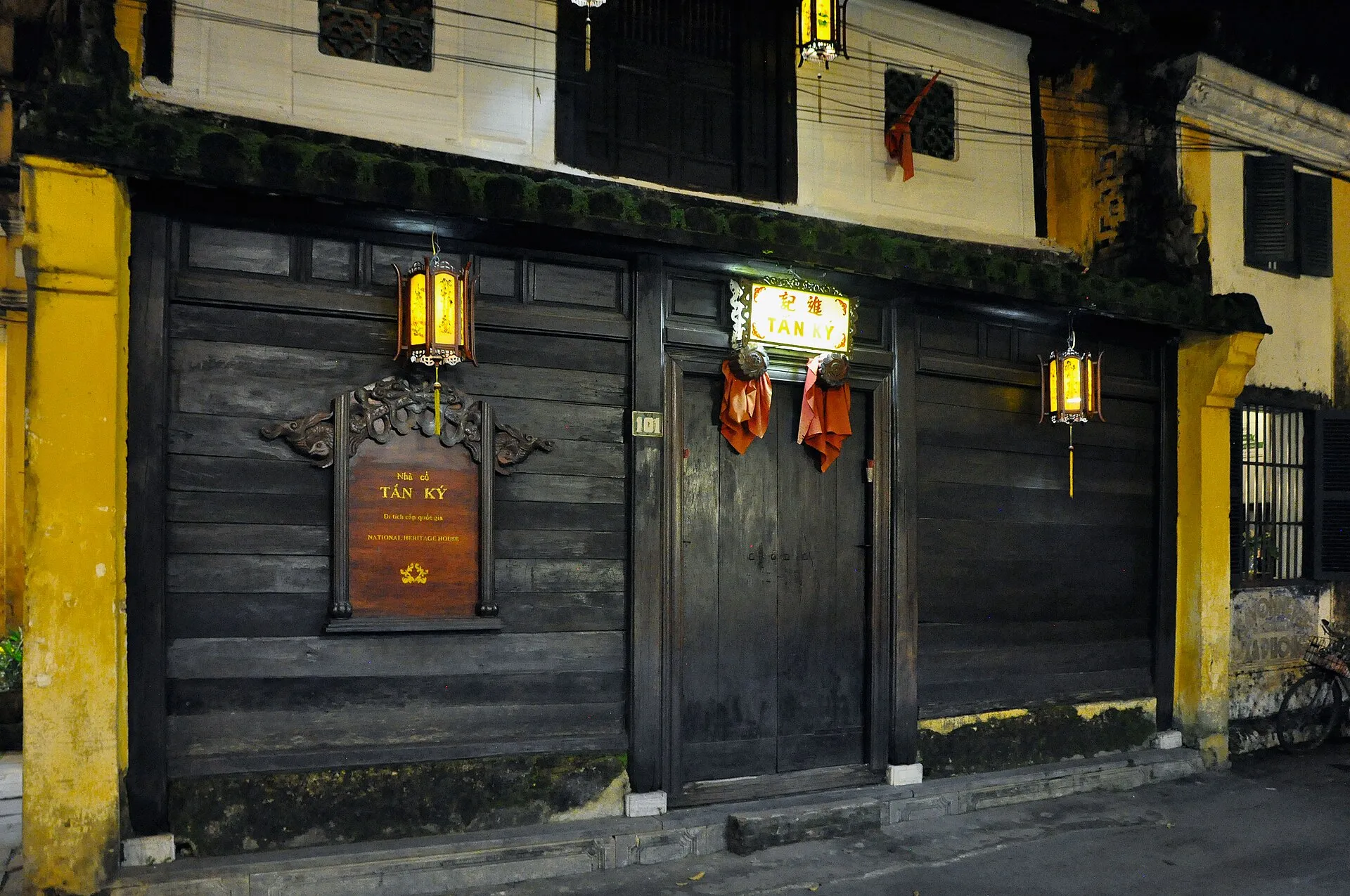
The Tan Ky (Tấn Ký) old house was built in 1741 and seven generations of one Vietnamese family have lived in it.
The largest old house in the district holds the Museum of Folk Culture at 33 Nguyen Thai Hoc, 57 metres long and 9 metres wide.
The Museum of Folk Culture presents traditional crafts with performances, while the Museum of History and Culture retells about 2,000 years through objects. The Museum of History and Culture was once a pagoda to the Bodhisattva Guanyin, built by Vietnamese and Minh Huong people around the 17th century.
The five Chinese assembly halls
Hoi An still has five assembly halls, matching the five big overseas-Chinese groups: Fujian, China (the Five Congregations Hall), Teochew, Hainan (Quynh Phu) and Cantonese. All five stand on the Tran Phu axis and all face the Thu Bon River.
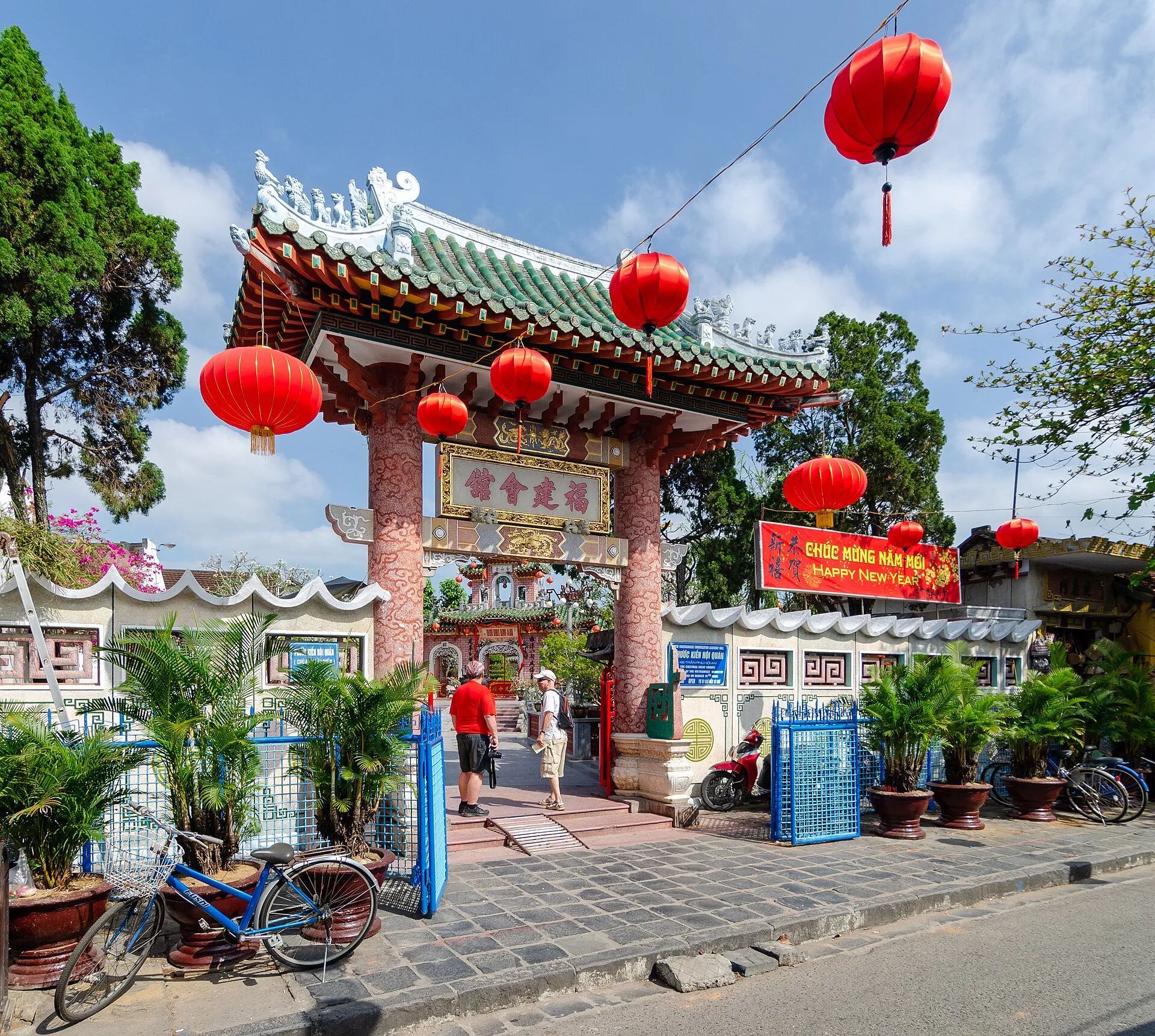
The largest is the Fujian Assembly Hall (Hội quán Phúc Kiến) at 46 Tran Phu.
Its origin is a surprise. It began as a thatched pagoda built by Vietnamese in 1697 to worship the Buddha, and Fujian merchants bought it in 1759. After several restorations it became the Fujian Assembly Hall in 1792.
The gate has a spectacular roof system of 7 curving blue-glazed tube-tile roofs. Every year on the 23rd day of the third lunar month, the Chinese hold the festival of Thien Hau, the Holy Mother, here.
Coming in from the Japanese Covered Bridge, the five halls stand on Tran Phu, all on the even-numbered side, in this order: Cantonese, China, Fujian, Hainan, then Teochew. The photo below shows the Cantonese hall at Faifo, taken between about 1891 and 1898, in an album kept at the National Library of France. The album’s caption names the place “Fei-Foo”.
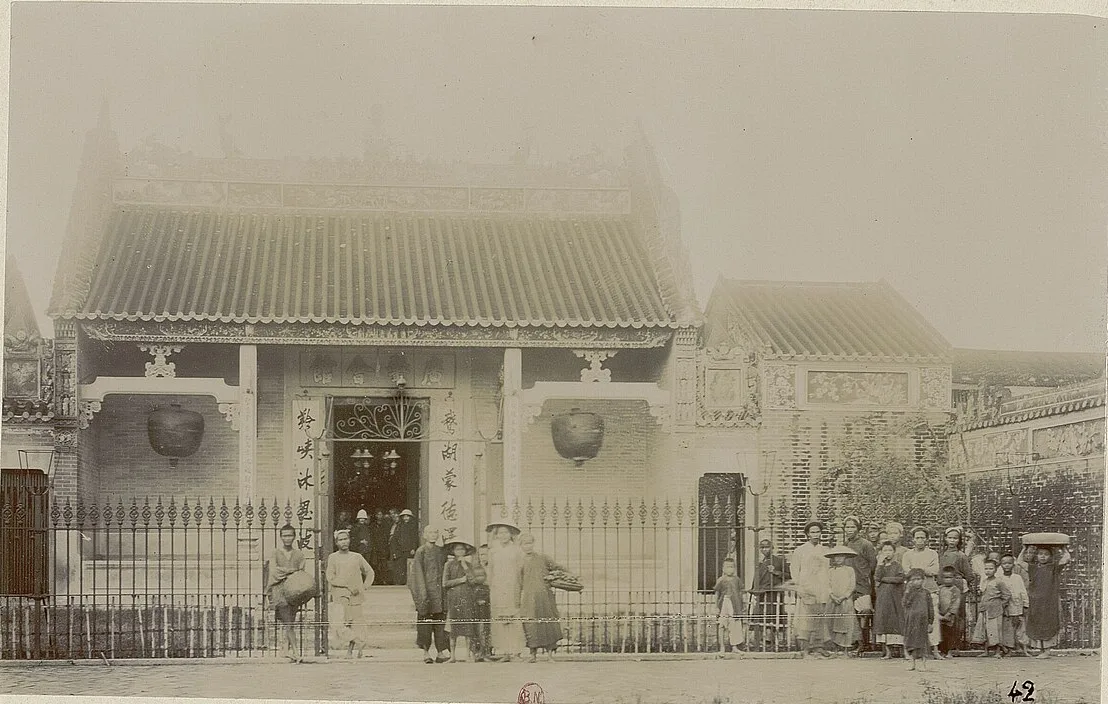
Each hall worships a god of the home region of the community that founded it.
In the Fujian hall the Chinese worship Thien Hau together with six loyal Ming officials. The Hainanese founded the Quynh Phu hall to worship the 108 Chieu Ung, Hainan traders lost at sea who were later given royal titles by the Nguyen court. The Teochew worship General Phuc Ba, the god who cut the waves to save merchant boats.
Living in the old town: worship and festivals
Hoi An is not a court city like Hue. Its monuments are the traditional cultural institutions of everyday life. In their homes, Hoi An people worship the Ngu tu gia duong, most often held to be five spirits who guard a family’s fate. They are the Kitchen god, the Well god, the Gate god, the patron craft ancestor and Cuu thien huyen.
For ages Hoi An people have also worshipped Quan Cong as a guardian spirit protecting the family’s peace.
At the village communal halls around the town, people hold the Long Chu festival on the full moon of the first and the seventh lunar months. In the fishing villages by river and sea, boat racing is an essential pastime, usually at Lunar New Year from the 2nd to the 7th of the first month.
Ong Pagoda, clan chapels and quieter corners
Ong Pagoda (Chùa Ông) is in fact the temple of Quan Cong, at 24 Tran Phu, in the middle of the old town. Minh Huong and Vietnamese people built it in 1653 to worship Quan Cong.
It was the faith centre of Hoi An merchants, the place that witnessed their business deals and gave them trust. The Ong Pagoda festival is held on the 13th of the first lunar month and the 24th of the sixth.
Clan chapels are monuments few visitors notice, yet they tell a great deal. The earliest dated chapels are mostly overseas-Chinese ones, from the early 17th century. The Tran clan chapel at 21 Le Loi dates from the early 19th century. Behind the ancestral hall is a raised patch of ground where the afterbirth of clan members was buried at birth.
The earliest pagoda known in the area is Chuc Thanh, said to date from 1454, about 2 km north of the old town.
The Japanese Covered Bridge
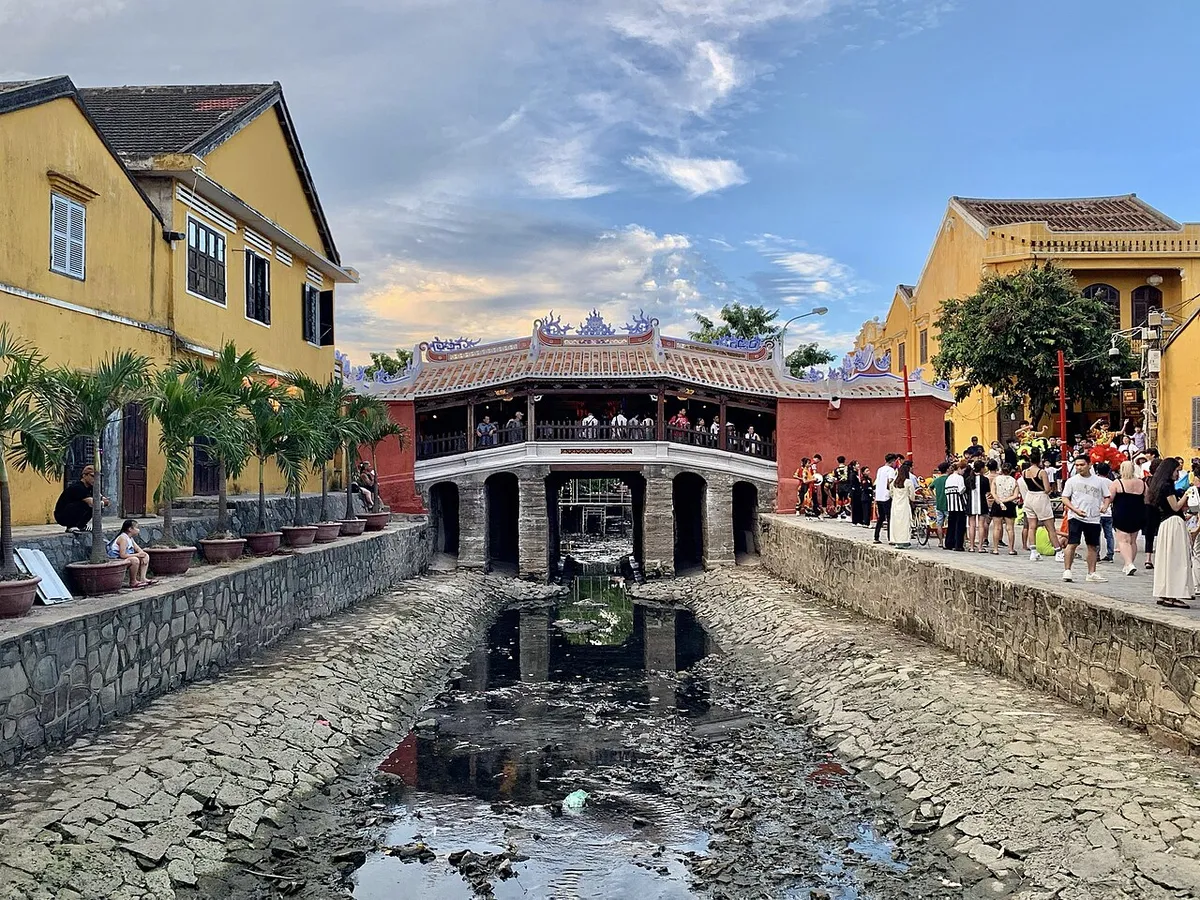
The Japanese Covered Bridge (Chùa Cầu) is the only old bridge left in Hoi An, about 18 metres long.
It was built from the late 16th to the early 17th century and first called the Japanese Bridge, in the style of a pagoda above a bridge. In 1719 Lord Nguyen Phuc Chu named it Lai Vien Kieu, meaning bridge for visitors from afar. Its image is on the VND 20,000 note.
The old-town ticket includes the small temple inside, and ticket money is used to preserve the bridge. Why the Japanese built the bridge, and why it has monkey and dog statues, is in Hoi An history.
The full-moon night
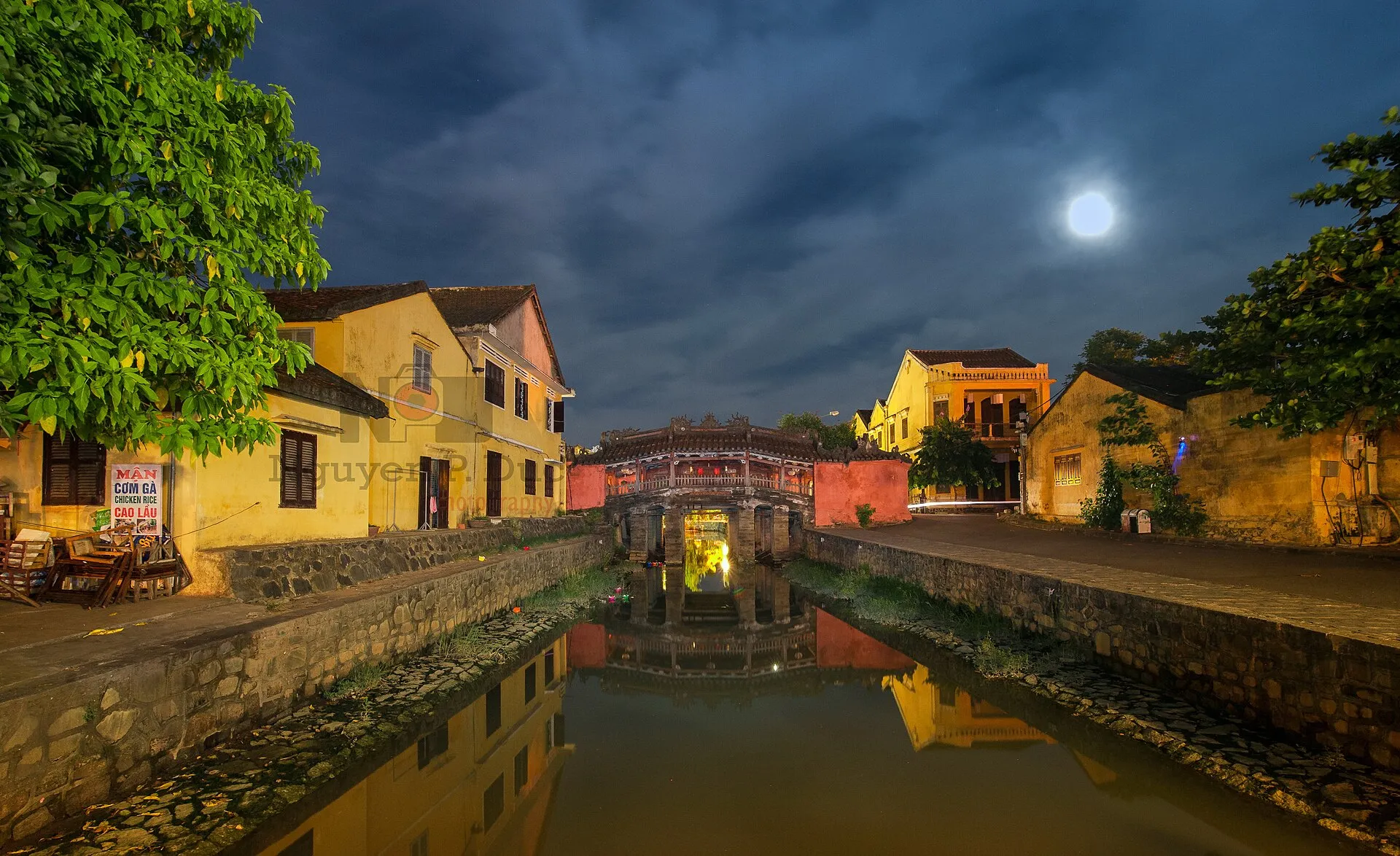
Since 1998, Hoi An has held the Old Town Full-Moon Night Festival on the 14th night of every lunar month. The idea began with the wish of the Polish architect Kazimierz Kwiatkowski. From 17:00 to 22:00 the houses, shops and restaurants switch off their lights, and the whole district is left with only the full moon and lanterns.
On the same night, bai choi is performed regularly at the corner of Nguyen Thai Hoc and Bach Dang. It is a pastime rich in the culture of Quang Nam and the whole central coast.
What to eat in the old town
Seafood has always made up much of the daily meal of Hoi An people. One of the signature dishes of Hoi An cuisine is cao lau. Mi Quang is also sold everywhere in the old town; the full story is in the mi Quang page.
Banh bao and banh vac (white rose dumplings) are the refined, delicious and unusual dishes of the old town. The rice-flour water must be clear, usually taken from the old Ba Le well. Also try banh beo, goi ca Nam O, banh trang cuon thit heo and Hoi An chilli sauce. For restaurants in Da Nang, see danangoi.com (opens in a new tab), a sister guide to eating in Da Nang.
Tickets and opening hours
Since 15 May 2023, all visitors to the old town have had to buy a ticket at the booths. It costs VND 120,000 for foreigners and VND 80,000 for Vietnamese. The ticket price corresponds to the number of sights you visit. The booths are open from 7:30 to 21:30 every day in summer and until 21:00 in winter.
The city states that ticket income goes to restoring heritage and upgrading infrastructure in the old town.
When to go
February to April is cool and has little rain. To see the old town lit by lanterns alone, come on the night of the full-moon festival (see above).
How far Hoi An is from Da Nang
Hoi An is about 30 km south of Da Nang and only 5 km from the East Sea. To add a day trip, see Cu Lao Cham and My Son sanctuary, the heritage site inscribed on the same day as the old town. See also the Hoai River, which flows through the town.
Photo credits
- Tran Phu Street, the main axis of the old town: Wikimedia Commons — Steffen Schmitz (opens in a new tab) (CC BY-SA 4.0)
- Fai Fo from the air, 1925-1930: Wikimedia Commons — Archives de la Planete (Albert Kahn collection), 1930, public domain (opens in a new tab) (Public domain)
- The front of Tan Ky Old House: Wikimedia Commons — P. Hughes (opens in a new tab) (CC BY 4.0)
- The gate of the Fujian Assembly Hall: Wikimedia Commons — Steffen Schmitz (opens in a new tab) (CC BY-SA 4.0)
- The Cantonese (Quang Dong) pagoda at "Fei-Foo", in an old photograph: Wikimedia Commons — Gustave Trumelet-Faber album, BnF Gallica (1891-1898), public domain (opens in a new tab) (Public domain)
- The Japanese Covered Bridge after renovation: Wikimedia Commons — Chainwit. (opens in a new tab) (CC BY 4.0)
- The Japanese Covered Bridge on a full-moon night: Wikimedia Commons — Nguyen Phu Duc, CC0 (opens in a new tab) (CC0)
Common questions
When did UNESCO recognise Hoi An old town?
On 4 December 1999, in Marrakech, Morocco, UNESCO inscribed the Hoi An ancient town and the My Son temple complex on the World Cultural Heritage list.
Do you need a ticket for Hoi An old town, and how much is it?
Since 15 May 2023, all domestic and international visitors must buy a ticket at the ticket booths: VND 120,000 for foreigners and VND 80,000 for Vietnamese. The price corresponds to the number of sights you visit.
What time do the Hoi An old town ticket booths open?
From 7:30 to 21:30 every day in summer, and until 21:00 in winter.
How far is Hoi An old town from Da Nang?
About 30 km to the south.
What is the best season to visit Hoi An?
February to April is the cool, low-rain season. On the 14th night of each lunar month the full-moon night festival is held, with restaurants and houses switching off their lights from 17:00 to 22:00.
How many Chinese assembly halls does Hoi An old town have?
Five: Fujian, China (the Five Congregations Hall), Teochew, Hainan (Quynh Phu) and Cantonese, matching the five big overseas-Chinese groups of the town.
When did the full-moon night festival in Hoi An start?
Since 1998, Hoi An has held the Old Town Full-Moon Night Festival on the 14th night of every lunar month.
How big is Hoi An old town, and can you walk it?
The old urban area covers about 2 km², and it is perfectly walkable.
Read next
- Hoi An History: The Faifo Trading Port and Old TownVerified 18 October 2026
- Cao Lau Hoi An: History, Noodle Makers and Three PlacesVerified 18 October 2026
- Mi Quang: Origins, Phu Chiem Village, How It Is Made and Three ShopsVerified 18 October 2026
- Banh Beo of Quang Nam: From Hue Bowls to Hoi An and Da NangVerified 18 October 2026
General information checked against the sources listed above, not legal advice for your situation. Rules and office practice change; confirm with the relevant office or a licensed adviser before you act. See how guides are checked.
Spotted an error? Report it.