Co Tu People of Quang Nam: Guol House, Weaving, Festivals
The Co Tu are an ethnic group of 74,173 people, living in the mountains of north-west Quang Nam and south-west Hue, next to the Co Tu area in Laos. Their village centre is the guol, a tall communal house. Women weave indigo brocade, and visitors can meet them at Bho Hong, 80 km from Hoi An.
In this guide
Who the Co Tu are
The Co Tu live in the mountains west of Hoi An and Da Nang. The state counts them at 74,173 people. Most live in Quang Nam: 55,091 people, or 74.2% of all Co Tu in Vietnam. Hue city holds 16,719, which is 23.8%.
Their home is a belt of high country. The Co Tu have long lived in the north-western mountains of old Quang Nam and the south-west of Thua Thien Hue. The area runs on into the Co Tu lands of Laos. In Quang Nam they live mainly in three districts: Nam Giang, Tay Giang and Dong Giang.
Part of that old Quang Nam now belongs to Da Nang city, so Co Tu villages are listed under both names. For the lowland story, start with the history of Hoi An.
Language and script
Co Tu belongs to the Mon-Khmer branch of the Austroasiatic family. It is close to Ta Oi and Bru-Van Kieu.
The Co Tu officially got their own script in 1957. One spoken art stands out: noi ly and hat ly, spoken and sung verse. It is one of the signature intangible cultural products of the Co Tu. It was recognised as national intangible heritage in 2015.
You meet it in the evening. Elders sit by the fire, drink ta vat wine and tell epics. At festivals the same verse becomes a contest: chieftains gather over pipe liquor and trade ly singing.
Daily life: fields, baskets and food
Swidden farming is the main work. Families clear the slope with an axe and a billhook, then burn it. They plant only one crop a year. Daily food comes mainly from gathering, hunting and fishing.
Basket weaving is widespread. The back basket, the gui, hangs on the back from two shoulder straps. Men have their own three-compartment basket, the bat-wing basket.
Meals are plain rice on weekdays, with sticky rice added on festival days. The Co Tu like grilled and marinated dishes and food cooked in bamboo tubes. Wealth is counted in gongs, jars, buffalo, jewellery and cloth.
The favourite outfit is woven cloth on a black ground. Brocade is worn at festivals, Tet, weddings, funerals and big events. In Da Nang the Co Tu have kept their costume fairly well and revived brocade weaving.
Village New Year falls around January and February, after the rice threshing. Today many places celebrate it on the national Tet instead.
The village and the guol
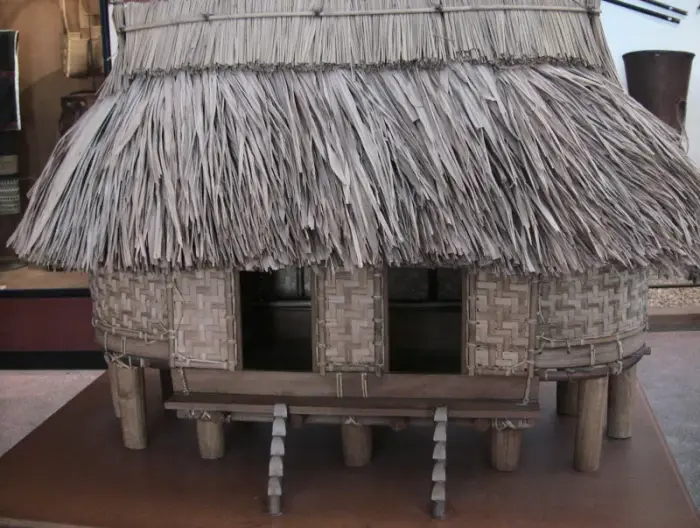
A Co Tu village is a ring. The houses stand on stilts, with a roof curved at the gables like a turtle shell. They form a circle around an open space in the middle.
On that ground stands the building every village has: the common house, the guol. It is the tallest and finest house of the village. Guol means community in Co Tu. Like the rong house of the Central Highlands or the Viet communal house, it grew out of the need to meet and live as a community.
The plan is simple. Whether the guol is big or small, long-roofed or round-roofed like a hat, it has one main post, the father post. The floor is of sturdy wood and bamboo, wide enough to receive villagers from the whole village.
The post carries meaning. The big post in the middle stands for the heart of the village. It is called the father post because the Co Tu are patrilineal. Around it stand the mother posts.
The guol is also a shelter. Villagers gather there against storms and floods. Births and deaths are marked with a ceremony at the guol. Traditionally the size and finish of the guol shows how united the community is.
Carving, colour and the buffalo
Men are the carvers. They decorate tomb houses and the guol with buffalo heads, birds, snakes, forest animals and chickens. Artisans chisel wooden panels and colourful statues with simple tools.
The two main colours are indigo black and red. Black comes from the ta ram plant and the ma rot tuber and stands for the earth. Red comes from the nau tuber and stands for the sun. To keep the art alive, artisans and local authorities collected works and organised teaching classes.
The rooster and the buffalo are essential decorations of the guol. Every carved panel in the guol has the figure of a buffalo. However big the guol, the buffalo sits in the place of honour. It shows the strength of the village and how close buffalo and people are.
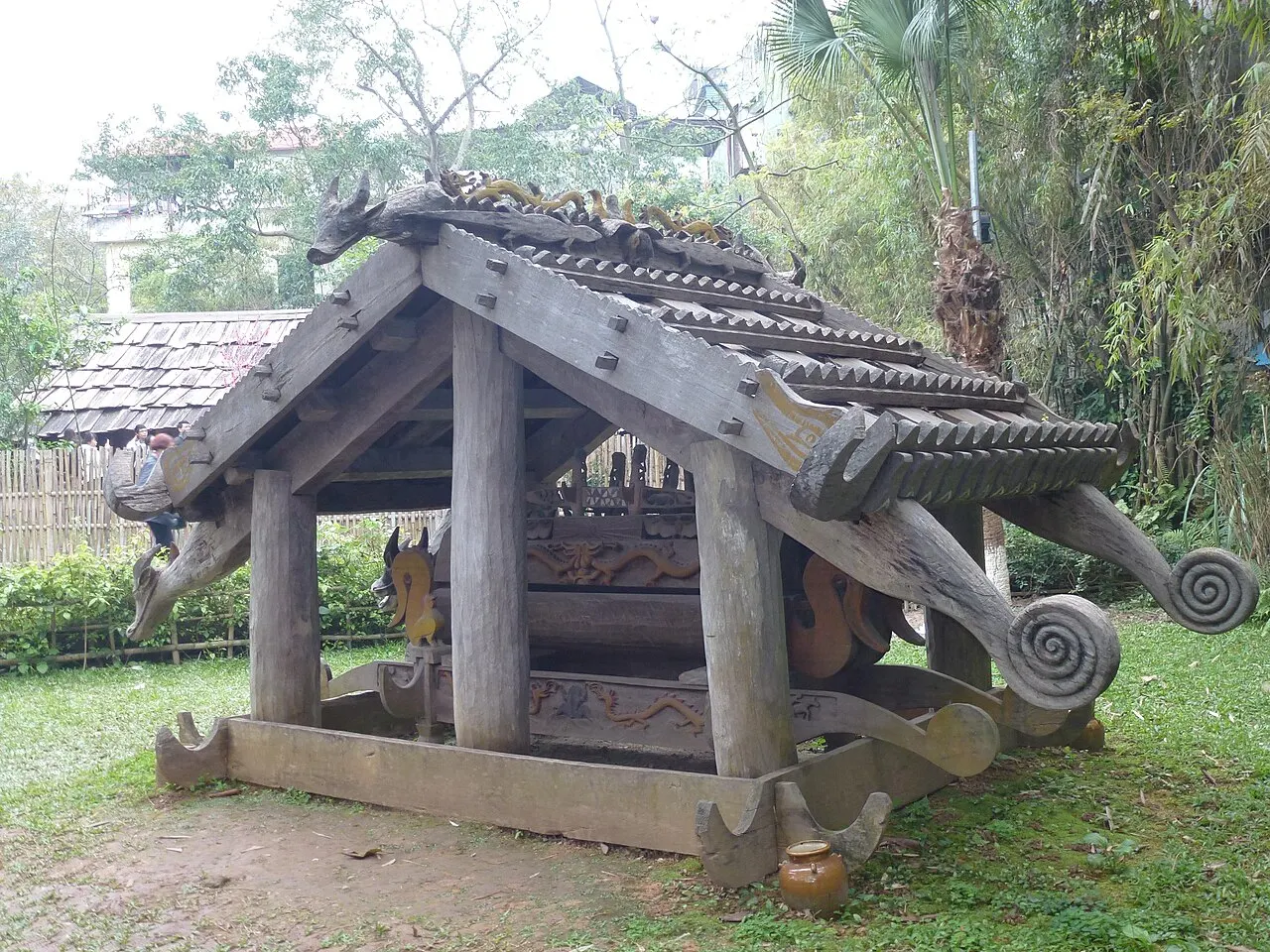
The buffalo is not a plough animal here. Highland Co Tu in Quang Nam grow dry-field rice and do not use buffalo for farming. The animal belongs to ritual: new rice, founding a village, weddings, engagements and oath-taking.
The tomb house shows the link at its clearest. It is built of fine wood with many carved and painted decorations. The buffalo appears on the coffin inside. At the Tay Giang traditional village two buffalo heads sit at the ends of the coffin and at one gable of the roof.
Brocade: indigo, beads and the loom
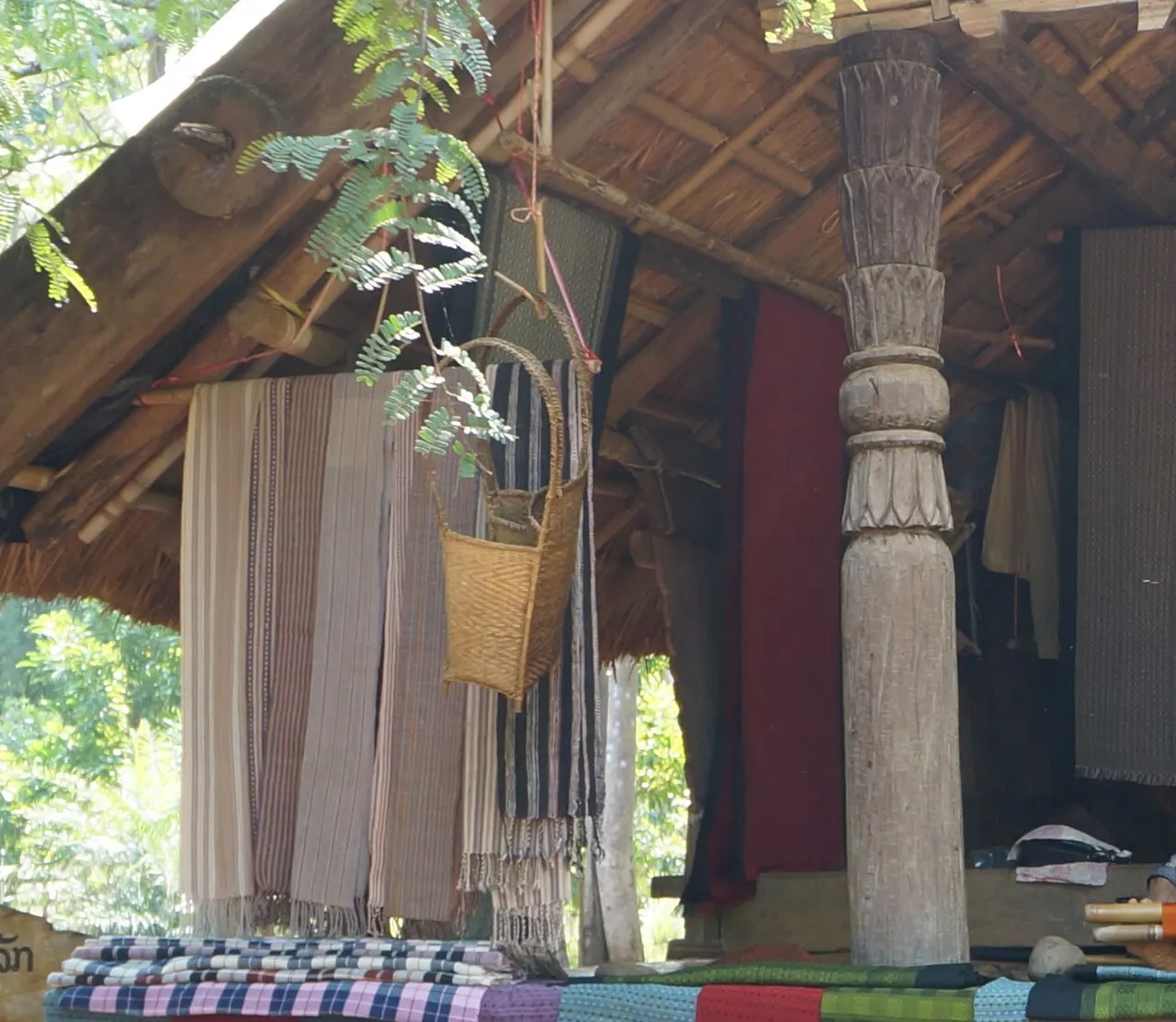
Every Co Tu woman knows how to weave from childhood. Women weave geometric patterns with coloured thread. The motifs include triangles, circles, rhombuses and zigzags.
Weaving here is one closed chain done by hand. The steps run from growing cotton, hemp and jute to spinning, dyeing, weaving, patterning, beading, embroidery and sewing. The looms are simple frames of wood, bamboo and rattan.
The indigo takes a week and more. Stems and leaves of the ta ram plant are pounded and soaked in a jar for about a week, then squeezed for the dye. Soaking the cotton thread for about 10 days gives the characteristic indigo colour. Pregnant women may not take part in the dyeing.
For a bead pattern the weaver cuts the weft thread and sets the beads as imagination suggests. The weaving of the Co Tu in Quang Nam is on the national intangible heritage list.
The Zara weaving village in Ta Bhing commune keeps age-old techniques intact. It has about 40 products, from shirts and loincloths to wrap skirts, shawls, blankets and bags. They are recognised as 3-star OCOP.
Gongs, dance and song
At festivals women dance Da da and men dance Ting tung. The usual instruments are a set of three gongs, a big gong, a drum, a flute and string instruments.
The best-known piece, tung tung da da, means the dance offered to Heaven in Co Tu. Men dance in a loincloth and a brocade shawl, barefoot, gripping a shield and a spear. Women wear colourful brocade skirts with bead necklaces. They dance barefoot, on tiptoe, turning anticlockwise.
At festivals these dances are staged before the guol. Grandmothers, mothers and girls dance with their hands raised to the sky, praying for holy rice grains and thanking the Rice God. Young men dance with a shield in one hand and a spear in the other.
The new-rice festival
Every October or November the terraced paddies tended by the Co Tu ripen and turn bright gold. The festival that follows is held after each harvest to thank the spirits, above all the rice spirit Giang Haro. The locals call the rite the Cha ha roo tamee festival.
In late June 2025 the festival of the Co Tu in Khe Tre, Nam Dong and Long Quang communes in Hue was entered in the national intangible heritage list. Note the place: this listing is for Hue, not for Quang Nam.
The buffalo rite today
The old buffalo-spearing rite has changed, and visitors should know how. From 2013 the Tay Giang district authorities began persuading the Co Tu to give it up gradually. Tay Giang led the way in reforming the festival.
Now the buffalo is led to the rite and then taken elsewhere to be slaughtered, not speared as before. Since 2016 the 90 villages of the district no longer hold the old form. At Tet 2019 one village held the festival without spearing a buffalo and still kept it intact. The festival keeps its soul, with some changes connected to the buffalo.
At the Hue new-rice festival the rite is re-enacted with a foam buffalo, symbolically.
Where to meet the Co Tu
The villages below are far from the coast, so pick one rather than a long tour.
Bho Hong (Song Kon commune, Da Nang city). This village in the former Dong Giang district of old Quang Nam opened to tourism in 2013. It lies 80 km from Hoi An old town and 70 km from Da Nang city, and has over 700 residents. More than half of the households weave brocade or plait rattan and bamboo.
The visit is built around a guol in the village centre, ringed by four moong houses that recreate an old Co Tu village. Offers include traditional food, the tang tung da da dance, music and love songs, crossbow lessons, basketry and homestay. You can sleep in a villager’s home, join daily life, learn Co Tu words and sit by a campfire. Not far away is the A Pang hot spring.
Zara weaving village (Ta Bhing commune). The place to see brocade being made and to buy it. See the weaving section above.
Por ning. A village on a Truong Son peak, whose visitors are mostly foreigners coming up from Hoi An, plus groups of young explorers. The guol here is the heart of the village. Growing native medicinal plants such as ba kich and dang sam has become a strength of the local economy.
Tay Giang traditional village. The place where traditional festivals take place. In Tay Giang district 100% of villages have a guol.
The Co Tu of Da Nang. Not all Co Tu live in the highlands. The lowland Co Tu, called Co Tu Phuong or Ep, live in three hamlets: Phu Tuc, Ta Lang and Gian Bi. After the merger Phu Tuc belongs to Ba Na commune, and Ta Lang and Gian Bi to Hai Van ward.
Both Gian Bi and Ta Lang have a traditional village house, a guol. It is built from natural materials: thatch, rattan and palm leaves, bamboo and wood. It works as a small museum, with back baskets, fish baskets, fish nets, teardrop winnowing trays, dried gourds, rice mortars, hunting tools and instruments. The villagers also build a few moong houses for living, display and festival food.
Read on
The coast tells the other half of the story. Read the history of Hoi An and the Hoi An ancient town guide for the trading port. Then go inland with the My Son sanctuary and the Cham towers of Quang Nam.
Photo credits
- A model of a guol, the Co Tu communal house: Wikimedia Commons — Binh Giang, public domain (opens in a new tab) (Public domain)
- A Co Tu tomb house with a buffalo head on the ridge, as rebuilt in the garden of the Museum of Ethnology in Hanoi: Wikimedia Commons — Hungda (opens in a new tab) (CC BY-SA 3.0)
- Cloths and a back basket of the Katu (Co Tu) across the border in Laos, in the village of Lao Ngam: Wikimedia Commons — Pierre André Leclercq (opens in a new tab) (CC BY-SA 4.0)
Common questions
How many Co Tu are there and where do they live?
The Co Tu number 74,173 people in the 1 April 2019 survey. Quang Nam holds 55,091 of them, 74.2% of all Co Tu in Vietnam, and Hue city holds 16,719. They have long lived in the mountains of north-west Quang Nam and south-west Thua Thien Hue, next to the Co Tu area in Laos.
What is a guol?
Guol means community in Co Tu. Every village has one as its common house, the tallest and finest building in the village. It has one main post, the father post.
What language do the Co Tu speak?
Co Tu belongs to the Mon-Khmer branch of the Austroasiatic family and is close to Ta Oi and Bru-Van Kieu. The Co Tu officially got their own script in 1957.
Where can a visitor meet the Co Tu?
The Bho Hong community tourism village in Song Kon commune, Da Nang city, is 80 km from Hoi An old town and 70 km from Da Nang city. Its homestays let you join daily life and sit by a campfire. In Da Nang itself the lowland Co Tu live in three hamlets.
Do the Co Tu still spear buffalo at festivals?
Since 2016 the 90 villages of Tay Giang district no longer hold the old form of the rite. Villagers still lead the buffalo to the ceremony and then take it away to be slaughtered. In the re-enacted rite at the Hue new-rice festival the buffalo is made of foam.
What is Co Tu brocade?
Hand-woven cloth, dyed indigo from the ta ram plant and set with beads. Every Co Tu woman knows how to weave from childhood. The weaving of the Co Tu in Quang Nam is on the national intangible heritage list.
Read next
- Hoi An History: The Faifo Trading Port and Old TownVerified 18 October 2026
- Hoi An Old Town: Heritage, Assembly Halls, TicketsVerified 18 October 2026
- My Son Sanctuary: History, Towers, Tickets and TransportVerified 18 October 2026
- Cham Towers in Quang Nam Beyond My Son: Bang An, Khuong My, Chien DanVerified 18 October 2026
General information checked against the sources listed above, not legal advice for your situation. Rules and office practice change; confirm with the relevant office or a licensed adviser before you act. See how guides are checked.
Spotted an error? Report it.