Cham Sculpture Museum, Da Nang: The Tourane Garden
The Cham Sculpture Museum began as a statue garden in the Tourane park, where Resident Charles Lemire gathered Cham statues from 1891-1892. The architects Delaval and Auclair designed the first building, begun in 1915, finished in 1916 and first opened in 1919. Today it holds nearly 2,000 objects and 12 national treasures.
In this guide
The Cham Museum in the middle of Da Nang
The museum stands at No. 2 on 2 Thang 9 street, at the corner of Bach Dang and Trung Nu Vuong streets. It is also called the Cham Museum, a translation of the French name Musée Cham. Inside are nearly 2,000 objects, with about 500 representative pieces on permanent display. Most are sandstone, with a few in bronze and terracotta, dated from the seventh to the fifteenth century.
The galleries are arranged by place of origin. There are rooms for Tra Kieu, My Son, Dong Duong and Thap Mam, and corridors for Quang Nam, Quang Ngai, Binh Dinh and Kon Tum. This page tells how the museum came to be, then goes through the rooms and treasures, and ends with hours and tickets.
The Tourane statue garden
The story starts before the building. The statue garden was begun by Resident Charles Lemire in the late 19th century. From 1891 and 1892 he had pieces collected in the villages of Tra Kieu and Khuong My in Quang Nam. They went to the Tourane park, the spot later chosen for the museum.
Over twenty years before there was a roof, Cham statues found around Da Nang, Quang Nam and neighbouring provinces were gathered in that park. Not everything stayed. Some pieces went to France, some to the museums in Hanoi and Saigon, but most of the representative works remained in Da Nang.
The urban setting of the Tourane park is told separately in French Tourane.
Seventeen years to get a roof
The body behind it all was the French School of the Far East (EFEO), founded in 1900 to inventory, conserve and restore heritage across Indochina. The idea of a Cham sculpture museum in Da Nang first appeared in 1902 in an EFEO project to which Henri Parmentier contributed greatly. From project to opening came efforts lasting 17 years to raise the money.
Building began in 1915 and finished in 1916. The site was a mound beside the Han River. In 1919 the museum opened to display for the first time.
At first it was called Musée Cham, Tourane, and showed about 160 pieces like an open store. The plan was a rectangle with one central room and four corridors around it, 306 square metres in all.
Cham towers in French stone
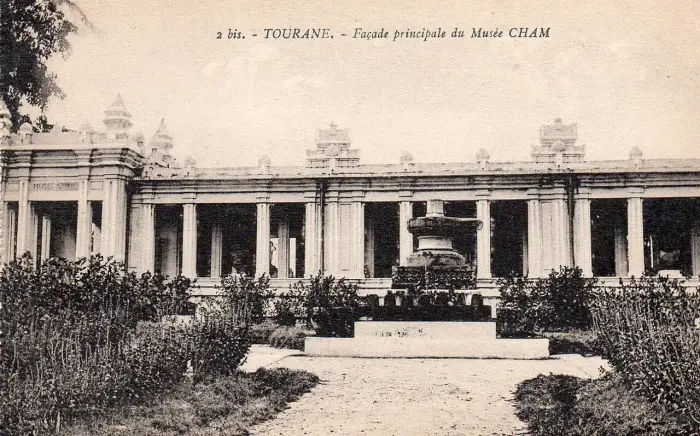
The first building was designed by the French architects Delaval and Auclair, on Parmentier’s suggestion of using some lines of Cham architecture. It keeps lines imitating the forms of Cham towers.
On the old photograph the idea is plain: a row of classical French columns, with small tower-shaped blocks on the roof. Two signposts in the garden carry the names of the sponsor and the section: École française d’Extrême-Orient, Section des antiquités chames.
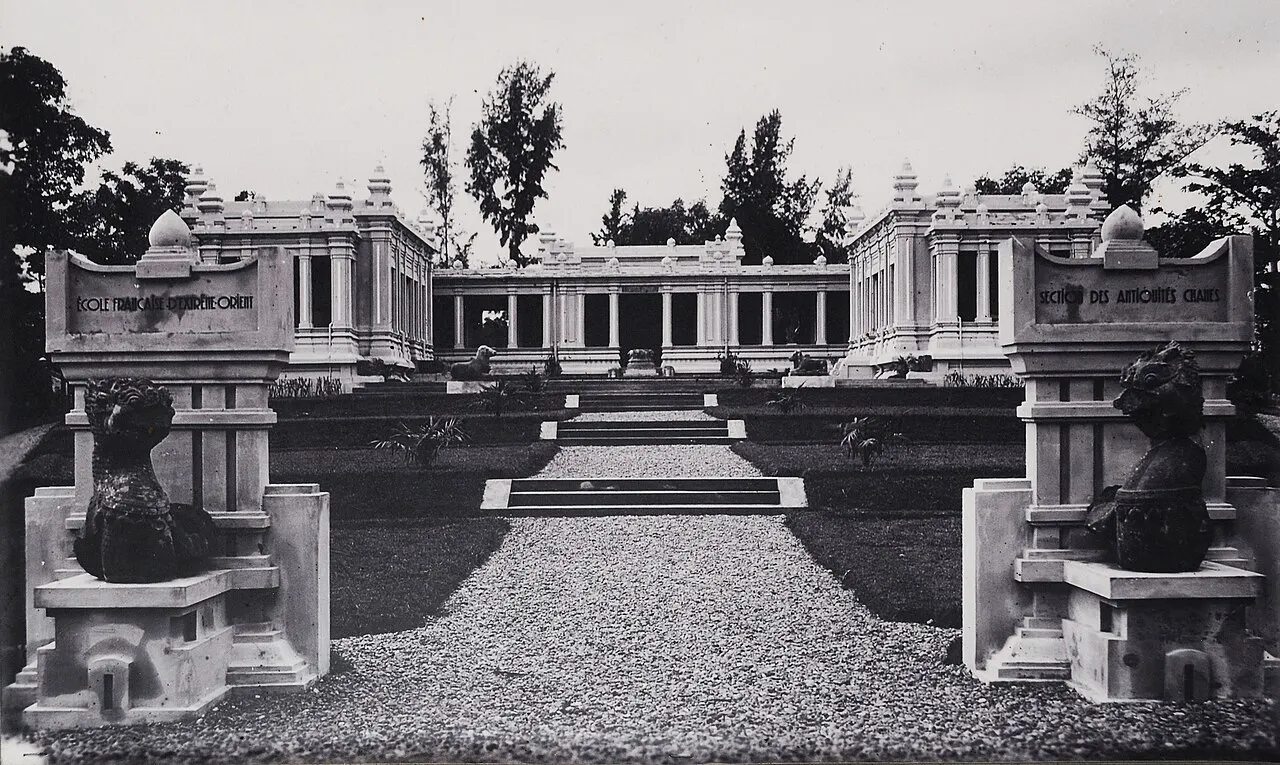
Later extensions kept the same look. The new parts copied the decoration of the first building, including the A, B and C roof reliefs at 1:1. One detail worth remembering: the original 1915 design drawings are no longer held in Vietnam’s national archives or in France.
Tra Kieu 1927-1928 and the name Henri Parmentier
The large Tra Kieu excavations of 1927 and 1928 sent more pieces to Da Nang. EFEO found many sculptures there, with temple foundations and traces of walls.
In 1927 the EFEO architect Claeys proposed enlarging the museum, but the project dragged until 1936.
The extension added two wings of 102 square metres each, joined to the old building in a U shape open to the front court. In 1936 the museum was named the Henri Parmentier Museum. The man honoured had contributed greatly to the project from 1902.
From 1946 to today
In 1946 the museum was plundered; by 1948, 150 pieces had been recovered. EFEO handed it to the local authorities in 1960.
The milestones since:
- 2002: a two-storey building added at the back for pieces collected after 1975.
- 2009: the My Son and Dong Duong rooms renovated with French experts and reopened.
- 2011: the museum was ranked a first-class museum in Vietnam.
- 2015: Da Nang agreed to invest nearly VND 45 billion in an upgrade.
- 2016: a citywide project fully restored the buildings. The main sculpture display now sits with themed rooms on inscriptions, ceramics, music, festivals and the crafts of today’s Cham people.
- 2021: the building was recognised as a city-level historic monument.
In 2026 the museum opened a photo display of more than 40 archive images from EFEO’s collection. The museum and EFEO also announced a cooperation agreement for 2026-2028, centred on events for 100 years since the Tra Kieu excavation (1927-2027).
Reading the museum room by room
The My Son room
My Son was an important religious centre of Champa, about 30 km west of Tra Kieu. It has more than 70 towers, most built to worship Shiva.
In the first excavations of 1903-1904 Henri Parmentier and Charles Capeaux grouped the towers, naming groups by letters and towers by numbers. Names such as E1 and C1 in the treasure list below follow that scheme. The earliest surviving buildings at My Son date from about the seventh century, as in group E.
Three My Son pieces are on the treasure list: the E1 altar, the E1 relief of the birth of Brahma and the C1 statue of Shiva. To see where these pieces once stood, read My Son Sanctuary.
The Tra Kieu room
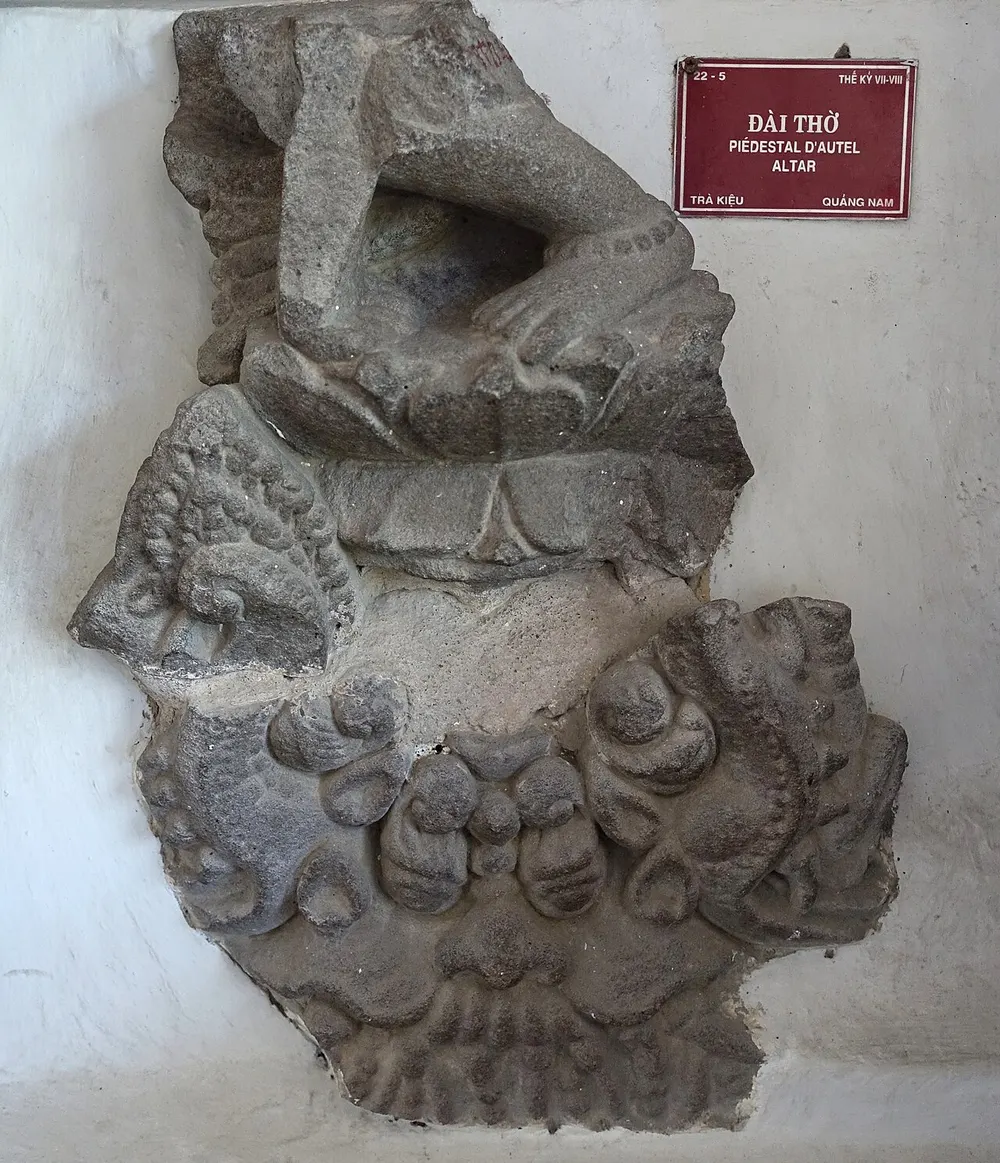
The Tra Kieu site is in Duy Son commune, Duy Xuyen district, Quang Nam, 50 km south of central Da Nang. In the late nineteenth and early twentieth century collectors picked up altar fragments, a linga and decorative reliefs there. Some researchers identify Tra Kieu as a capital of Champa, matching the name Simhapura in a few Cham inscriptions.
Most Tra Kieu pieces are dated to about the tenth to eleventh century. Some, including an altar, are dated by scholars as much as 3-4 centuries apart.
The Dong Duong room
Dong Duong was a Buddhist centre of Champa on the plain, about 20 km south of the My Son valley.
By an inscription, in 875 King Indravarman II had a monastery and temple built there to worship the bodhisattva Laksmindra Lokesvara, a form of Avalokitesvara. Parmentier and Charles Carpeaux studied and excavated the site in the autumn of 1902.
Today the site is almost wholly destroyed by time and war. The pieces in this room are the way to picture its grandeur.
The Thap Mam and Da Nang rooms
Thap Mam, in An Nhon district, Binh Dinh, is dated to about the twelfth to thirteenth century. The 1934 excavation yielded 58 tonnes of objects. The name Thap Mam later also named a style of Cham art, and the Thap Mam dragon statue is a national treasure.
The Da Nang gallery holds pieces collected before 1975 from the Phong Le, Qua Giang and Xuan Duong sites. It shows the Champa that lies inside the city boundary.
Twelve national treasures
The museum holds and displays 12 national treasures:
- Tra Kieu altar, Tra Kieu Apsara relief and My Son E1 altar.
- Ganesha statue, My Son E1 relief of the birth of Brahma and My Son C1 Shiva statue.
- Dong Duong altar, Tara bodhisattva statue and Gajasimha statue.
- Thap Mam dragon statue, Phong Le relief of dancing Shiva and Chanh Lo relief of Uma.
The Tara statue is shown only at important events of the museum and the city.
The Tra Kieu altar, an epic in stone
The Tra Kieu altar was found in 1918 at the main tower of the Tra Kieu citadel and named a national treasure in 2012. It is sandstone, dated to the seventh to eighth century, 128 cm high, 190 cm long and wide. It did not appear whole: it is the result of assembly and adjustment lasting over a century.
That break-up made the carvings a matter of debate. No earlier hypothesis explained the whole composition consistently. A newer reading proposes the altar as a stone epic of the Buddha’s life.
On one face the prince shoots an arrow through seven palm trees. On the other, Prince Siddhartha rides the horse Kanthaka with his servant Chandaka, leaving the palace quietly.
Visiting: hours, tickets, rules
- Address: No. 2 on 2 Thang 9 street, at the corner of Bach Dang and Trung Nu Vuong. About 3 km from the airport and about 4 km from the railway station.
- Hours: 07:00 to 17:00 every day, including holidays and Tet.
- Tickets: VND 60,000 per visit for Vietnamese and foreign visitors. Permanent residents of Da Nang and students pay VND 20,000.
- Free entry: children under 16 and pupils, and Vietnamese citizens aged 60 and over. Everyone enters free on the first day of Tet, 29 March, the tenth day of the third lunar month and 2 September.
- Audio guide: connect to the museum wifi and open chamaudio.com in a browser, then pick Vietnamese, English or French.
- Rules to remember: no flash or tripod when taking photographs. Luggage over 3 kg must be left at the designated place.
Compare the old photographs above with the real building: the lines imitating Cham towers and the roof reliefs are still those of the first building.
Read next
For the streets around the museum in French times, read French Tourane. For the landing at the same harbour, see the Da Nang landing. The place these statues once stood in Quang Nam is My Son Sanctuary.
Photo credits
- The museum seen on an early 20th-century postcard titled 'Tourane - Façade principale du Musée Cham': Wikimedia Commons, postcard 'Tourane - Façade principale du Musée Cham', early 20th century (opens in a new tab) (Public domain)
- Early view of the museum: the signposts read 'École française d'Extrême-Orient' and 'Section des Antiquités chames': Wikimedia Commons, early photograph of the museum with the EFEO signboards, public domain (opens in a new tab) (Public domain)
- A piece of a Tra Kieu altar in the museum, labelled 7th-8th century. Photo: Daderot, CC0: Wikimedia Commons, Daderot (CC0): altar part from Tra Kieu, 7th-8th century, Museum of Cham Sculpture (opens in a new tab) (CC0)
Common questions
When was the Cham Sculpture Museum built?
Building began in 1915 and finished in 1916. The museum opened to display for the first time in 1919.
Who designed the museum?
The French architects Delaval and Auclair, following Henri Parmentier's suggestion to use some lines of Cham architecture.
What was the Tourane statue garden?
The spot where Cham sculptures found around Da Nang, Quang Nam and neighbouring provinces were gathered before the museum building existed. Resident Charles Lemire started it.
How many objects does the museum hold?
Nearly 2,000, with about 500 representative pieces on permanent display. It holds 12 national treasures.
Where do I see the My Son, Tra Kieu and Dong Duong pieces?
Each has its own room: Tra Kieu, My Son, Dong Duong and Thap Mam, plus corridors for Quang Nam, Quang Ngai, Binh Dinh and Kon Tum.
How much is a ticket?
VND 60,000 per visit for Vietnamese and foreign visitors alike. Permanent residents of Da Nang and students pay VND 20,000.
Which days are free?
The first day of Tet, 29 March, the tenth day of the third lunar month and 2 September. Children under 16 and pupils also enter free.
What are the opening hours?
07:00 to 17:00 every day, including holidays and Tet.
Read next
- French Tourane: The Chessboard Town on the Han RiverVerified 18 October 2026
- My Son Sanctuary: History, Towers, Tickets and TransportVerified 18 October 2026
- Da Nang Under Attack: The Landing in Old Prints and MapsVerified 18 October 2026
- Cham Sculpture Museum, Da Nang: The Tourane GardenVerified 18 October 2026
General information checked against the sources listed above, not legal advice for your situation. Rules and office practice change; confirm with the relevant office or a licensed adviser before you act. See how guides are checked.
Spotted an error? Report it.