Quang Nam Home Dishes: Snail Soup, Ca Sao, Flying Fish
Quang Nam home cooking leans on what stream and sea provide: stone-snail soup with rau ranh in the hills, ca sao braised or in sour soup at the Thu Bon estuary, and flying fish around Nui Thanh. The snails are best from spring to mid-summer; flying fish start around March or April.
In this guide
Quang Nam’s everyday table follows what a family catches or gathers that week. Four dishes below have a solid press source each: a stream snail soup from the hills, a river-mouth fish from Hoi An, and two ways with flying fish from the coast. Each one stands alone, so jump to the one you want.
| Dish | Where | Season | How it is eaten |
|---|---|---|---|
| Stone-snail soup with rau ranh (canh oc da) | Mountain districts such as Tien Phuoc and Bac Tra My | All year, best spring to mid-summer | With rice, greens first, then suck out the snails |
| Ca sao braised with pickles, or in sour soup | Lower Thu Bon, near Cua Dai, Hoi An | Low-water season | With rice |
| Grilled flying fish (ca chuon nuong) | Nui Thanh and Bai Rang | From about March or April | By hand, dipped in fish sauce, or wrapped in rice paper with herbs |
| Flying-fish roe salad (goi trung ca chuon) | Quang Nam coast | Summer | With crisp grilled rice paper |
Stone-snail soup with rau ranh (canh oc da)
Picture a bowl of clear, sweet broth in a hill-district kitchen. VnExpress calls stone snails cooked with rau ranh, a wild forest vegetable, a favourite in the mountains of Quang Nam. Dan Viet adds a local saying, “Rau ranh, oc da / La ca nau nguon”, which puts the greens and snails in the place of fish for the upland people.
The snails are small: a big one is about as long as an index finger, 3-5 cm. They live in the crevices of forest streams, and only where the water is clean and flowing. In Tien Lanh commune in Tien Phuoc, VnExpress watched people go out to the Da Mai stream with head torches from about 6 pm. In June 2022 they sold at VND 40,000-50,000 per kg, and traders paid VND 40,000-45,000 per kg, mostly for sale locally and in Da Nang.
Season matters here. The snails and the greens are available all year, but spring to mid-summer is best, when the rau ranh is young and less bitter and the snails carry more, sweeter flesh. Gathering stops when rain muddies the water. Bac Tra My and Tien Phuoc are named as districts where both are easy to find, and a visitor who stops at a house is often invited to rice with this soup.
Cooking is simple. Soak the snails for a day, scrub the shells and cut off the tails so they are easy to suck out; the soaking takes more than a day with the scrubbing repeated. Season the snails (chilli, lemongrass and a little young lime leaf) and stir-fry them before adding water. A little rice or mung bean goes in; the rau ranh follows once the water has boiled a good while, and the pot comes off after it boils again.
The rau ranh leaf is slightly bitter, a counterpoint to the sweet broth. Eat it with rice, greens first and snails afterwards. Stone snails also appear stir-fried with lemongrass and lime leaf, boiled, or in porridge.
Ca sao from the Thu Bon estuary
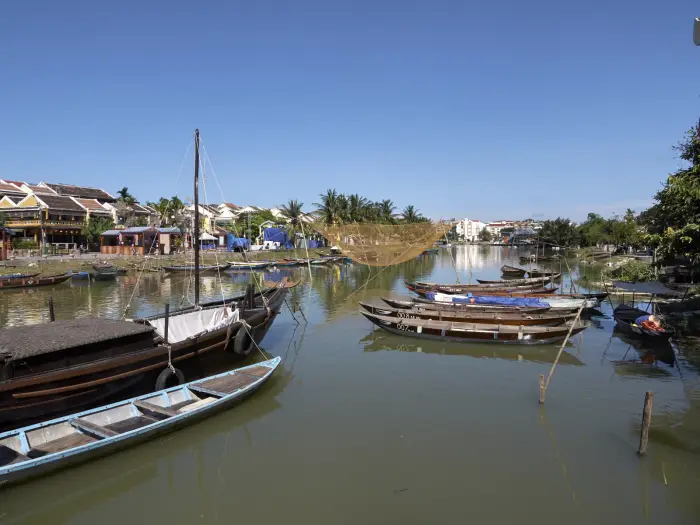
For a river dish, go to the lower Thu Bon, where the water meets the sea at Cua Dai in Hoi An. In the low-water season sea fish, and above all ca sao (grunter), follow the current into the brackish water to spawn. Ca sao is known for sweet, fatty flesh and simple cooking, and counts as an indispensable dish on many local families’ rice trays.
The braise comes first. The cleaned fish is marinated with sugar, salt, chilli and turmeric for about fifteen minutes. A thick layer of sliced pickled mustard greens and pickled gourd lines the pot and the fish goes on top. Bring it to a rolling boil, drop to very low heat, add a little water once the seasoning has soaked in and let it braise until the sauce thickens. The result tastes sweet from the white flesh with a slight sharpness from the pickles, and it goes with rice.
The same writer was also served a sour soup (canh chua) made from freshly caught fish, tomato, star fruit and herbs, all from the family garden.
Grilled flying fish at Nui Thanh (ca chuon nuong)
Flying fish is an everyday summer fish in Quang Nam. The season usually starts around the third or fourth month, although the article does not say whether that means lunar or solar months. Families cook it in many ways; one is braised with young jackfruit, the same fruit behind mit tron.
VnEconomy’s Bang Hao writes that the fish is found along the south-central coast but is tastiest around Nui Thanh. Visitors to Nui Thanh and Bai Rang are offered it grilled. The cleaned fish is marinated with a little fish sauce and chilli for about 20 minutes, then grilled over hot charcoal for about 30 minutes. It smells especially good with cu nen, the shallot-like bulbs.
To eat it, hold it in your hand, break it in two and dip it in pure fish sauce or in salt and green chilli. Better still, wrap it in rice paper with raw herbs and chilli fish sauce. At Bai Rang there is fresh grilled flying fish in every season. In 2018 a plate of six wrist-sized fish with rice paper, herbs and ginger fish sauce, enough for three or four people, cost under one hundred thousand dong; treat that as an old price.
Flying-fish roe salad (goi trung ca chuon)
The roe is the most prized part of the fish. The salad was once a humble coastal dish and is now a sought-after specialty for visitors to Quang Nam, with a version that stands out for its fragrant herbs. Along the central coast in general, the roe is a seasonal delicacy among coastal people.
The roe is dried first, and one kilogram of dried roe takes hundreds of fish. In the past the salad was a staple at ancestral offerings and summer feasts, served with crisp rice paper from Tuy Loan village in Da Nang. Today it is rarely seen at gatherings or banquets because of the preparation. People can still make it at home; in February 2025 fresh roe sold in seafood markets for around VND 500,000 per kg.
How it is made: soak dried roe in clean water for about two hours, then clean it, boil it with fresh ginger and drain it. Mix it with boiled pork belly, steamed shrimp, roasted peanuts and shredded carrot, cucumber, tomato, pineapple and chilli. Dress it with fish sauce, lime juice, garlic and chilli, and eat it with crisp grilled rice paper. The summer flying fish season is when the roe turns up. For a sister raw-fish salad from the Da Nang coast, see goi ca Nam O.
Dishes we left out
We looked for ca bong kho tieu, mam nhum and ca thai bai and found no source placing them in Quang Nam. The pepper-braised goby articles are about the Tra River in Quang Ngai. Mam nhum was linked to the Quang Ngai and Binh Dinh coast. For ca thai bai we found nothing at all, so we left all three out rather than guess.
If you know a written source, editors@xuquang.com would like to see it. For the islands off this coast, see Cu Lao Cham.
What to remember
If you only have time for one, order the stone-snail soup in the hills in spring or early summer, or ca sao braised with pickles at the river mouth in the low-water season. Both are plain home cooking, and both depend on the season.
Photos (1)
- Edgardo W. Olivera, CC BY 2.0 (opens in a new tab)
Not confirmed: No shop names or addresses were sourced for any dish. The months of the flying-fish season in VnEconomy are not stated as lunar or solar. Prices come from 2018 to 2025 reports and will have moved. Dropped for lack of a Quang Nam source: ca bong kho tieu (Thu Bon or Truong river gobies), mam nhum and ca thai bai.
Common questions
What is oc da (stone snail) soup in Quang Nam?
Stone snails cooked with rau ranh, a wild forest vegetable, a favourite in the mountains of Quang Nam. It is usually eaten with rice.
When is stone-snail soup at its best?
Rau ranh and stone snails are around all year but best from spring to mid-summer, when the greens are young and less bitter and the snails sweeter.
How do you eat the soup properly?
With rice, taking the greens first and sucking out the snails afterwards. The tails are cut off beforehand so the snail is easy to suck out.
Where in Quang Nam do people catch ca sao?
At the lower Thu Bon River, where it meets the sea at Cua Dai in Hoi An. The fish come into the brackish water in the low-water season.
Where is the best flying fish in Quang Nam?
Around Nui Thanh, where the fish is called tastiest; visitors there and at Bai Rang are offered it grilled. That is one writer's view, not a ranking.
Is flying-fish roe salad still a home dish?
People make it at home from market roe, but it is rarely seen at gatherings or banquets now because of the meticulous preparation.
Why are ca bong kho tieu, mam nhum and ca thai bai not here?
We found no source placing them in Quang Nam. The goby braise articles we found are about the Tra River in Quang Ngai, and mam nhum was tied to the Quang Ngai and Binh Dinh coast. We found no source at all for ca thai bai, so we left all three out.
Read next
- Mit Tron: Quang Nam's Kitchen-Corner Jackfruit SaladVerified 18 October 2026
- Goi Ca Nam O: Fishing Village, Herring and Fish SauceVerified 18 October 2026
- Cu Lao Cham: History, Monuments, Boats and Calm SeasonVerified 18 October 2026
- Be Thui Cau Mong: Roast Veal on Highway 1, Dien BanVerified 1 November 2026
General information checked against the sources listed above. Ticket prices, opening hours and rules change; check with the place before you go. See how guides are checked.
Spotted an error? Report it.