Nam O Fish Sauce: Old Village, Families and Fermenting
Nam O fish sauce is the anchovy sauce of an old village below the Hai Van Pass, now in Hai Van ward, Da Nang. Fish and salt go in at 10 parts to 4, ferment in jars for 12 months and are filtered drop by drop. The craft has been national intangible heritage since 2019.
In this guide
- Nam O, a stop at the foot of Hai Van
- A Cham village first, a Viet village later
- A craft born from the sea trips
- The families and the old labels
- Making the sauce: from the anchovy to the last drop
- What sets real Nam O sauce apart
- National heritage and today’s place names
- The craft today
- Two workshops to visit
- Huong Lang Co (Hương Làng Cổ)
- Binh Minh mam nhi (Mắm nhĩ Bình Minh)
- Tasting and buying Nam O fish sauce
- Common questions
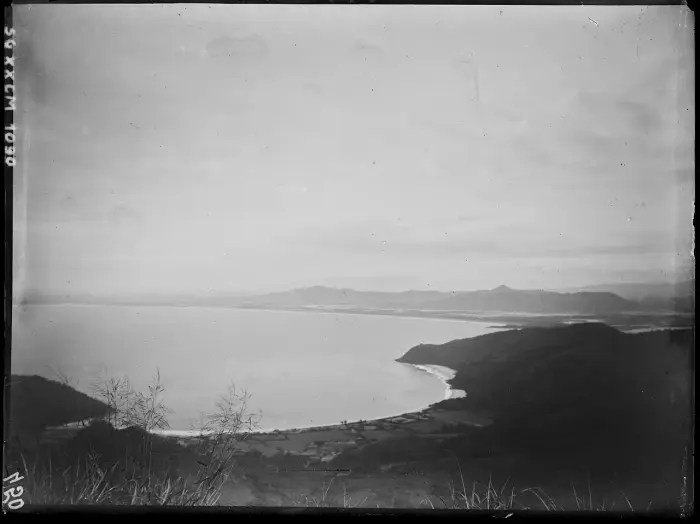
Nam O fish sauce (nước mắm Nam Ô) is the mam nhi of an old fishing village, and its story starts with the village. Nam O (Nam Ô) tucks in beside Da Nang Bay, about 3 km from the Hai Van Pass (đèo Hải Vân). Its beach now belongs to Hai Van ward.
Since long ago Nam O fish sauce has been known across Quang Nam. For the villagers, that dark red drop is a story of the sea, of ca com than (cá cơm than, a small anchovy) and of many generations.
Nam O, a stop at the foot of Hai Van
On the old north-south road, Nam O is a stop right at the foot of Hai Van mountain. Because of that one-road position, Nam O has been a resting place with a dense population for thousands of years. Many researchers say few seaside villages can claim a village age of more than 700 years the way Nam O can.
The name is in the royal records. The Dai Nam nhat thong chi (Đại Nam nhất thống chí) names a mountain also called Hoa O, the former name of Nam O.
A Cham village first, a Viet village later
Long ago Nam O was a Cham village, and the Cham lived there until Gia Long took the throne. Much is left: three Ba Giang shrines and many Cham lime tombs that villagers call ma Hoi. In the middle of the village are 4 ancient Cham wells with sweet, cool water even beside the sea.
The best-known story of the area is that of Princess Huyen Tran (Huyền Trân). She hid in the rocky forest of Nam O to escape Champa pursuers. The villagers protected and sheltered her until she boarded a boat back to the capital.
In 1999, when villagers rebuilt the shrine on the old foundation, they dug up a set of three wooden spirit tablets.
A craft born from the sea trips
Villagers still do not remember in what year the craft began. They only recall that it grew strongly around the end of the nineteenth century and the start of the twentieth.
The craft began with fishermen who caught a lot of fish and salted it to keep it from spoiling. It was born from the fishing trips themselves. Fish sauce was never the main trade of this seaside village. Villagers sell the fresh fish first and only then keep a part to salt.
Village elders say the Cham brought fish-sauce making and the habit of using fish sauce to the villagers. So the Nam O craft is seen as a product of Viet-Cham cultural exchange.
This kind of sauce also appears in the earliest notes on Cochinchina. The missionary Borri, early in the seventeenth century, wrote that the people there eat more fish than meat. The sauce he names is balaciam, made of salted fish, and every household stored it in jars and vats. He does not say it was Nam O sauce, but it shows how old the habit is.
What villagers are proudest of is that Nam O fish sauce was once chosen to be presented to the king. In the mid-eighties of the last century it won a gold medal at the Giang Vo (Giảng Võ) fair in Hanoi.
The families and the old labels
Nam O has no single “sauce factory” but a great many families, each keeping the old spirit in its own recipe. One article counted 92 households in the trade, 62 of them in the craft association, 10 large producers and 17 with their own brand. A 2023 survey counted 74 facilities, down from 92. Of these, 91.9% were households.
The oldest label the press still records is Hong-Huong (Hồng - Hương). In 1958 the Hong-Huong label at 42 Highway 1, Nam O, was licensed by the Pasteur Institute as pure, top-grade fish sauce. Nam O people say the Ky Chau (Ký Châu) label of that time was just as famous.
The Hong-Huong label was later lost to the turns of history. Mr Bui Van Phong (Bùi Văn Phong), the label’s third-generation maternal grandson, and his son rebuilt it under the name Huong Lang Co (Hương Làng Cổ). Today the village has a craft association with 71 members: 3 cooperatives, 10 mid-sized processors and 17 registered brands.
Making the sauce: from the anchovy to the last drop
The fish and the season
The fish that gives Nam O sauce its own taste is ca com than. Villagers say it comes originally from Ca Mau, riding the current along the coast. At the start of the third lunar month the shoal reaches Da Nang Bay, and fishermen go out to catch fish for sauce. Before dawn they go out in big boats carrying a special net called manh.
The village makes sauce twice a year, in the third and eighth lunar months, following the anchovy run. The first sauce is called mam ca com thang ba. The eighth-month sauce is called mam ca thang tam, and this time all three anchovies come: than, do and sung.
The salt
Nam O sauce is good partly because of its salt: De Gi or Sa Huynh salt from Quang Ngai, or Ca Na salt from Ninh Thuan. Large-grained Ca Na salt is used, aged for years until the bitterness is gone and only a pure saltiness remains.
Salting, pressing and fermenting
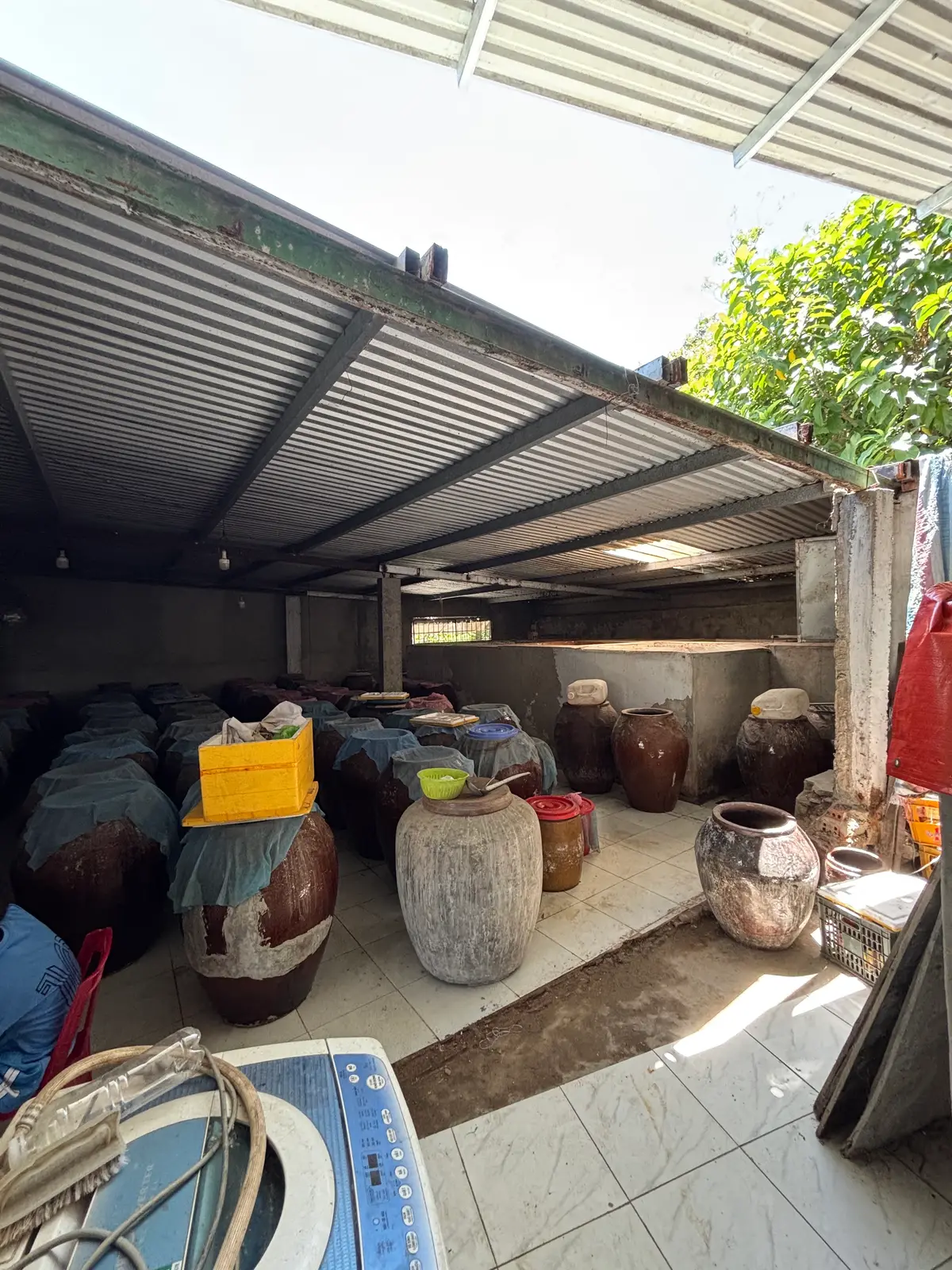
By the traditional recipe, fresh ca com than is mixed with salt at 10 parts fish to 4 parts salt. The salted fish goes into jars. The jars are made of jackfruit wood, packed with gravel and broom reeds at the bottom, and each holds 200 to 300 kg of salted fish. When a jar is full, bamboo slats press the fish down and the mouth is sealed tight.
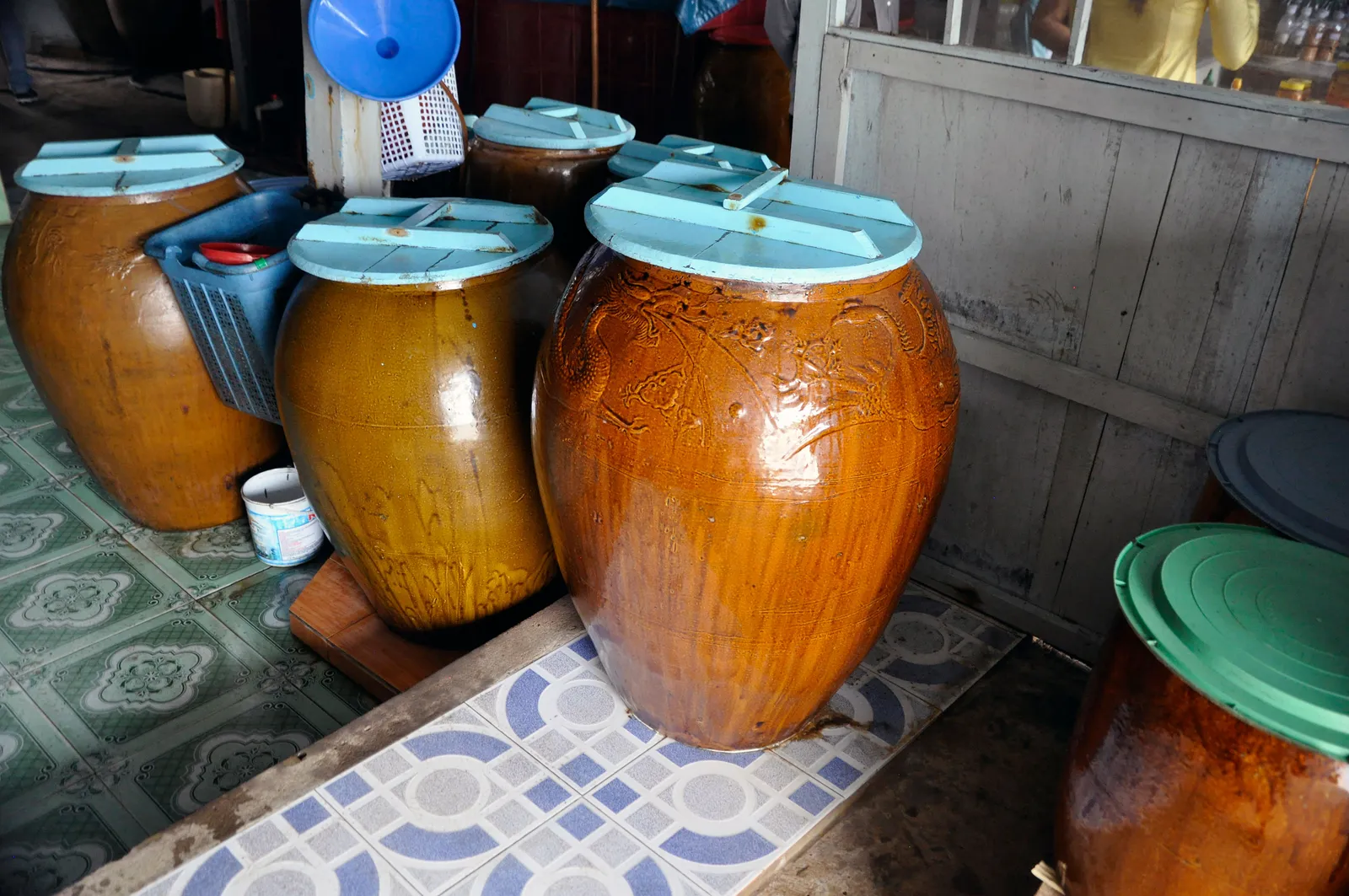
The fish ferments for 12 months until it has rotted into mam, and only then is it filtered. Fermenting is also recorded as lasting 12 to 18 months. The method of Nam O sauce is named danh, quay, gai, nen (beat, stir, seal, press).
Filtering the nhi
The word “nhi” lives in the last step, where the sauce is filtered with great care. The filter is a conical bamboo basket wrapped in white cloth, hung up so the sauce drips like a phin coffee filter. Villagers also lay several layers of cloth in a large bamboo funnel so the sauce stays free of fish remains. A large batch takes two days and two nights to filter.
After 12 months a jar yields about 100 to 150 litres of grade-1 sauce. Grade-1 sauce is dark red and thick, with a natural sweetness. Nam O sauce is made by the traditional filtered method, from pure anchovy, with no chemicals.
What sets real Nam O sauce apart
The craft village keeps a three-no rule: no chemicals, no preservatives, no colour or scent additives. The only ingredients are ca com than and salt. Grade-1 sauce is dark red and thick.
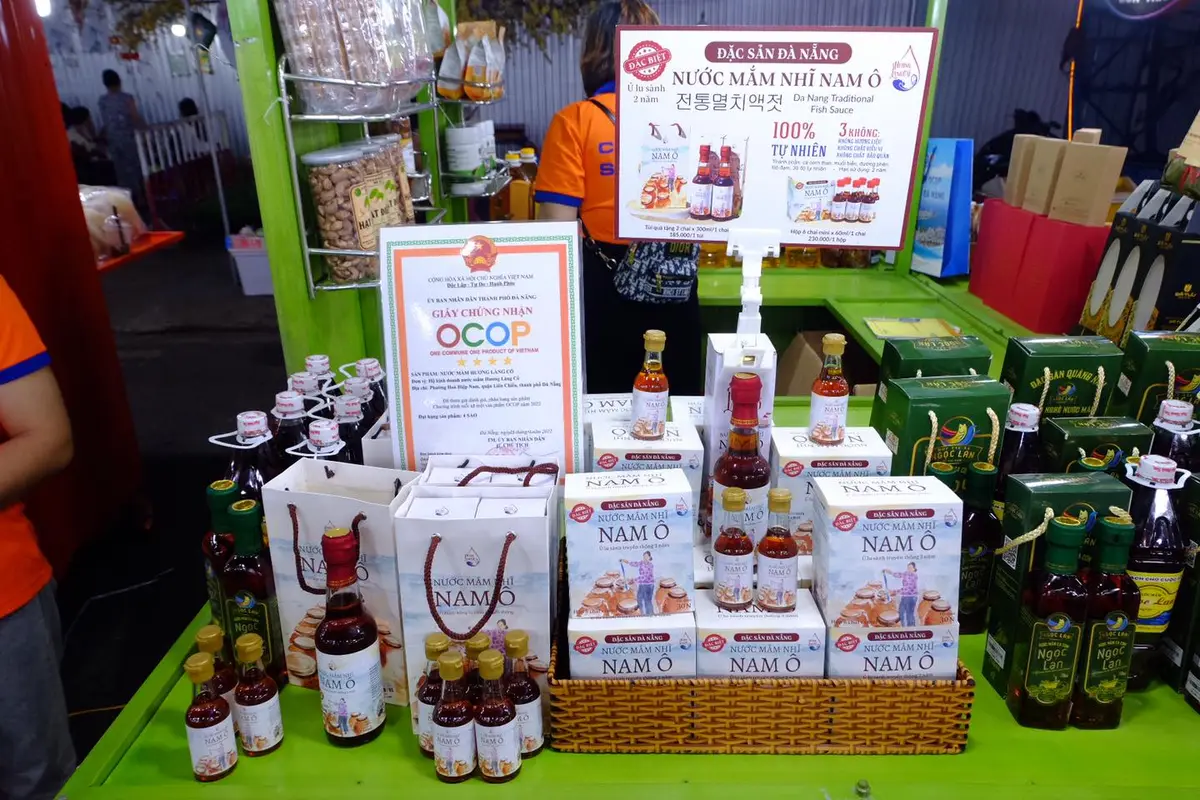
The name Nam O is also protected by law. Vietnam has 3 geographical indications for fish sauce: Phu Quoc, Phan Thiet and Nam O. The Nam O certificate was issued in 2024, the first geographical indication of Da Nang. The sauce also holds a 4-star OCOP rating.
National heritage and today’s place names
The Nam O fish sauce craft is national intangible cultural heritage under Decision No. 2974 of 27 August 2019 of the Minister of Culture, Sports and Tourism. What is recognised is the craft, not a dish.
Older articles place the craft in Hoa Hiep Nam and Hoa Hiep Bac wards, Lien Chieu district. After the merger that area is Hai Van ward, formed from the Hoa Hiep Bac and Hoa Hiep Nam wards, Hoa Bac commune and part of Hoa Lien commune. The new ward government has operated since 1 July 2025.
The craft today
Each year the village supplies about 300 thousand litres to the market. The 2023 survey counted about 243,000 litres of mam nhi a year. The village needs about 100 to 200 tonnes of anchovy a year. Local fish is scarcer, and producers ride to Tho Quang fishing port, more than 15 km from the village, to buy fish.
Since the craft won heritage recognition and the geographical indication, the number of households reviving fish-sauce making has risen fast. Huong Lang Co is among the pioneers combining fish sauce making with community tourism.
Two workshops to visit
The two workshops here are tied to the village’s history and craft association, and both rate 4.8 stars or more on Google Maps. Details come from Google Maps on 18 October 2026.
Huong Lang Co (Hương Làng Cổ)
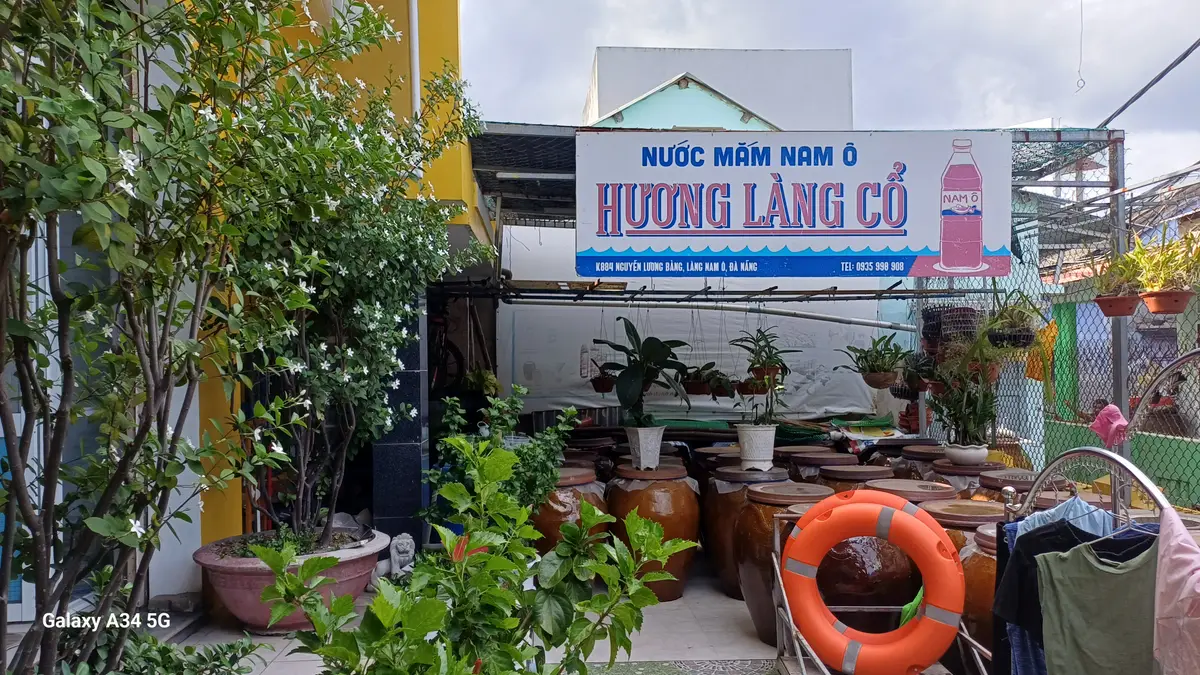
This is the brand rebuilt from the old Hong-Huong label. The workshop is at alley 884/74/4 Nguyen Luong Bang, Nam O 2, Hai Van ward. It has 4.8 stars on Google Maps from 45 reviews. On Sunday it opens 7 am to 12 noon.
It is one of the pioneers of community craft-village tourism.
Binh Minh mam nhi (Mắm nhĩ Bình Minh)
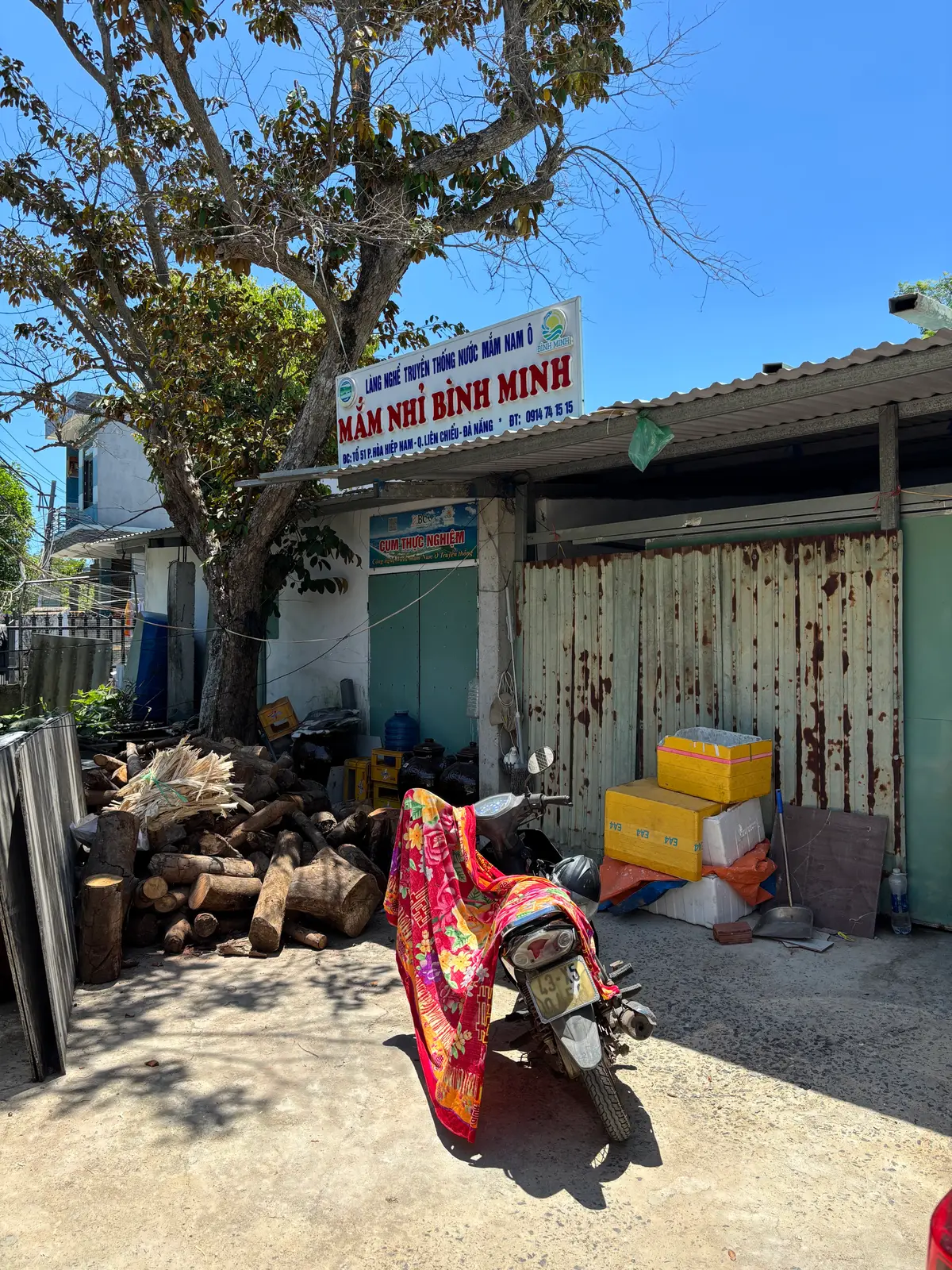
Binh Minh is a cooperative whose director is vice chairman of the craft association. The workshop is in Group 51, Hai Van ward. It has 5 stars on Google Maps from 21 reviews, and opens 6 am to 10 pm. Photos posted by visitors on Google Maps show a row of fermenting jars in the workshop’s tin-roofed shed.
Tasting and buying Nam O fish sauce
To taste it for real, go to the village. Visitors can watch the sauce being made, hear the village’s history, taste the pure sauce and buy it as a gift. A German visitor said that in the village he tried pork rice rolls dipped in the fish sauce and a fish-sauce coffee.
The average price is about VND 80 to 150 thousand per litre. Nam O sauce also goes into the dipping sauce for goi ca from the same village, boiled fish juice mixed with Nam O fish sauce and chilli. For how it is eaten, see goi ca Nam O. More dishes of Quang country are on the food page.
Photo credits
- Da Nang Bay seen from the Hai Van road, glass-plate photograph by Andre Salles (National Library of France): Wikimedia Commons, Bibliotheque nationale de France, photograph by Andre Salles (1860-1929), dated 1898, public domain (opens in a new tab) (Public domain)
- Clay jars used to ferment fish sauce in southern Vietnam. A general view of the method, not a photo of Nam O: Wikimedia Commons, P. Hughes (Indies1), 2015 (opens in a new tab) (CC BY 4.0)
- Photos and clips uploaded to Google Maps (Huong Lang Co fish sauce on Google Maps (opens in a new tab), Binh Minh fish sauce on Google Maps (opens in a new tab)) by Mecoffee Roastery, Nuoc mam Nam O - Huong Lang Co, Nguyen Ngoc Phuc.
Common questions
When did Nam O fish sauce begin?
Villagers still do not remember exactly when the craft began. The elders recall it growing strongly around the end of the nineteenth century and the start of the twentieth. The village itself is said to be over 700 years old.
What fish and salt is Nam O fish sauce made from?
The main ingredients are ca com than anchovy and salt. The salt is De Gi or Sa Huynh salt from Quang Ngai, or Ca Na salt from Ninh Thuan.
How long is Nam O fish sauce fermented, and how?
Fish and salt are mixed at 10 parts fish to 4 parts salt, pressed into jars, sealed tight and fermented for 12 months before filtering. Some sources give 12 to 18 months for the fermenting.
What is the difference between the third-month and eighth-month sauce?
The village makes sauce twice a year, in the third and eighth lunar months, following the anchovy runs. The first run gives mam ca com thang ba and the second mam ca thang tam. The eighth-month run brings all three anchovies: than, do and sung.
How much does Nam O fish sauce cost per litre?
The average price is VND 80 to 150 thousand per litre.
Is Nam O fish sauce heritage listed, and does it have a geographical indication?
The Nam O fish sauce craft is national intangible cultural heritage under Decision No. 2974 of 27 August 2019. The product received its geographical indication in 2024, the first of Da Nang.
Where do you buy real Nam O fish sauce?
The surest way is to go to the village, where visitors can watch the sauce being made, taste it pure and buy it as a gift. Huong Lang Co is at alley 884/74/4 Nguyen Luong Bang, and Binh Minh mam nhi in Group 51, Hai Van ward.
Where is Nam O and how far is it from central Da Nang?
The old village sits beside Da Nang Bay, about 3 km from the Hai Van Pass. Its beach is in Hai Van ward.
Read next
- Goi Ca Nam O: Fishing Village, Herring and Fish SauceVerified 18 October 2026
- Banh Beo of Quang Nam: From Hue Bowls to Hoi An and Da NangVerified 18 October 2026
- Banh Kho Me Cam Le: the Seven-Fire Cake of QuangVerified 18 October 2026
- Banh Trang Cuon Thit Heo: Dai Loc Roots and Tuy Loan Rice PaperVerified 18 October 2026
General information checked against the sources listed above, not legal advice for your situation. Rules and office practice change; confirm with the relevant office or a licensed adviser before you act. See how guides are checked.
Spotted an error? Report it.