Non Nuoc Stone Village, Da Nang: History, Stone and Craft
Non Nuoc stone village lies at the foot of the Marble Mountains in Da Nang. Craftsmen from Thanh Hoa and Nghe An founded it in the early seventeenth century. A Pho Khanh pagoda stele of 1678 names a carver from Quan Khai. The mountain was closed to quarrying in 1991, and the craft became national heritage in 2014.
In this guide
- A stone village under the mountains
- The Pho Khanh stele and the Quan Khai carvers
- Who was the founding ancestor
- From millstones to statues
- Stone workers at the Hue court and the red-vein tea set
- Where the stone comes from
- Tools and steps
- Viet and Cham in one block of stone
- The people who keep the craft
- Before you go
- Common questions
A stone village under the mountains
Non Nuoc (Non Nước) stone village sits at the foot of the Marble Mountains. It stretches along Le Van Hien street, Huyen Tran Cong Chua street and route 538, over nearly 3 sq km.
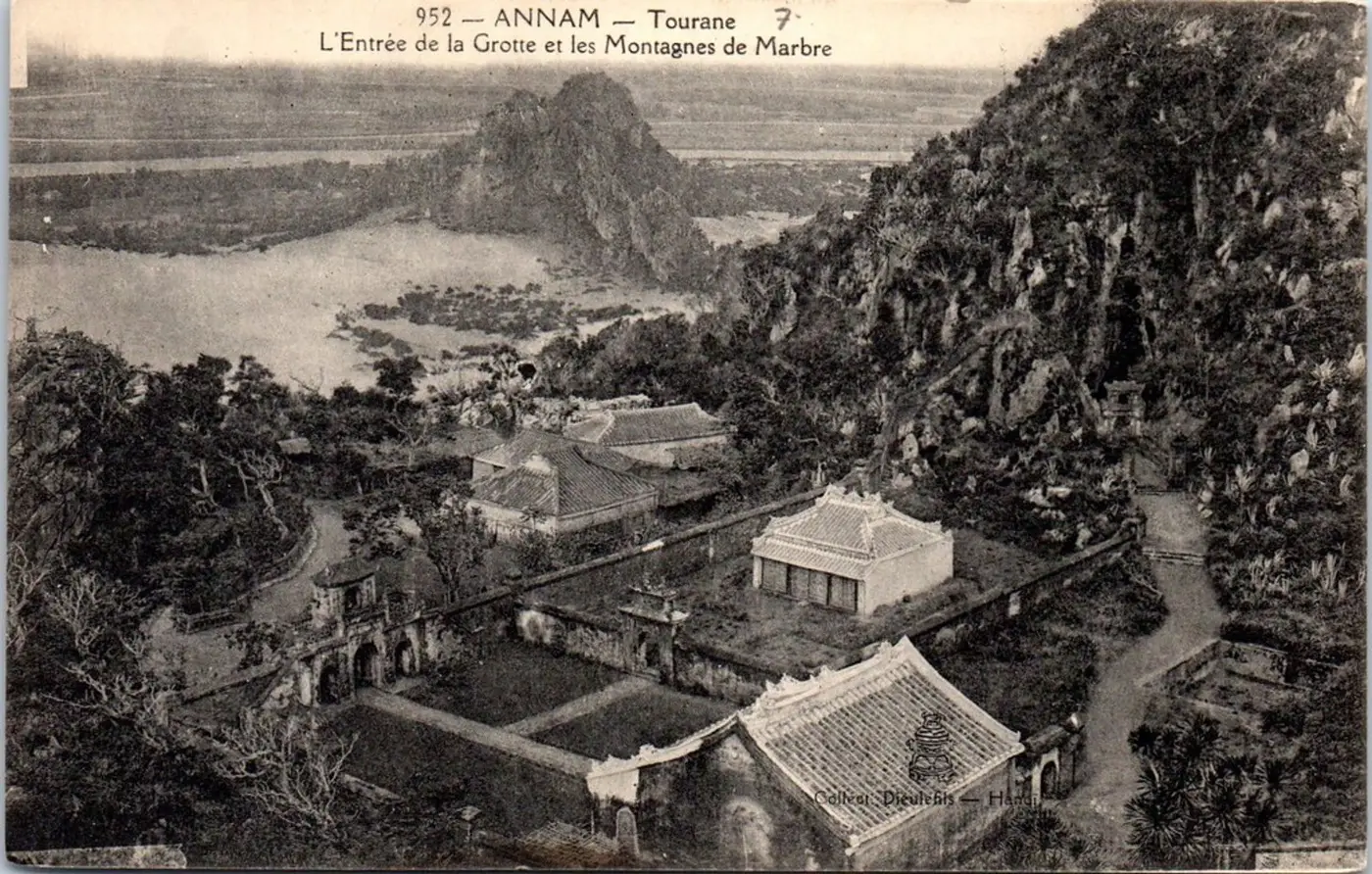
The mountains have six limestone peaks: Kim Son, Moc Son, Thuy Son, Tho Son, Duong Hoa Son and Am Hoa Son. Their caves and pagodas are covered in the Marble Mountains guide. This page covers the village below.
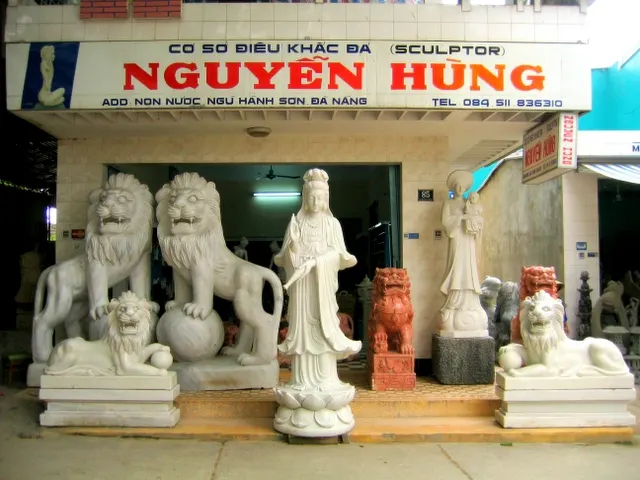
Today the village has nearly 500 workshops and nearly 4,000 workers, about 80% of the ward’s households. Carvers make around 80,000 pieces a year. In 2014 the Ministry of Culture, Sports and Tourism recognised the craft as national intangible cultural heritage.
The Pho Khanh stele and the Quan Khai carvers
Ask how old the village is and the usual answer is more than 400 years. It dates to the early seventeenth century and was founded by craftsmen from Thanh Hoa and Nghe An.
The best-dated record sits elsewhere. A stele of Pho Khanh pagoda, carved in 1678 under King Le Huy Tong, names its carver as from “Quan Khai commune”. The pagoda stands in Ai Nghia village and is one of the oldest in Quang land.
From that stele, Quan Khai already had stele carving and lettering from long before, at least from the seventeenth century. The stele also shows the carvers came from Thanh Hoa and settled at Quan Khai. No villagers lived around the mountain foot then.
Later the craftsmen moved gradually to the foot of the Marble Mountains. The village lost its paperwork, too. All its royal decrees and land records burned, along with the communal house.
Who was the founding ancestor
Several names are cited. Recent research says the ancestor may be of the Huynh Ba or Nguyen Van family, and the most convincing candidate is Huynh Ba Quat. A tomb stele of the Huynh Ba lineage copies a decree text: “the stone craft of Quan Khai village was first started by Huynh Ba”.
Elders of Quan Khai Dong say Huynh Ba Quat brought the old craft from Thanh Hoa and founded the village. His stele and tomb still stand there.
Villagers also recite a saying that ranks the best stone-quarrying climbers: “Nhat Tri, Nhi Ngo, Ba Gang”.
From millstones to statues
The first products were crude, for work and daily life. They included fishing-net weights, millstones and tools for sea and farm work, cut from Non Nuoc rock. At first only 5 to 6 families practised the craft.
In the eighteenth century the village split, and only Quan Khai Dong kept the traditional craft. Early in the twentieth century about 10 to 15 families worked stone, still mostly civil products.
Stone workers at the Hue court and the red-vein tea set
Under King Tu Duc, many artisans were summoned to the capital as foremen of stone carving at palaces and tombs. Among them were Cuu Dan, Nguyen Van De and Nguyen Van Binh. Some skilled carvers were given the ninth-rank title by the court.
One of them was Huynh Ba Triem, also called Cuu Dan. At the capital he noticed stone carvers cutting very beautiful tea sets. Back home he developed a red-vein tea set and tray, which opened the way to art-stone goods.
Where the stone comes from
Each peak has its own rock colour. Thuy Son is pink, Moc Son white, Hoa Son red, Kim Son ink-wash and Tho Son brown. Before, the raw stone was quarried on the spot, mainly marble in red, black and white, fine, soft and easy to chisel.
The stone-finder is called “ong Vo”, usually an experienced elder who leads strong young men up the mountain. He uses an iron bar 60 to 70 cm long to find the grain of the stone. A skilled worker can tell from the sound of stone whether it is soft or hard and what it can become.
That quarrying had a price. In 1980 the Marble Mountains were recognised as a national scenic-relic site. Afterwards the site faced excessive quarrying by the stone village. In 1991 the Quang Nam - Da Nang provincial committee banned quarrying on Non Nuoc mountain.
Workers no longer quarry the stone themselves at the mountain. The village’s raw stone now comes from Thanh Hoa, Nghe An, Thai Nguyen and some other countries.
Tools and steps
Hand tools include sledgehammers and crowbars for quarrying, and vot and cham chisels to split layers. The mui bat chisel cuts straight lines and right angles. The mui ve makes details such as lettering and patterns. In the early 80s of the twentieth century, carvers began using modern machines for some steps.
The first step is roughing out, the work of “ong Van”. For hard pieces the carver first draws a sketch and makes a clay model.
Hand grinding, washing and polishing is usually done by assistants, mostly women. For colour, carvers sometimes dye stone with food colouring plus green-tea dregs, brown shoe polish and indigo.
Viet and Cham in one block of stone
The village is seen as a harmonious meeting of old Viet and Cham cultures. You see this in the products. Alongside Buddha statues, human and animal figures and polished carved bracelets in many colours, there are Apsara, Ganesha and Laksmi statues. For the Cham roots of this region, read the My Son sanctuary.
The people who keep the craft
The craft passes from father to son, hand on hand. Many families have seven or eight generations in stone carving. One carver in the village began practising chiselling after school at the age of 11.
The Non Nuoc art-stone cooperative was dissolved because it could not adapt to the market economy.
At the foot of the mountain, in Dong Hai block, stands the Thach Nghe To Su ancestral house. The sixth day of the first lunar month is the rite that opens the working year. The ancestor death-anniversary rite falls on the sixteenth day of the third lunar month.
In 2013 that day fell on 25 April. The rite remembers the founder and also prays for stone workers killed in accidents at work.
Before you go
The village lies at the foot of the Marble Mountains. Its workshops line Le Van Hien, Huyen Tran Cong Chua and route 538. Products range from polished bracelets to Buddha statues and human and animal figures.
For a large piece, buyer and seller agree terms. The seller packs it carefully and ships it by sea to the buyer’s address. One warning: copied designs and mixed quality are lowering the value and reputation of the village. Look closely at the grain and the chisel work before you bargain.
Photo credits
- A stone-carving workshop in Non Nuoc: lions and a Quan Am statue in white stone: Wikimedia Commons — viajar24h.com (opens in a new tab) (CC BY 2.0)
- Early twentieth-century postcard "The Entrance of the Grotto and the Marble Mountains, Tourane": Wikimedia Commons — postcard by Pierre Dieulefils, public domain (opens in a new tab) (Public domain)
- Two monks of Linh Ung and Tam Thai pagodas in ceremonial dress, photographed in the early twentieth century (Albert Sallet): Wikimedia Commons — Association des Amis du Vieux Hué (AAVH), public domain (opens in a new tab) (Public domain)
Common questions
How old is Non Nuoc stone village?
It formed more than 400 years ago, in the early seventeenth century, when craftsmen from Thanh Hoa and Nghe An came into Quang land. The best-dated record is the 1678 stele of Pho Khanh pagoda.
Who founded the stone craft?
Recent research says the founding ancestor may be of the Huynh Ba or Nguyen Van family, and the most convincing candidate is Huynh Ba Quat. Elders say he brought the craft from Thanh Hoa to Quan Khai.
Where does the stone come from?
It used to be quarried on the spot from the Marble Mountains. Quarrying on Non Nuoc mountain was banned in 1991. Today stone comes from Thanh Hoa, Nghe An, Thai Nguyen and some other countries.
When did the village become national heritage?
In 2014 the Ministry of Culture, Sports and Tourism recognised it as national intangible cultural heritage.
How big is the village today?
It has nearly 500 workshops and nearly 4,000 workers, about 80% of the ward's households. Carvers make around 80,000 pieces a year.
Can large statues be shipped abroad?
For large pieces, buyer and seller agree terms. The seller packs the piece carefully and ships it by sea to the buyer's address.
When is the stone craft ancestor festival?
The ancestor death-anniversary rite is held on the sixteenth day of the third lunar month. In 2013 that day fell on 25 April.
Read next
- Marble Mountains: History, Caves and the Stone VillageVerified 18 October 2026
- My Son Sanctuary: History, Towers, Tickets and TransportVerified 18 October 2026
- Kim Bong Carpentry Village, Hoi An: History, Guilds, VisitVerified 18 October 2026
- Non Nuoc Stone Village, Da Nang: History, Stone and CraftVerified 18 October 2026
General information checked against the sources listed above, not legal advice for your situation. Rules and office practice change; confirm with the relevant office or a licensed adviser before you act. See how guides are checked.
Spotted an error? Report it.