Marble Mountains: History, Caves and the Stone Village
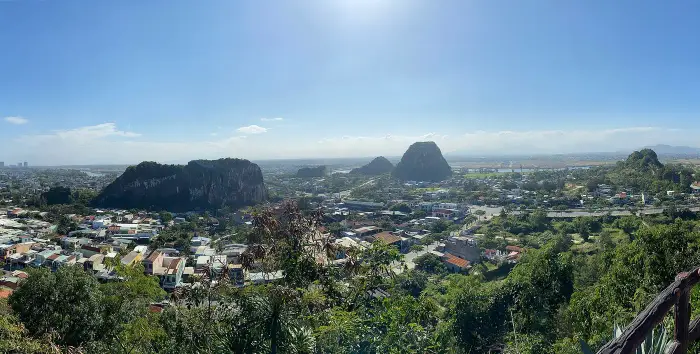
The Marble Mountains (Ngu Hanh Son) are six limestone mountains about 11 km south-east of central Da Nang. In 1825 Emperor Minh Mang named them after the five elements, while locals call them Non Nuoc. The Cham lived and traded here from the seventh to the eleventh century. The site became a national monument in 1980.
In this guide
- Mountains risen from an old sea
- Three names: Non Nuoc, Ngu Hanh Son, marble mountains
- The Cham came first
- Thuy Son: the mountain of pagodas and caves
- Am Phu cave: hell built in stone
- The French period: stone to the ships, tourists to the mountain
- The stone village at the foot of the mountain
- Two rankings
- The Co Co river, Ben Ngu and the Quan The Am festival
- Visiting the Marble Mountains
- Common questions
Mountains risen from an old sea
From a distance the Marble Mountains are six limestone peaks standing out of a coastal sand plain, spread over almost 2 sq km. Geologists say the group was once small islands in the East Sea, joined to the mainland as the Quang Nam plain built up. The coast has now drawn back about 800 metres from the foot of the mountains.
Each peak has its own rock colour: Thuy Son pink, Moc Son white, Hoa Son red, Kim Son ink-grey and Tho Son brown. The caves are open caves with many holes to the outside, so they stay cool and airy. In Huyen Khong cave you can see this for yourself: natural holes in the roof let in light and cool air.
Three names: Non Nuoc, Ngu Hanh Son, marble mountains
Locals call the group Non Nuoc, the French called it the marble mountains. Each peak also has a folk name. Thuy Son is the pagoda mountain and Moc Son the cockscomb. Tho Son is the stacked-stone mountain, Kim Son the Dung mountain and Hoa Son the Ong Chai mountain.
The name Ngu Hanh Son came later. Le Quang Dinh mentioned it in Hoang Viet nhat thong du dia chi in 1806.
Emperor Minh Mang came to visit for the first time in the fourth lunar month of 1825. He named the group Ngu Hanh Son after the five elements, Kim, Moc, Thuy, Hoa, Tho, matching the layout of the five peaks. In 1837 an edict gave the name Thuy Son to the north-east peak, the Tam Thai mountain.
So the names of the peaks carry the mark of a Nguyen emperor, while Non Nuoc belongs to the people.
The marble name is French. Albert Sallet named the site Les montagnes de marbre after the material of the rock. Strictly speaking the rock is limestone, but “marble” survives in the English name Marble Mountains.
A fourth layer of names is legend. The story goes that the five peaks formed from five fragments of the dragon egg in the tale of the Golden Turtle. The Cham version says the eggshell split into five pieces and each became a peak: Kim, Moc, Thuy, Hoa, Tho. This is folk tale, not history, but it shows that both Viet and Cham treated the group as a sacred place.
The Cham came first
Before there were Viet pagodas, this was Cham land.
The heritage file calls Ngu Hanh Son a place with a long history, once a centre of settlement, trade and worship of the Cham, the native people. Two excavations at the Nam Tho Son site, in 2000 and 2018, show the Cham living and trading here in the seventh to eleventh centuries. On his Cham archaeological map printed in 1908, Henri Parmentier marked a Ngu Hanh Son tower.
The traces survive inside the pagodas and caves.
In front of Linh Ung pagoda stands an altar in the Dong Duong style. That altar, carved with Indra on an elephant among Apsara dancers, is recorded as the most beautiful altar found at Ngu Hanh Son so far.
In Tang Chon cave a stone Linga-Yoni of the Cham is still worshipped. A stone statue of Vishnu on Garuda is catalogued by museums as coming from this marble mountain area.
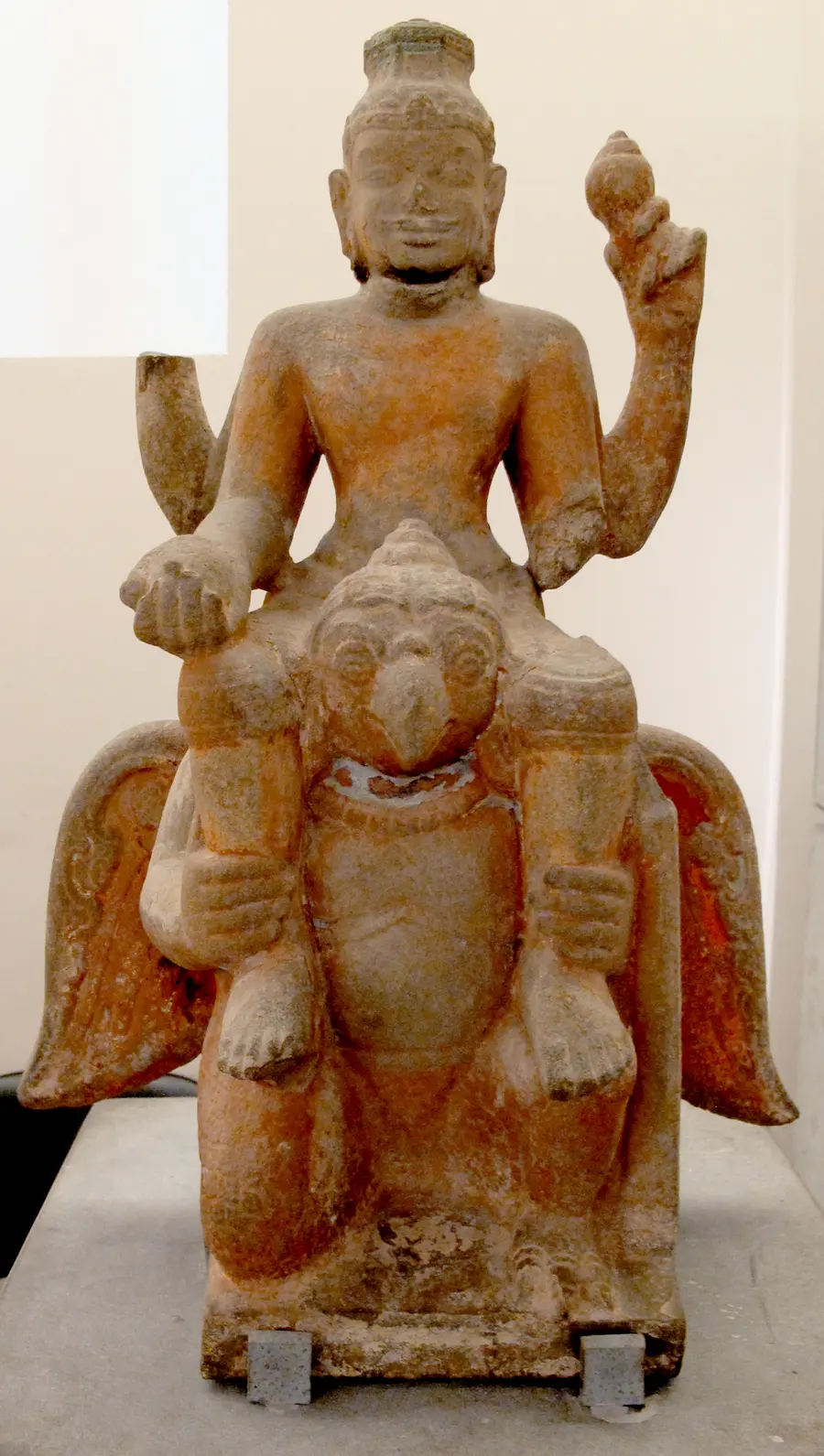
When the Cham land passed to Dai Viet, the goddess Po Inu Nagar became a Viet goddess named Thien Y A Na, or Ba Chua Ngoc. That is how two peoples shared one shrine, and why you meet Cham statues beside Buddhas at Ngu Hanh Son. For the larger Cham sanctuaries of Quang, read My Son sanctuary.
Thuy Son: the mountain of pagodas and caves
Thuy Son has three peaks on three levels, like the three Tam Thai stars at the tail of the Great Bear, so it is also called Tam Thai mountain. From the west gate you climb 156 stone steps to Tam Thai pagoda.
Tam Thai pagoda existed before the monk Thich Dai San visited in 1695 and wrote it down in Hai ngoai ky su. A great storm destroyed the pagoda completely in 1901, and it was rebuilt only in 1907. Princess Ngoc Lan, Minh Mang’s sister, vowed to spend her whole life as a nun at this pagoda.
Down the slope is Linh Ung pagoda, leaning on the mountain and facing the sea, built in the first half of the 17th century. In 1825 Minh Mang had it rebuilt in tile and brick. Under Thanh Thai, in 1891, it was renamed Linh Ung tu, the name it keeps today.
In Hoa Nghiem cave the stele Pho Da Son linh trung Phat is cut straight into the rock wall in the year Canh Thin, 1640. It lists 53 donors, including at least 10 Japanese families.
The Quan Am statue in the cave was carved by the stone sculptor Nguyen Chat in 1960. Another stele, from Thai Binh pagoda near Thuy Son and Tho Son, is dated 11 July of the year Tan Suu, which is 1721. For the port of Hoi An to the south, see Hoi An history.
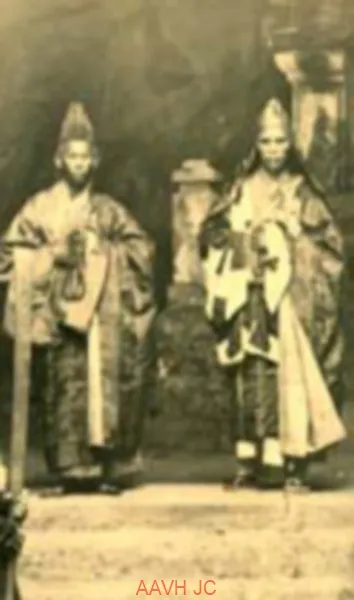
Dr Sallet last met the Linh Ung monk Nguyen Viet Lu in 1920, a year before his death, and the photo was taken on that occasion.
Huyen Khong is the best-known cave. Folk tale says that when King Thanh Thai, in his tenth year, came to pray for the nation and by chance touched the outer stalactite, it stopped dripping. From Vong Giang Dai you look out over the Cam Le and Co Co rivers and the whole Ngu Hanh Son.
Am Phu cave: hell built in stone
Am Phu cave dates from the time of Minh Mang, when the emperor travelled incognito to this mountain. By yin-yang thinking, a road up to heaven on Thuy Son pairs with a cave down to the underworld. The scenes inside, such as the Yin-Yang bridge and the river Nai Ha, were imagined by craftsmen and carved in marble at the foot of Thuy Son.
The main story in the cave is that of Muc Kien Lien searching for his mother. From that tale of filial piety the full-moon day of the seventh lunar month is called the day of filial piety, the Vu Lan festival.
The French period: stone to the ships, tourists to the mountain
The notes of the Association of Friends of Old Hue (AAVH) attached to the photo tell the quarry story plainly. Under the first Nguyen emperors, quarrying here was forbidden. In the early decades of colonial rule it was allowed and large quantities of marble were shipped to Cochinchina, China and Japan.
The streets of Tourane were even lined with marble pavements. Excessive quarrying was later banned under Thanh Thai, with villagers tolerated to make small objects from fallen pieces.
On the same route a 35 km narrow-gauge railway ran from the Observatory islet opposite Tourane to Faifo, serving the quarries and carrying tourists to the mountains. For how Tourane became a concession, read the story of Da Nang’s port.
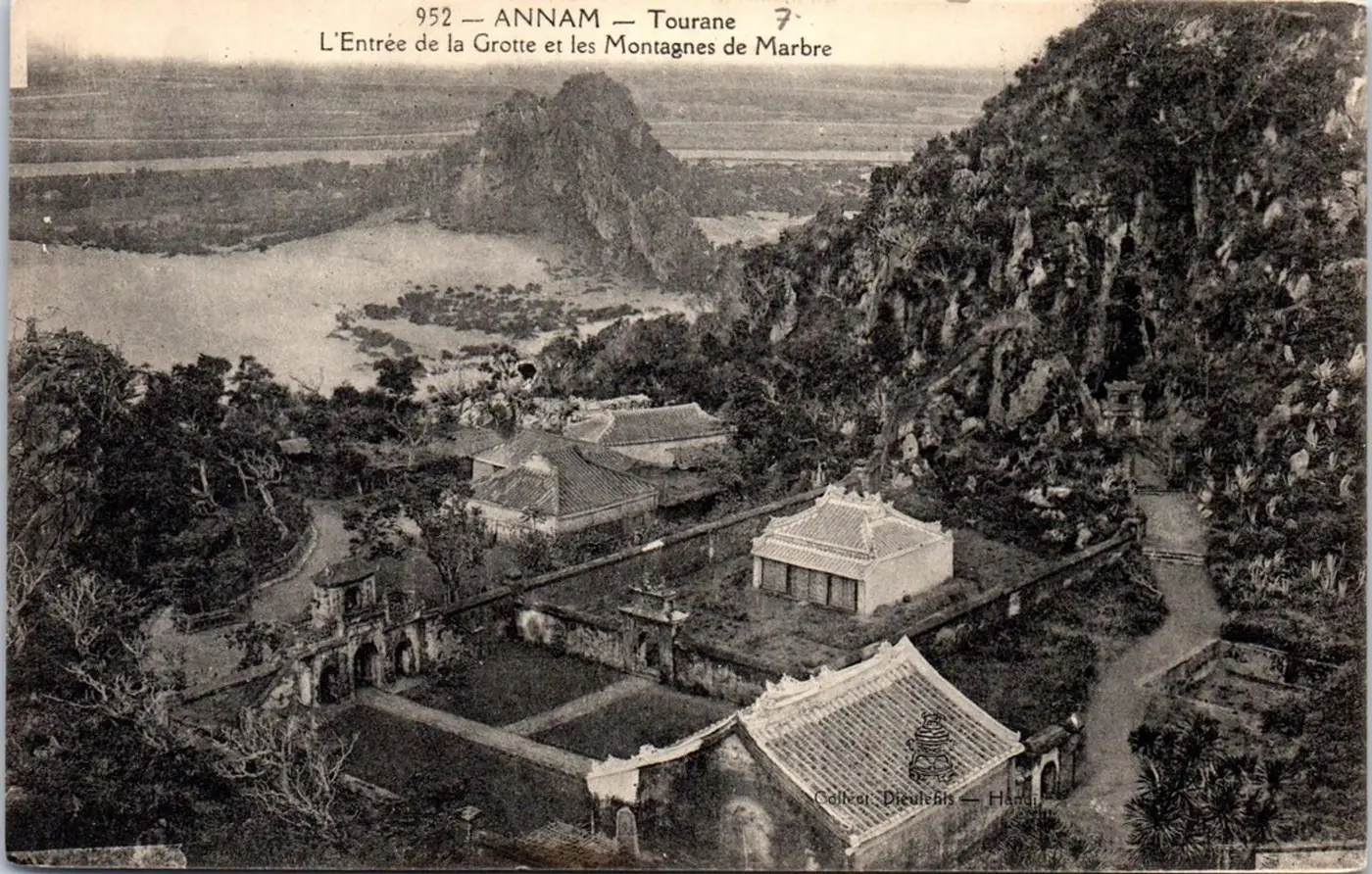
The postcard above is titled “The Entrance of the Grotto and the Marble Mountains, Tourane”.
The stone village at the foot of the mountain
The Non Nuoc stone-carving village took shape in the early seventeenth century, founded by craftsmen from Thanh Hoa and Nghe An who came to the Quang lands.
A stele of Pho Khanh pagoda dated 1678 names its carver as from Quan Khai commune. So stele carving and lettering existed there since at least the seventeenth century. At first the craftsmen made rough goods for daily life: fishing gear, millstones, tools for the sea.
Today the village makes Buddha statues, human and animal figures and carved stone bracelets. The Non Nuoc stone association holds the annual Le ky Thach nghe To su; in 2013 it fell on the 16th day of the third lunar month.
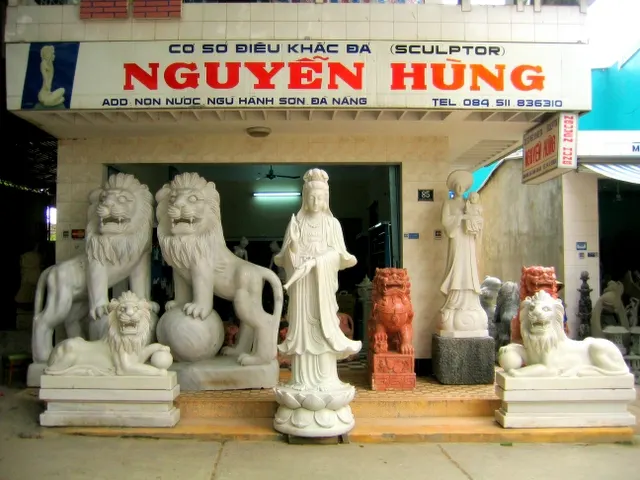
Quarrying from the mountain itself has changed. After the site was ranked in 1980 it was badly encroached upon. In 1991 the Quang Nam - Da Nang province decided to ban quarrying stone from Non Nuoc mountain.
Two rankings
The Ngu Hanh Son scenic area was ranked a national monument in 1980. On 24 December 2018 the Prime Minister signed a decision raising it to special national monument.
The Co Co river, Ben Ngu and the Quan The Am festival
West and south of the group runs the Co Co river. In the 17th and 18th centuries this branch was the main waterway between Da Nang and Hoi An, and later silted up. At the foot of Kim Son there was once a Ben Ngu, the landing where the king’s boat moored when he visited Ngu Hanh Son.
The biggest festival is Quan The Am, held for three days on the 17th, 18th and 19th of the second lunar month. In late 1999 the state recognised it as one of 15 national-level folk festivals.
Visiting the Marble Mountains
The group lies 11 km south-east of Da Nang, with Non Nuoc beach to the east and Hoi An old town to the south. The group lies between Da Nang and Hoi An old town. The management board is at 81 Huyen Tran Cong Chua Street, Da Nang.
An adult ticket for Thuy Son is VND 40,000 a visit and for Am Phu cave VND 20,000. It opens 07:00 to 17:00 daily. For Thuy Son you buy a ticket for gate 1 or gate 2; if you take the lift, buy a lift ticket at VND 15,000 a trip. These prices come from the management board’s notice, so carry a little extra cash in case they change.
The Japanese and Chinese merchants of Hoi An left many other traces, starting with the assembly halls.
Photo credits
- The limestone mountains of Ngu Hanh Son seen from above: Wikimedia Commons — Kuroczynski (opens in a new tab) (CC BY-SA 4.0)
- Cham stone statue of Vishnu riding Garuda, catalogued as coming from the Marble Mountains: Wikimedia Commons — sailko (opens in a new tab) (CC BY-SA 3.0)
- Two monks of Linh Ung and Tam Thai pagodas in ceremonial dress, photographed in 1920 (Albert Sallet): Wikimedia Commons — Association des Amis du Vieux Hué (AAVH), public domain (opens in a new tab) (Public domain)
- Early twentieth-century postcard "The Entrance of the Grotto and the Marble Mountains, Tourane": Wikimedia Commons — postcard by Pierre Dieulefils, public domain (opens in a new tab) (Public domain)
- A stone-carving workshop in Non Nuoc: lions and a Quan Am statue in white stone: Wikimedia Commons — viajar24h.com (opens in a new tab) (CC BY 2.0)
Common questions
How many mountains are in the Marble Mountains?
Six limestone mountains: Kim Son, Moc Son, Thuy Son, Tho Son, Duong Hoa Son and Am Hoa Son, spread over almost 2 sq km.
Why are they called Non Nuoc?
Non Nuoc is the people's name for the group, while the French called it the marble mountains. The name Ngu Hanh Son came later, and Le Quang Dinh already mentioned it in a book of 1806.
Why did the French call them marble mountains?
Albert Sallet named the site Les montagnes de marbre after the material of the rock. In fact the rock is limestone.
When were the Marble Mountains listed as a monument?
They were ranked a national monument in 1980, and on 24 December 2018 the Prime Minister signed a decision ranking them a special national monument.
How much is the ticket and when does it open?
An adult ticket for Thuy Son is VND 40,000 a visit, Am Phu cave VND 20,000 and the lift VND 15,000 a trip. It opens 07:00 to 17:00 daily.
Is Am Phu cave really hell?
The underworld scenes were imagined by people and carved in marble at the foot of Thuy Son. The cave dates from the time of Minh Mang.
How far is it from Da Nang?
About 11 km south-east, with Non Nuoc beach to the east and Hoi An old town to the south.
How old is the Non Nuoc stone village?
It took shape in the early seventeenth century, founded by craftsmen from Thanh Hoa and Nghe An who came to the Quang lands.
Read next
- My Son Sanctuary: History, Towers, Tickets and TransportVerified 18 October 2026
- Hoi An History: The Faifo Trading Port and Old TownVerified 18 October 2026
- Da Nang Under Attack: The Landing in Old Prints and MapsVerified 18 October 2026
- Hoi An Old Town: Heritage, Assembly Halls, TicketsVerified 18 October 2026
General information checked against the sources listed above, not legal advice for your situation. Rules and office practice change; confirm with the relevant office or a licensed adviser before you act. See how guides are checked.
Spotted an error? Report it.