Bai Choi: The Singing Card Game of Central Vietnam
Bai choi (bài chòi) is a card game played in bamboo huts at Lunar New Year. The caller draws a card and sings a verse as a riddle instead of naming it. It has a second form, performance on a mat. UNESCO inscribed it on 7 December 2017. In Hoi An artists perform it every evening.
In this guide
What bai choi is
Bai choi (bài chòi) blends music, poetry, acting, painting and literature. It has two main forms. One is the game: a card game played in bamboo huts at Lunar New Year. The other is the performance, in which male and female Hieu (Hiệu) artists sing on a rattan mat, moving from place to place or performing for families.
On 7 December 2017 UNESCO inscribed the art of Bai Choi in Central Viet Nam on the Representative List of the Intangible Cultural Heritage of Humanity. The decision came at the twelfth session of the Intergovernmental Committee in Jeju, Korea.
The heritage belongs to no single village or province. The Departments of Culture, Sports and Tourism of nine provinces work with communities to update its record every year. Hoi An, now part of Da Nang city, is one place that keeps the art alive.
This page runs from root to branch. It covers where bai choi comes from, how the huts go up, what a ho thai call contains, and where to hear it in the old town in the evening.
One name, two ways to play
People in central Viet Nam say “choi bai choi” or “danh bai choi” when they mean the game. They say “ho bai choi” or “hat bai choi” when they mean the role-playing and performing art. The two belong together but are not the same thing.
Bai choi stories also carry lessons on morality, compassion and love for the village.
Origin: two accounts
Nobody has yet made a thorough study of the history and emergence of bai choi. So two accounts live side by side.
The story of the farm huts
Historical documents call the courtier Dao Duy Tu (1572-1634) the founder of bai choi. The game is tied to the time he went to Hoai Nhon in Binh Dinh (now Gia Lai province) to clear new land.
To scare off wild animals that wrecked the crops, farmers built huts about 3 m high. Lonely in the wilderness, they strung bamboo tubes between the huts to talk, sing back and forth and play cards. That animal-chasing card game slowly became a folk game of cards and sung calls, handed down through generations.
The trace in the cards
Most authors suppose bai choi was born in the 15th century. That view rests on the French music researcher G.L. Bovier. He guessed it formed with the southward migration of the Vietnamese in 1470.
A paper from the Vietnamese Institute of Musicology sets the two decks side by side. Bai choi has the same card sets and cards as the older game to tom diem. Players of to tom diem build a hut (diem), and players of bai choi build a hut (choi).
The author concludes that bai choi was born with the migration from the Central North (Thanh Hoa and Nghe An) to the Central South in the 15th century. Researchers of central Vietnamese culture agree on one point: bai choi is an entertainment created by the Vietnamese.
Raising huts, opening the festival
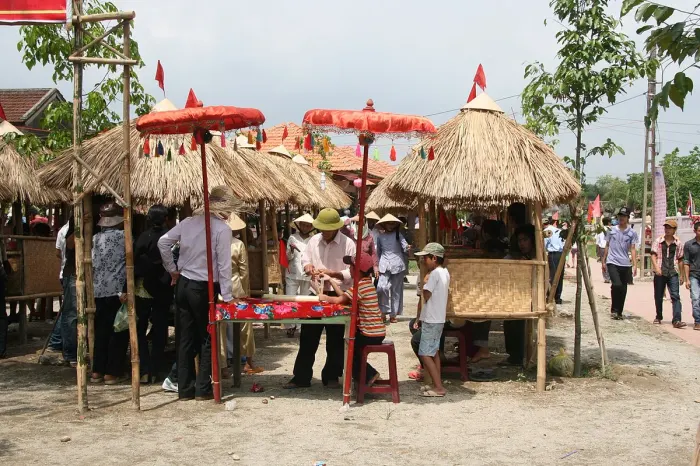
A bai choi festival is held at Lunar New Year, on a ground large enough for 9 or 11 huts and for the crowd to join in. Villagers start building a few days after seeing the Kitchen God off to heaven. The huts are made mainly of bamboo, straw or coconut leaves. Each hut has 4 legs and stands over 2 m high.
The huts are set out in a U: one owner hut and 8 or 10 guest huts. The owner hut is for the card seller and the others are for card buyers. A second set of cards, the bai noc (bài nọc), is placed in the middle of the yard. The whole festival lasts only 3 to 4 days.
The 33-card deck
A bai choi set has only 33 cards, while a to tom diem set has 120. When the drawings change, the card names change with them.
In to tom diem the suit sach holds cards such as Nhat sach, Nhi sach and Cuu sach. In bai choi the same suit carries earthier names: Tu Cang, Nhut Noc, Nhi Ngheo, Ba Ga, Tu Xach, Ngu Dum, Luc Hot, Bay Thua, Tam Dung and Cuu Dieu.
Ho thai: the sung riddle
What sets bai choi apart from every other card game is how a card is read out. The caller draws a card but does not name it at once. He raises his voice and calls, using a witty, metaphorical luc bat (six-eight) verse as a riddle for the players.
Stretching the suspense is like buying a lottery ticket and waiting for the draw. That may be why it is called ho thai (hô thai).
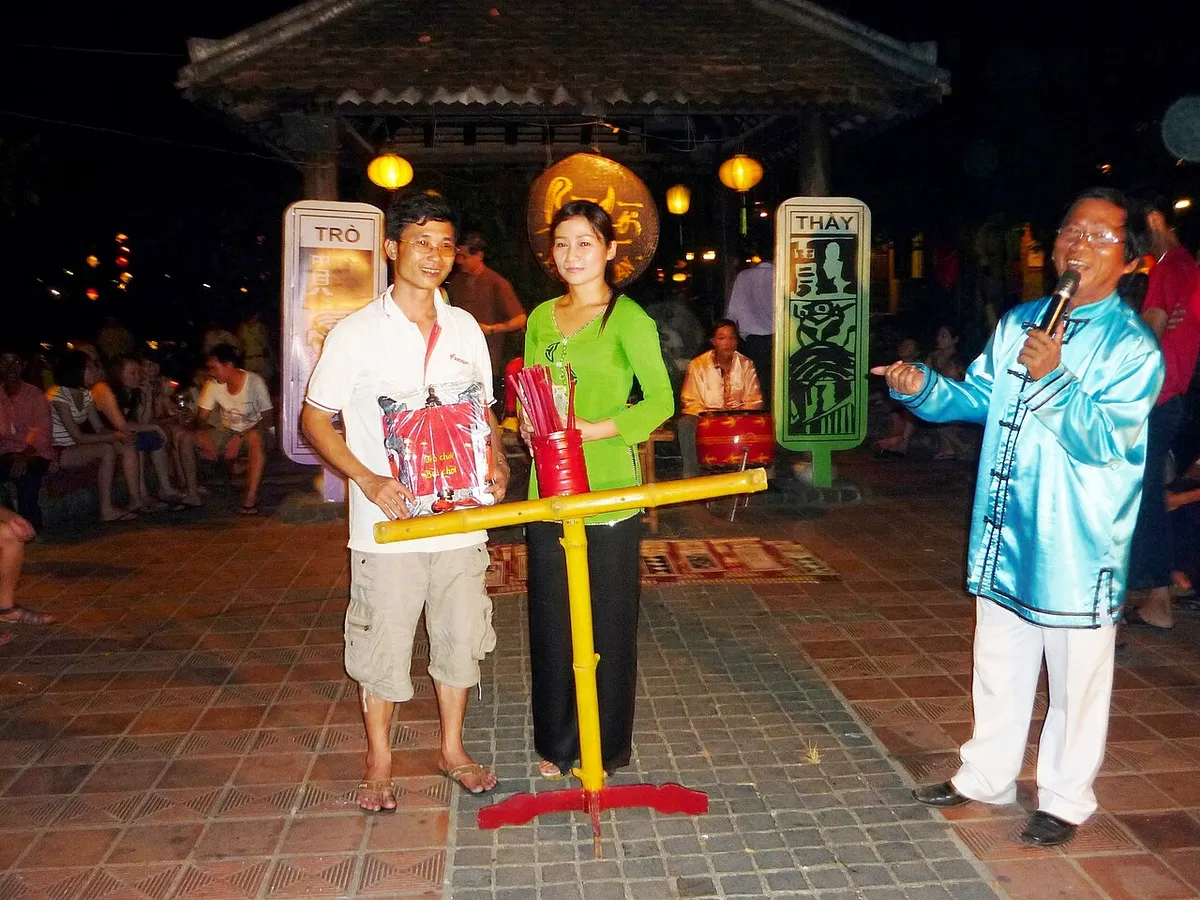
A ho thai call has three phrases and ends by calling the name of the card. The lyric is a six-eight verse or a variant of it. The rule of the craft is that the last word of the eight-word line must be the card’s name.
One recorded call runs: “Tay bung dia muoi, nam dam / Vua di vua cham te am xuong muong”. It finishes with “Ong am hue Ong am”. Players hear the “am” at the end of the verse and know the card in play is Ong Am.
The game is not rough gambling. The winner receives only a small symbolic prize, a formal blessing and a cup of spring wine from the caller.
Anh Hieu, the caller
The caller is called anh Hieu. He is the one folk artist who creates the artistic atmosphere of the game. He sings, composes lyrics, makes movements to illustrate them and plays clappers.
UNESCO’s file recognises both male and female Hieu artists. With them, solo performers, card makers and hut makers carry the craft.
The skills pass mostly within families and by word of mouth, and also through clubs, schools and associations. Communities have set up nearly 90 bai choi teams, groups and clubs to practise and teach the art.
From the hut to the mat, from the mat to the stage
Three or four days after a game ends, many Hieu are invited to perform in villagers’ homes. That is the start of bai choi on the mat. A travelling group usually has 3 to 4 people, and each can play an instrument, beat a drum and sing.
To keep listeners from getting bored, performers turned simple calls into story songs of 20 to a hundred lines. From the ho thai melodies they developed 6 more tunes. A mat performer’s kit is everyday clothes, a conical hat, a scarf, a two-string fiddle, bamboo clappers, a gong-drum and the gift of improvisation.
From the mat, bai choi climbed onto a stage. In mid-1933 two artists, Bon Trang and Ba Nho, took bai choi onto a wooden stage at An Luong market, Phu My, Binh Dinh, now in Gia Lai.
The Tan Xuan troupe (1934) opened a golden age of more than 10 famous bai choi troupes. Later artists raised bai choi from a folk tune into the theatre form dan ca kich bai choi. The Institute of Musicology paper treats the mat art as the root of the bai choi drama theatre of the Central South in the second half of the 20th century.
In Quang Nam, after 1975, the Quang Nam-Da Nang Opera Company set off a sweeping movement to enjoy bai choi and write new lyrics for its tunes. It is now called the Quang Nam Folk Opera Company.
Bai choi in Hoi An
Hoi An people knew bai choi as a folk game played at spring Tet. Before the first half of the 20th century, elders built the huts themselves and ran the game for the villagers. Then the game seemed to wither away in town.
In September 1998 the city included bai choi in its Old Town Night programme. The game was revived in the inner town and held every night.
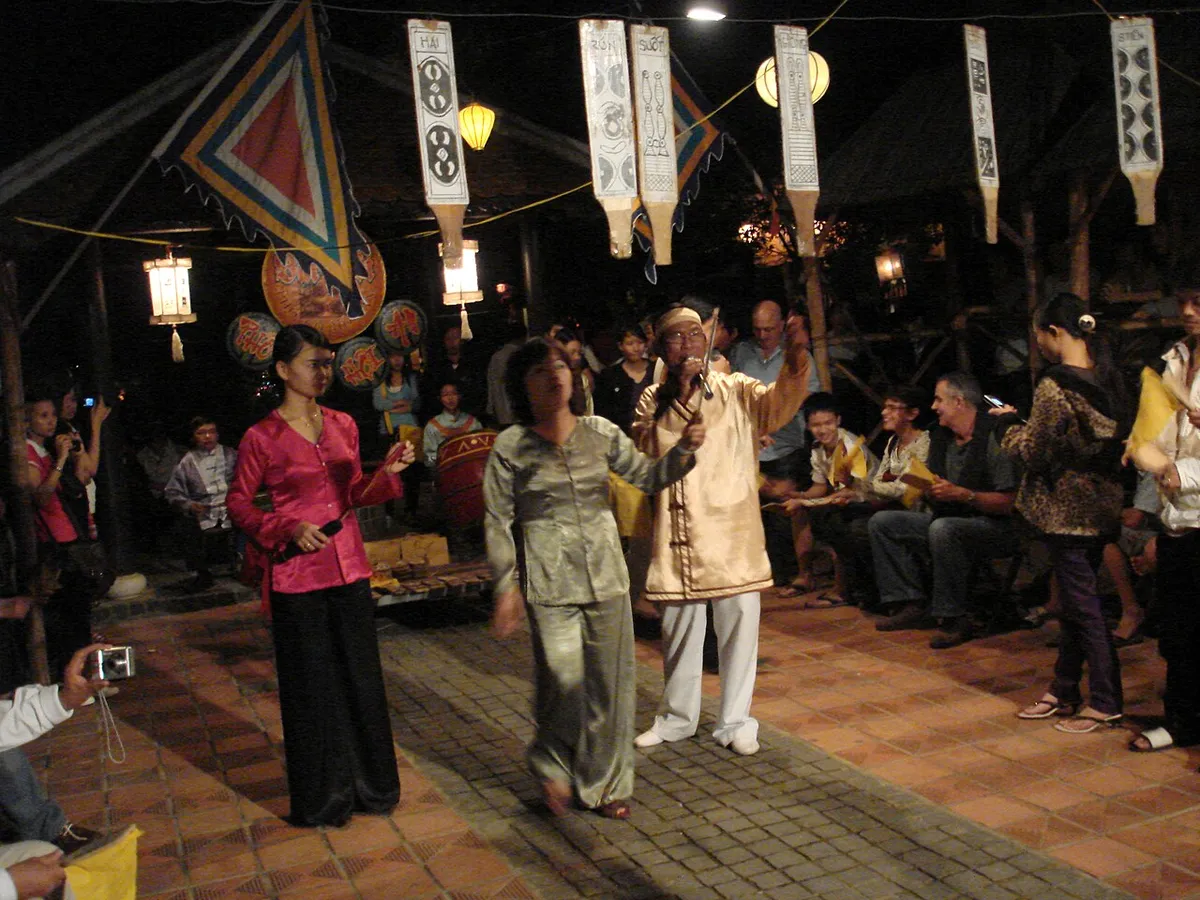
Today bai choi is a festival custom in almost every Hoi An village. Since 2004 the Hoi An heritage centre has worked with the schools to teach bai choi. It also runs free folk-song classes in the “night street” programme.
The art of calling and singing bai choi is an official subject in secondary school. A class open to children and visitors runs every night in the old town.
In December 2025 Hoi An held an evening of exchange to mark eight years since UNESCO inscribed bai choi.
Where and when to listen
At the An Hoi roundabout in the middle of the old town, artists of the Hoi An heritage centre perform bai choi each evening for visitors to the night street. The roundabout is in Hoi An ward, Da Nang city.
The free classes in the old town are a stop for many visitors. Audience, learners and teachers lose themselves in bai choi calls, xang xe, xuan nu, ho Quang and ho khoan.
To see a festival game proper, go at Tet. A bai choi festival is held at Lunar New Year and lasts only 3 to 4 days.
For the old town where these evenings take place, read Hoi An ancient town and Hoi An history. For the Cham towers of Quang Nam, see My Son sanctuary.
Why it is worth keeping
UNESCO’s file records that bai choi was put on the National List of Intangible Cultural Heritage by the Ministry of Culture, Sports and Tourism in 2013-2014.
The ceremony to receive the certificate in Hoi An took place on the evening of 7 May 2018. The Ministry, the Quang Nam People’s Committee and Hoi An city organised it.
What keeps bai choi alive is not a certificate but the people who sing it. They are the Hieu, the card makers, the hut makers and the children now learning to call in the night street.
Photo credits
- Thatched huts built for a bai choi festival, with the caller's table in front. Photo: Luu Ly, CC BY 3.0: Wikimedia Commons, Chòi bài, by Lưu Ly, CC BY 3.0 (opens in a new tab) (CC BY 3.0)
- A bai choi session in Hoi An: the caller sings the clue in front of an evening audience. Photo: Le Tan Loc, CC BY-SA 3.0: Wikimedia Commons, Bài chòi Hội An 3, by Lê Tấn Lộc, CC BY-SA 3.0 (opens in a new tab) (CC BY-SA 3.0)
- Singers perform bai choi under lanterns and giant painted cards. Photo: Liftold, CC BY-SA 3.0: Wikimedia Commons, Hát bài chòi, by Liftold, CC BY-SA 3.0 (opens in a new tab) (CC BY-SA 3.0)
Common questions
What is bai choi?
A diverse art combining music, poetry, acting, painting and literature. It takes two forms: a card game in bamboo huts at Lunar New Year and performances by Hieu artists on a mat.
When did UNESCO recognise bai choi?
On 7 December 2017, at the twelfth session of the Intergovernmental Committee for the 2003 Convention in Jeju, Korea. The file belongs to nine provinces of central Viet Nam.
What is ho thai?
It is how the caller announces a card: he does not name it at once but sings a witty luc bat verse as a riddle. A call has three phrases and ends with the card's name.
How many cards are in a bai choi deck?
There are 33, far fewer than the 120 of a to tom diem set.
When is bai choi played?
At Lunar New Year. A festival lasts only 3 to 4 days.
Is bai choi gambling?
No. The winner receives only a small symbolic prize, a formal blessing and a cup of spring wine from the caller.
Where can you hear bai choi in Hoi An?
At the An Hoi roundabout in the old town, where artists of the Hoi An heritage centre perform each evening for visitors.
How old is bai choi?
No thorough study of its history exists yet. Most authors suppose it was born in the 15th century; another account ties it to the courtier Dao Duy Tu (1572-1634).
Read next
- Hoi An Old Town: Heritage, Assembly Halls, TicketsVerified 18 October 2026
- Hoi An History: The Faifo Trading Port and Old TownVerified 18 October 2026
- My Son Sanctuary: History, Towers, Tickets and TransportVerified 18 October 2026
- Bai Choi: The Singing Card Game of Central VietnamVerified 18 October 2026
General information checked against the sources listed above, not legal advice for your situation. Rules and office practice change; confirm with the relevant office or a licensed adviser before you act. See how guides are checked.
Spotted an error? Report it.