Japanese Bridge in Hoi An (Chua Cau): History, Design and Legends
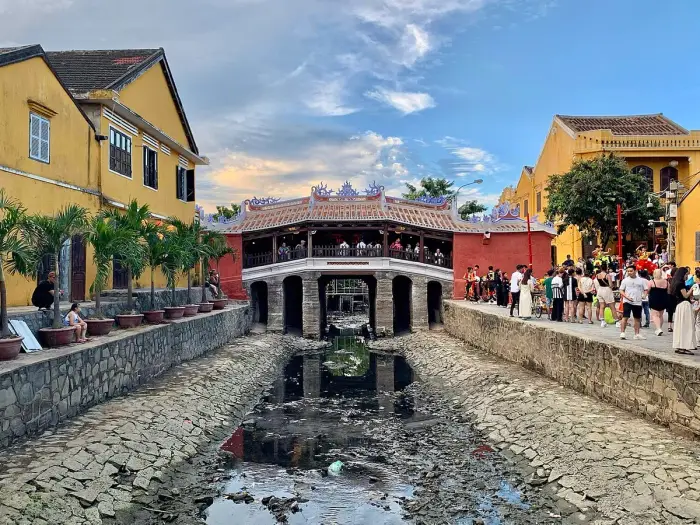
Chua Cau, the Japanese Bridge, is a covered bridge in Hoi An old town, dated to the late 16th or early 17th century and funded by Japanese merchants. The Chinese added the pagoda bay in 1653, Lord Nguyen Phuc Chu named it Lai Vien Kieu in 1719, and it reopened on 3 August 2024 after restoration.
In this guide
What kind of bridge is Chua Cau
Chua Cau crosses a canal nearly 10 m wide, joining Tran Phu street and Nguyen Thi Minh Khai street on the south-west side of Hoi An old town. It is about 18 m long and 3 m wide. For almost four centuries it has stayed in use as a main road of Hoi An. Its picture is on the back of the polymer 20,000 dong note.
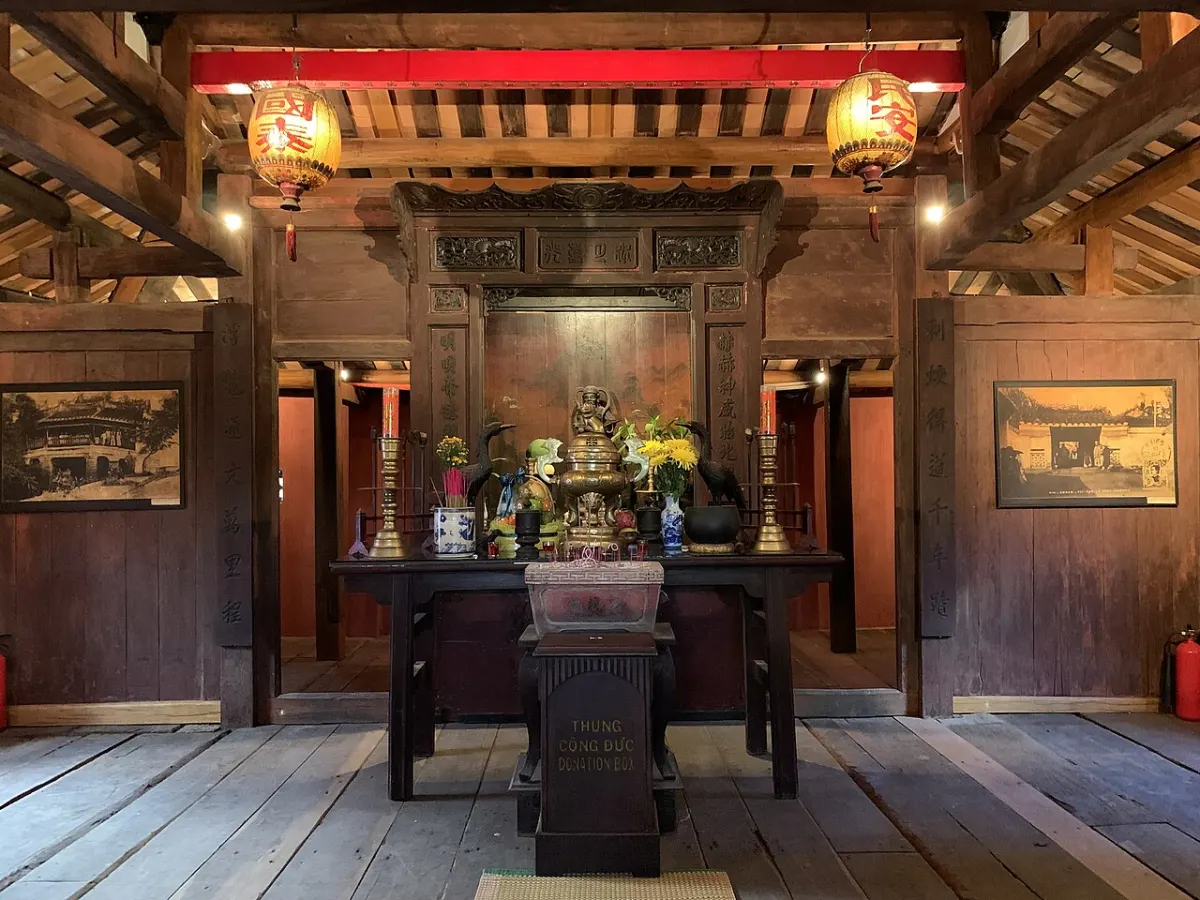
The bridge does three jobs at once. It links the Japanese and Chinese quarters. It houses the guardian deity Bac De Tran Vo. It is also a place to rest and look out.
Each job has its own space: the bridge outside is for crossing, the shrine inside is for worship.
This page goes deep on the bridge itself. The port of Faifo around it is in the history of Hoi An, and the streets are in the old town guide.
Three names for one bridge
The bridge has three names. Japanese Bridge, because it was the Japanese people’s bridge. Chua Cau (pagoda bridge), because bridge and pagoda were built together. And Lai Vien Kieu, the name Lord Nguyen Phuc Chu gave in 1719, meaning the bridge of people from far away.
The Nguyen court chronicle Dai Nam thuc luc records the naming. In the spring of 1719 the lord visited Quang Nam and came to Hoi An. He saw a bridge on the west side of the street where trading boats gathered, and named it Lai Vien.
The two characters come from a line in the Analects. The wooden board carrying them was made in 1719 and still hangs over the door. It measures 59 cm by 145 cm.
Who built it, and when
The exact year is unknown. Nothing in writing records when the bridge was built. The heritage record places it in the late 16th or early 17th century. Japanese merchants provided the funds and the design, and Vietnamese carpenters in Hoi An did the building.
Three documents point to the Japanese as owners. The first is the story of Father Benigne Vachet, who lived in Dang Trong from 1673 to 1683. It proves the bridge existed before 1683.
The second is the record of the Chinese monk Thich Dai San, who visited Hoi An in 1695 and wrote in Hai ngoai ky su. His note is the first written text naming the Japanese owner.
The third is a stele put up in 1817. It says the bridge was, by tradition, made by the Japanese. The bridge is also one of the few covered bridges drawn on Vietnamese maps of the 17th and 18th centuries.
The Chinese take over, and the pagoda bay appears
In 1653, after the Japanese had left Hoi An, the Chinese took over the bridge. They added a bay jutting out of its middle, again built by Vietnamese craftsmen. From then on locals called it a pagoda.
The Japanese had already thinned out in 1634-1635, because of Japan’s ban on going abroad.
The bay holds a statue of Bac De Tran Vo, to pray for peace and stability for the land and climate of Hoi An. The wooden statue stands 0.5 m tall. There is no festival here. Locals usually burn incense before the statues on the full-moon and first days of the lunar month.
How the bridge is built
The bridge follows the “house above, bridge below” pattern: a roof of yin-yang tiles, a wooden deck and a stone foundation. Two end bays join seven middle bays in the shape of the character for “work”. Seen from above, bridge and shrine together form a T.
Bridge and shrine were built more than half a century apart. Even so, their roof frames join harmoniously. Joining the two into one body is unique in Vietnamese architecture.
The bridge also shows the friendship of the Vietnamese, Chinese and Japanese who lived together in peace in Hoi An. Only the foundation survives almost intact. Most other parts were replaced in the restorations.
The dog and monkey statues
The bridge holds two pairs of dog and monkey statues. The four seated wooden figures are 110 cm tall. Only the male dog was restored, in 1956; the other three are old. The grey paint makes them look like stone, but they are wood.
The two dogs sit on a pedestal facing each other.
Why a dog and a monkey? One reading is a Japanese way of recording dates. Another is that they are animals the Japanese revered. A third reading: the work took three years, starting in the year of the Monkey and finishing in the year of the Dog.
Whichever reading you prefer, many people stop before the statues to burn incense for peace, especially on full-moon days and holidays.
The legend of the Cu (and the mamazu catfish)
This is legend, not history. A giant Cu lies under Hoi An. When it stirs, Hoi An’s streets collapse; when it wags its tail, Japan shakes with earthquakes.
To hold it still, the Japanese cast a golden sword and pinned it into its spine. They also melted lead and silver to pour the foundation. Later the Minh Huong villagers raised money to add a shrine on the north side and invited Bac De Tran Vo to be worshipped there.
The dictionary Dai Nam quoc am tu vi defines the Cu as a hornless dragon that lies under the ground. Japan has a similar myth about Mamazu, a giant catfish deep in the mud whose tail wag causes earthquakes. The legend confirms the Japanese as the first builders of the bridge.
Seven restorations, then the largest of all
The bridge was restored seven times: in 1653, 1763, 1817, 1865, 1915, 1917 and 1986. Three of those dates (1763, 1817, 1865) are carved into the ridge beams. Four large stone steles at the bridge ends record the major repairs. The earliest is dated 1817 and the latest 1917.
In 1915 the French Resident Lesterlin paid for a restoration. In 1986 the Ministry of Culture restored the bridge at the locality’s request. In 1990 the ministry issued the certificate recognising it as a historic-cultural relic.
By 2010 the foundation had sunk and cracked, the shrine and bridge had separated and the beams were rotting. Every day thousands of people crossed it.
Work began on 28 December 2022, and the bridge was dismantled. After 19 months Chua Cau reopened on the afternoon of 3 August. The ceremony took place during the 20th Hoi An - Japan cultural exchange.
It was the largest restoration to date, costing 20.2 billion dong from provincial and local budgets. The head of the heritage centre said the form, structure and frame were preserved almost intact. The new look drew mixed opinions.
Read on
The bridge links the Japanese and Chinese quarters. The water that fed the port is the Hoai River. The whole path from Faifo port to today’s old town is in the history of Hoi An.
Photo credits
- Chua Cau after the 2024 restoration: Wikimedia Commons — Chainwit. (opens in a new tab) (CC BY 4.0)
- Inside the covered bridge, 2024: Wikimedia Commons — Chainwit. (opens in a new tab) (CC BY 4.0)
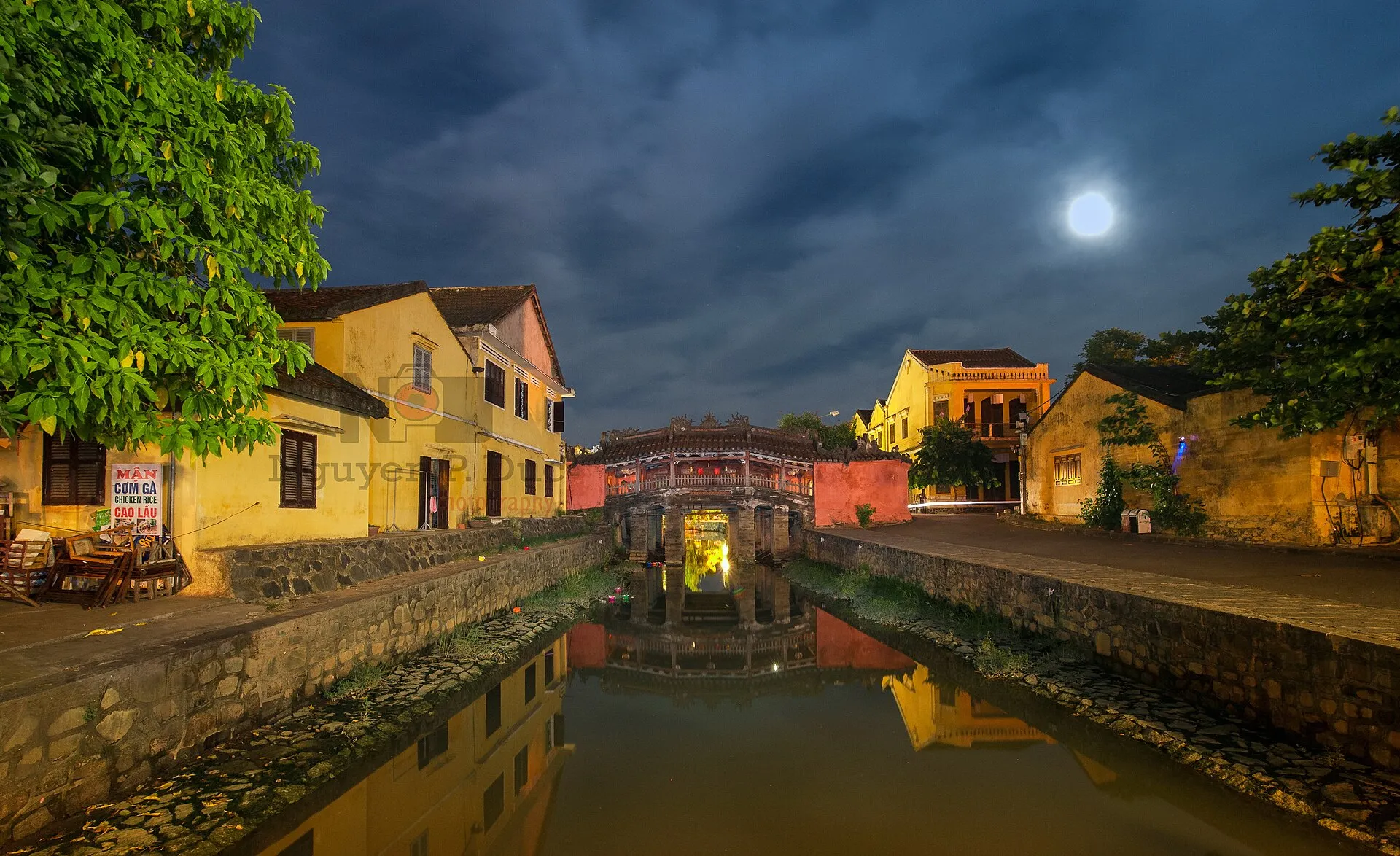
- Chua Cau on a full-moon night: Wikimedia Commons — Nguyen Phu Duc, CC0 (opens in a new tab) (CC0)
Common questions
Who built the Japanese Bridge in Hoi An, and when?
The heritage record says late 16th to early 17th century, with Japanese merchants providing the funds and the design and Vietnamese carpenters doing the work. The exact year is not known.
Why is it called a pagoda (chua)?
In 1653 the Chinese took over the bridge and added a bay jutting out of its middle; from then on locals called it a pagoda. The bay holds a statue of Bac De Tran Vo.
What does Lai Vien Kieu mean?
It means the bridge of people who come from far away; Lord Nguyen Phuc Chu gave the name in 1719. The two characters Lai Vien come from the Analects.
How long is the bridge and where is it?
It is about 18 m long and 3 m wide. It crosses a canal linking Tran Phu street and Nguyen Thi Minh Khai street.
Why are there dog and monkey statues at the ends?
The heritage record gives two views: a Japanese way of recording dates, or animals the Japanese revered. Another explanation: work began in the year of the Monkey and ended in the year of the Dog.
How many times has the bridge been restored?
Seven times according to the heritage record: 1653, 1763, 1817, 1865, 1915, 1917 and 1986. It was then dismantled for a full restoration from the end of December 2022 and reopened on 3 August 2024.
When did Chua Cau become a listed monument?
In 1990 the Ministry of Culture issued the certificate recognising it as a historic-cultural relic.
What is the legend of the Cu at Chua Cau?
The legend says that when the Cu stirs, Hoi An's streets collapse, and when it wags its tail Japan has earthquakes. The Japanese cast a golden sword and pinned it into its spine.
Read next
General information checked against the sources listed above, not legal advice for your situation. Rules and office practice change; confirm with the relevant office or a licensed adviser before you act. See how guides are checked.
Spotted an error? Report it.