Hoi An Assembly Halls: Five Chinese Congregations
Hoi An has five Chinese assembly halls, Fujian, Trung Hoa, Teochew, Quynh Phu and Quang Trieu, built by the Guangdong, Fujian, Teochew, Hainan and Gia Ung congregations. Four congregations had their own hall; Gia Ung used the common Trung Hoa hall. The Fujian hall dates from 1697, Teochew from about 1845; Quang Trieu's date is disputed.
In this guide
- What an assembly hall is, and why the Chinese needed one
- Minh Huong and the Five Congregations: two ways of being Chinese in Hoi An
- Five halls on one street
- The Fujian hall: the largest, with the most layers
- The Trung Hoa hall: the common house of the five
- The Teochew hall: chua Ong Bon
- The Quynh Phu hall: the Hainan temple
- The Quang Trieu (Cantonese) hall: when paper and beam disagree
- The five halls by age
- What the halls share
- The Quan Cong temple, next door to the five halls
- Visiting the halls
- Common questions
What an assembly hall is, and why the Chinese needed one
The Chinese came to Hoi An in two big waves. The first came at the start of the seventeenth century, mainly for trade. Merchants from Fujian arrived earliest and in greatest number. Once settled, they formed five congregations: Guangdong, Fujian, Teochew, Hainan and Gia Ung.
An assembly hall is where a congregation meets. Chinese far from home gather there, swap business experience and keep their feelings for home. It is also where the protector spirits and the forebears of each congregation are worshipped. The Chinese built four halls for four congregations and one common hall.
The Gia Ung congregation had no hall of its own and met in the common hall, the Trung Hoa hall.
In other words, each hall was at once a village hall, a place to talk trade and a temple for a group of fellow-countrymen. For the port as a whole, read Hoi An history.
Minh Huong and the Five Congregations: two ways of being Chinese in Hoi An
The Chinese of Hoi An were not one block. The first group were the Minh Huong, Chinese admitted as Dai Viet subjects by Lord Nguyen Phuc Lan, who founded the village of Minh Huong (1645-1653). The second group did not take Vietnamese nationality and kept their Chinese nationality, and the Viet usually called them Khach tru.
It was this second group that formed the five congregations and met in the halls. That is why they are also called the Five Congregation Chinese. The Trung Hoa hall, at 64 Tran Phu, is the common hall of all five.
Five halls on one street
All five halls stand on the north, even-numbered side of Tran Phu, the main street of the old town. The two farthest points of the temple and halls are less than 1 km apart. Viet temples and pagodas are different: they stand on the edge of the old town and are not packed into a cluster like this.
The halls were all built off the north-south axis, because the Chinese set great store by geomancy and consulted geomancers about the ground. When the halls were built, the Hoi An river still reached right to the south of Tran Phu street.
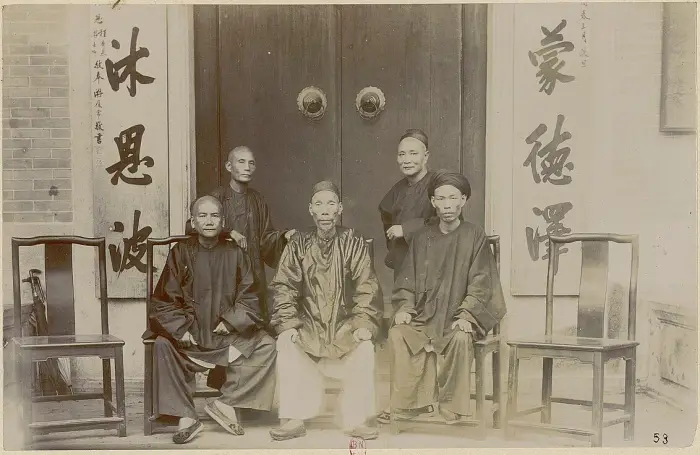
The photograph above shows the heads of the Chinese congregations of Faifo, taken between 1891 and 1898. It is in an album by the photographer Gustave Trumelet-Faber, kept at the National Library of France, which names the place “Fei-Foo”.
The Fujian hall: the largest, with the most layers
The Fujian hall is at 46 Tran Phu. It is the largest of the five. Its buildings cover 2000 sq m and run up to 100 m deep and 24 m wide. Only this hall has a rear hall, and it has the most columns, 86.
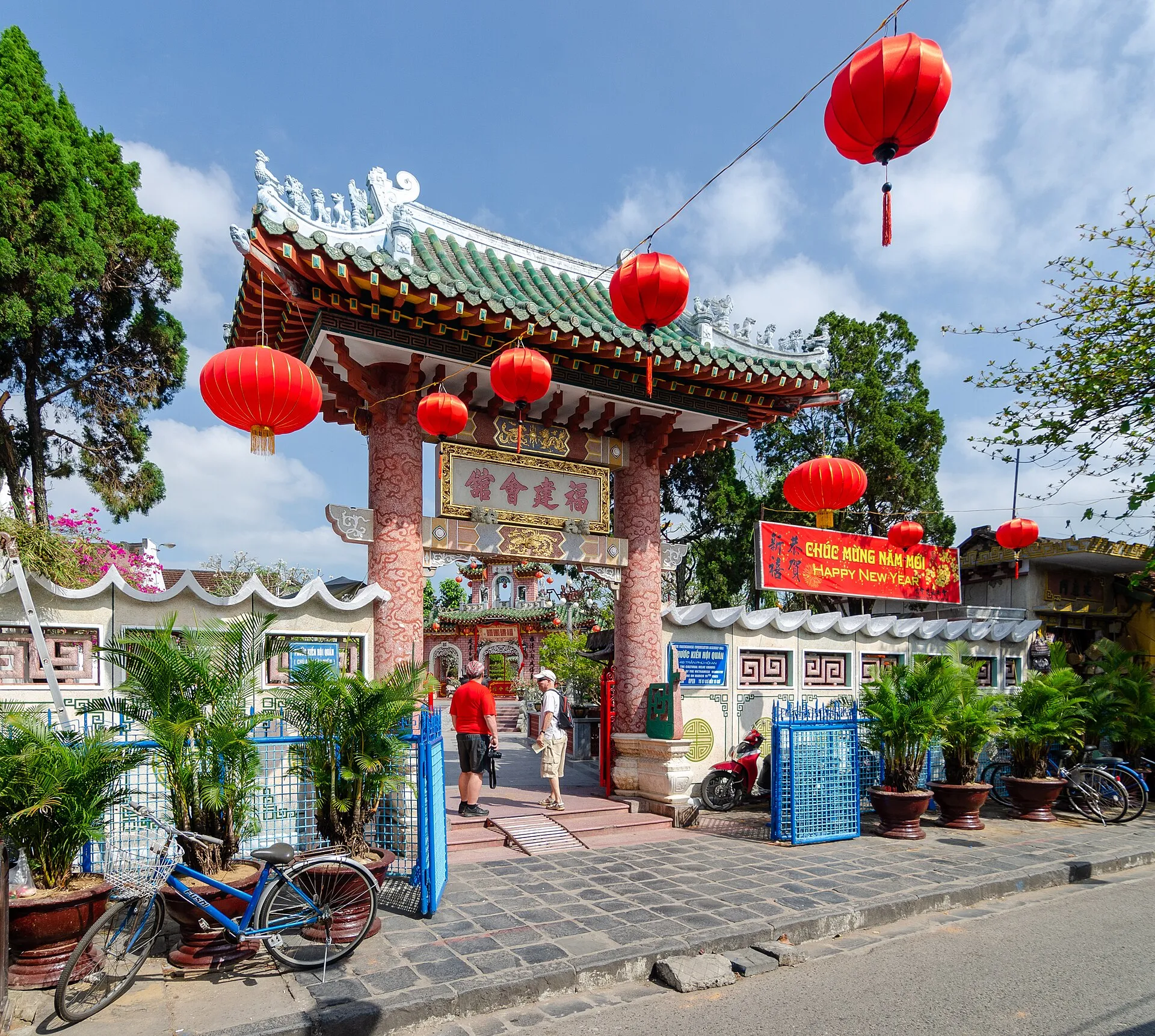
The hall was first built in 1697 as Kim Son Tu. From 1757 the Fujian congregation renovated it greatly and renamed it Phuoc Kien assembly hall.
In 1697, at the height of the trading port, Fujian merchants were coming to Hoi An in numbers and bought an old temple on the spot to build their hall. Legend says a Buddha statue drifted ashore with much gold on it, and villagers used the gold to pay for a temple.
The roof of the front hall is the most elaborately made and decorated. The ridge sags like a boat riding the waves. Among the beam inscriptions, two are dated 1849 and one 1895.
The main hall worships Thien Hau, protector of seafarers, as chief deity in the central bay. The rear hall worships Luc Tanh, six Ming-loyal Fujianese who rose against the Qing and failed.
Each year around the 16th of the second lunar month, Fujian descendants gather here from everywhere to honour the forebears. On that day four to five thousand people gather, so it is cramped. The biggest restoration ran from 1970 to 1974. The Ministry of Culture recognised the hall as a historic-cultural monument in the month of November.
The Trung Hoa hall: the common house of the five
The Trung Hoa hall is at 64 Tran Phu, facing Hoang Van Thu street, which runs straight to the Hoai River. It is the common hall of the five congregations, also called Thien Hau Ngu Bang because Thien Hau is worshipped in the central bay of the main hall. Stelae and Han-Nom documents date the hall to around 1741.
Only two halls have a phuong dinh, a pavilion for ritual: Trung Hoa and Quynh Phu. Of the five, Trung Hoa has 66 columns, the second most after Fujian.
The Teochew hall: chua Ong Bon
The Teochew hall is at 362 Nguyen Duy Hieu street, Son Phong ward, built in 1845. It was renovated in 1887 and 1970.
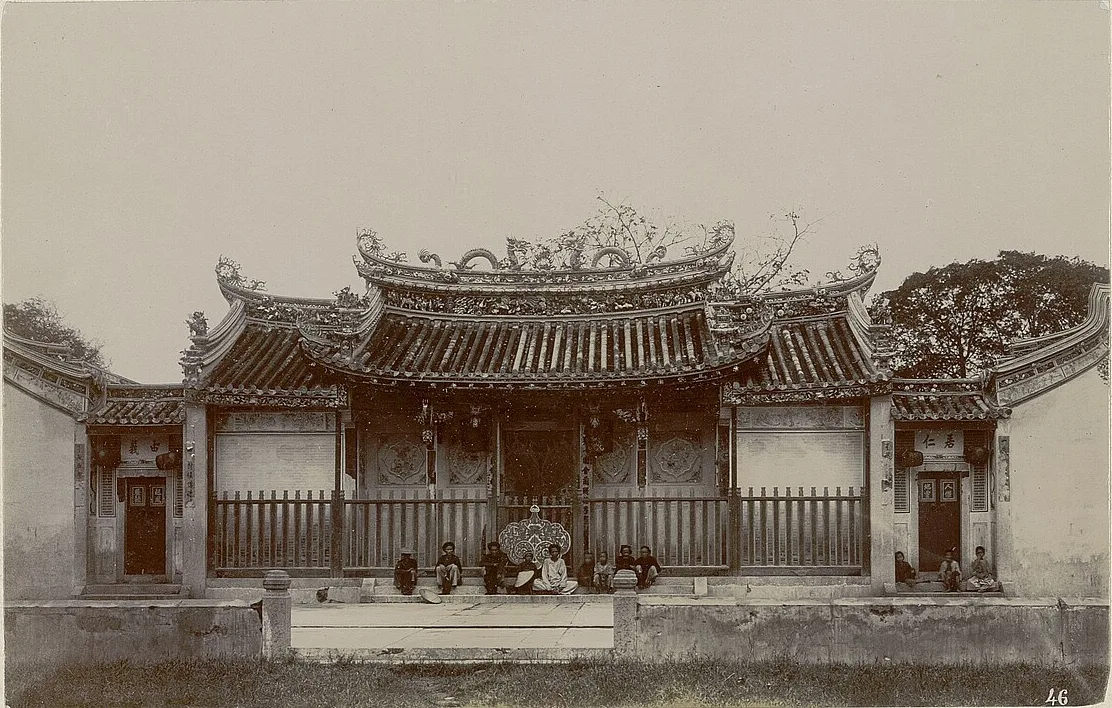
The photograph above shows the Teochew hall between 1891 and 1898. The hall has an open courtyard, and one beam in the main hall records 1885 and 1969.
The Teochew chose Ma Vien, General Phuc Ba, as chief deity. In the past Ong Bon was the main deity, so traders came to “borrow money” from him for luck.
The hall is also called chua Ong Bon or chua Am Bon, and the saying goes Thuong Chua Cau, ha Am Bon. On the full moon of the first lunar month the hall holds a prayer for blessings and the offering to the forebears.
The Quynh Phu hall: the Hainan temple
The Quynh Phu hall is at 10 Tran Phu. It was built around 1875 and greatly renovated in 1931. Its phuong dinh has a twin-roof found nowhere else, the most unusual roof in Hoi An.
The hall worships the 108 spirits on tablets. They were 108 Chinese who died in 1831 off Thu Xa, Quang Ngai province. After the facts were investigated, King Tu Duc conferred a title on them. On the full moon of the sixth lunar month the Hainanese hold a feast for them and make offerings to the forebears.
The Quang Trieu (Cantonese) hall: when paper and beam disagree
The Quang Trieu hall is at 176 Tran Phu, also called the Quang Dong hall. It stands out for its height, rising above the surrounding streetscape.
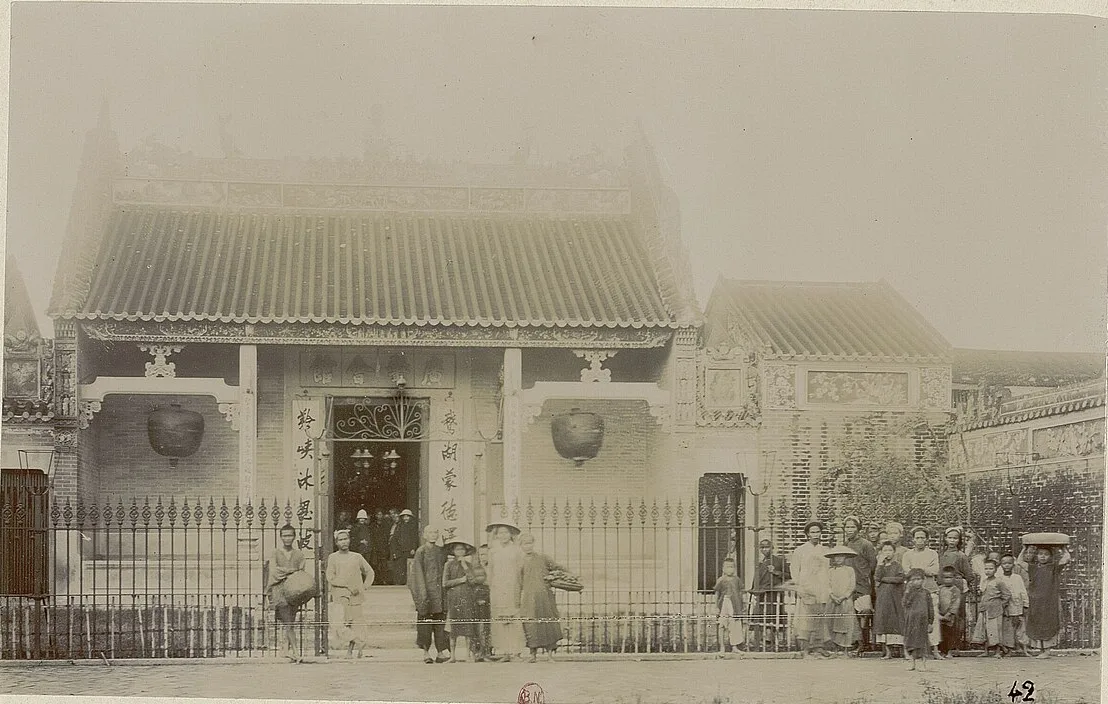
The old photograph above shows the front of the hall between 1891 and 1898.
This is the hardest hall to date. Many documents say it was built in 1885, the 11th year of Guangxu.
But the beam on the building records a repair in Guangxu 10, which is 1884. The incense basin in front of the main hall is dated Guangxu 9, 1883. So the repair came first and the construction after.
Some say the hall was first built at Thanh Chiem, west of Hoi An, and moved here in 1885, but no record has been found.
The safest way to put it: the hall was built in the late nineteenth century. Another detail: one of its beams carries two dates, 1884 and 1970, which shows the building was repaired many times.
The hall first worshipped Thien Hau. In 1915 Confucius was added in the centre, and a few years later all the central deities were replaced by Quan Thanh De Quan, as today. The main day of offerings is the 16th of the first lunar month. It had a major restoration in 1991, and as part of the old town it was recognised as a monument in 1990.
The five halls by age
Ordered by year of founding, the halls run as follows.
- Fujian: founded in 1697 as Kim Son Tu, greatly renovated from 1757.
- Trung Hoa: around 1741, according to stelae and Han-Nom documents.
- Teochew: 1845.
- Quynh Phu: around 1875.
- Quang Trieu: the late nineteenth century, the exact year disputed.
So the Fujian hall is the oldest and the Quang Trieu hall the youngest. The Minh Huong tam bao vu records, which the heritage file relies on, also put the Quang Trieu hall at around 1885. The order matches the order of the migrations: Fujian merchants arrived earliest, so the Fujian congregation also had the earliest hall.
What the halls share
Different congregations, but many shared features. Three halls have an open courtyard: Quang Trieu, Teochew and Fujian. Each main building has four central pillars called Tu Thien tru. Across the five halls, 176 columns are wooden.
The column counts give a sense of scale: Fujian 86, Trung Hoa 66, Quynh Phu 44, Teochew 30, Quang Trieu 24. In size the Fujian hall is first, then Quynh Phu, Trung Hoa and Quang Trieu; Teochew is the smallest.
The Quan Cong temple, next door to the five halls
Beside the five halls stands the Quan Cong temple at 24 Tran Phu. In the sixth year of Minh Mang the king passed the temple and gave 300 taels of silver. For traders in Hoi An market the temple meant something like an arbitrator or an economic court. The temple worships Quan Thanh, and the Quang Trieu hall later also chose Quan Thanh as chief deity.
Visiting the halls
Starting from the Japanese Bridge, follow the house numbers downward: Quang Trieu at 176, Trung Hoa at 64, Fujian at 46, Quynh Phu at 10. The Teochew hall is at 362 Nguyen Duy Hieu, a little further on.
Every visitor to the old town must buy a ticket from 15 May. It costs VND 120,000 for international visitors and VND 80,000 for Vietnamese. Ticket counters sell from 7:30 to 21:30 in summer and until 21:00 in winter. The ticket price corresponds to the number of sites visited.
For the old town in general, read Hoi An old town. To go on toward Da Nang, the limestone mountain where Japanese and Viet once gave money to build a pagoda is in Marble Mountains.
Photo credits
- Heads of the Chinese congregations of "Fei-Foo", photographed between 1891 and 1898: Wikimedia Commons — Gustave Trumelet-Faber album, BnF Gallica, public domain (opens in a new tab) (Public domain)
- The gate of the Fujian Assembly Hall: Wikimedia Commons — Steffen Schmitz (opens in a new tab) (CC BY-SA 4.0)
- The Teochew (Trieu Chau) Assembly Hall at "Fei-Foo", photographed between 1891 and 1898: Wikimedia Commons — Gustave Trumelet-Faber album, BnF Gallica, public domain (opens in a new tab) (Public domain)
- The Cantonese (Quang Dong) hall at "Fei-Foo", photographed between 1891 and 1898: Wikimedia Commons — Gustave Trumelet-Faber album, BnF Gallica, public domain (opens in a new tab) (Public domain)
Common questions
How many Chinese assembly halls are there in Hoi An?
Five: Fujian, Trung Hoa, Teochew, Quynh Phu and Quang Trieu. The Chinese built four halls for four congregations and one common hall.
Where did the Gia Ung congregation meet?
The Gia Ung congregation had no hall of its own and met in the common hall, the Trung Hoa hall.
When was the Fujian hall built?
The hall was first built in 1697 as Kim Son Tu, and from 1757 the Fujian congregation renovated it greatly and renamed it Phuoc Kien assembly hall. In 1697 Fujian merchants bought an old temple on the spot to build the hall.
Why do sources give different dates for the Quang Trieu hall?
Many documents say 1885, but the beam on the building records a repair in 1884 and the incense basin 1883, so the repair came before construction. Some say it was first built at Thanh Chiem and moved in 1885, but no record has been found.
Which hall is the largest?
The Fujian hall is the largest, then Quynh Phu, Trung Hoa and Quang Trieu; Teochew is the smallest. The Fujian hall has 2000 sq m of buildings and is up to 100 m deep.
What is the Teochew hall also called?
It is also called chua Ong Bon or chua Am Bon, tied to the saying Thuong Chua Cau, ha Am Bon. It has General Phuc Ba (Ma Vien) as its chief deity.
Who is worshipped in the Quynh Phu hall?
The 108 spirits, on tablets: 108 Chinese who died in 1831 off Thu Xa, Quang Ngai.
How much is the ticket to see the halls?
The old-town ticket is VND 120,000 for international visitors and VND 80,000 for Vietnamese. The ticket price corresponds to the number of sites visited.
Read next
- Hoi An History: The Faifo Trading Port and Old TownVerified 18 October 2026
- Hoi An Old Town: Heritage, Assembly Halls, TicketsVerified 18 October 2026
- Marble Mountains: History, Caves and the Stone VillageVerified 18 October 2026
- Cham Sculpture Museum, Da Nang: The Tourane GardenVerified 18 October 2026
General information checked against the sources listed above, not legal advice for your situation. Rules and office practice change; confirm with the relevant office or a licensed adviser before you act. See how guides are checked.
Spotted an error? Report it.