Thanh Ha Pottery Village, Hoi An: History, Clay and Kilns
Thanh Ha pottery village sits on the Thu Bon River, about 3 km west of Hoi An old town. Craftsmen from Thanh Hoa and Nghe An founded it around the sixteenth to seventeenth century. Its red ware uses brown Thu Bon clay, shaped without moulds or glaze and fired in wood kilns.
In this guide
- A red-clay village on the Thu Bon
- Six lineages from Thanh Hoa
- Bricks for the capital and the peak years
- Brown clay from the Thu Bon
- From the wheel to the wood kiln
- A village that nearly died
- The revival: old town and visitors
- Souvenirs and zodiac whistles
- The families that keep the craft
- The ancestral temple and the festival
- Before you go
- Common questions
A red-clay village on the Thu Bon
Thanh Ha (Thanh Hà) is a pottery village 3 km west of Hoi An old town, on the bank of the Thu Bon River. Locals also call it Nam Dieu (Nam Diêu). Since the administrative merger it lies in Hoi An Tay ward, Da Nang city.
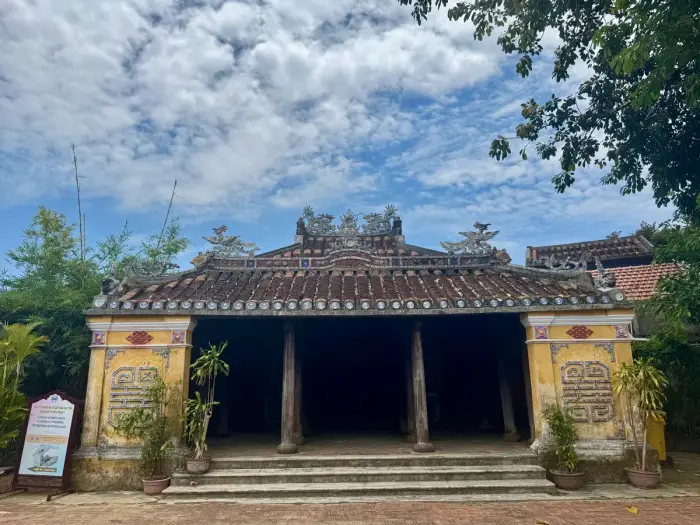
The village formed around the sixteenth to seventeenth century. Craftsmen from Thanh Hoa and Nghe An settled here and brought their craft with them. In 2019 the Ministry of Culture, Sports and Tourism added Thanh Ha pottery to the national intangible cultural heritage list. The village centre has 10 ranked monuments.
This page follows the pottery from its roots: the founders, the clay, the kiln and the village’s near collapse. It ends with the ancestor festival and a visiting guide. For the port context, read the history of Hoi An. For walking routes, see Hoi An old town.
Six lineages from Thanh Hoa
People from Thanh Hoa moved south to Quang Nam. Among them were six lineages with a pottery tradition in Thanh Hoa: Vo, Nguyen, Dinh, Ngo, Pham and Huynh.
On the Thu Bon bank they found clay that suited pottery and stopped to found a village. The name Thanh Ha means Thanh Hoa people living by the river.
The name is older than many people think. Research on old Vietnamese towns by the Institute of History shows the village name Thanh Ha existed before 1626.
The village’s ware went straight into the old port town. Thanh Ha supplied red brick for Hoi An’s old houses, plus jars, pots, jugs, vats and roof tiles.
Bricks for the capital and the peak years
At first the village made only lu jars, flower vases, bricks and tiles. Under the Nguyen, many potters were invited to Hue to make bricks and tiles for the citadel and the royal tombs.
The village was most prosperous in the first half of the nineteenth century. The Nguyen court listed it in the Dai Nam nhat thong chi, in the section on Quang Nam local products.
Brown clay from the Thu Bon
Northern pottery villages each have a signature clay. Tho Ha in Bac Giang uses green clay, Bat Trang in Hanoi uses white clay and Phu Lang in Bac Ninh uses yellow-brown clay. Thanh Ha takes brown clay along the Thu Bon, plastic and sticky.
An elderly potter says this clay gives the village something no other craft village has: ware with no glaze, only the colour of fired clay or natural red.
Potters mix, tread, knead and rest the clay until it is as fine as cake flour.
From the wheel to the wood kiln
Pieces are shaped by hand or on a foot-powered wheel. No mould is used, no glaze is applied and the firing is done in a traditional wood kiln. Shaping is the heart of the craft. Each piece takes form under the potter’s hands with no mould or ruler at all.
After shaping, a piece is left to firm up until it no longer feels sticky. Then it dries in the sun or in a corner of the kitchen before firing.
The kiln is stacked so pieces do not press on each other and space is saved. A firing lasts one to three days, depending on the product. A potter in the village puts the firing temperature at about 1,000 degrees Celsius.
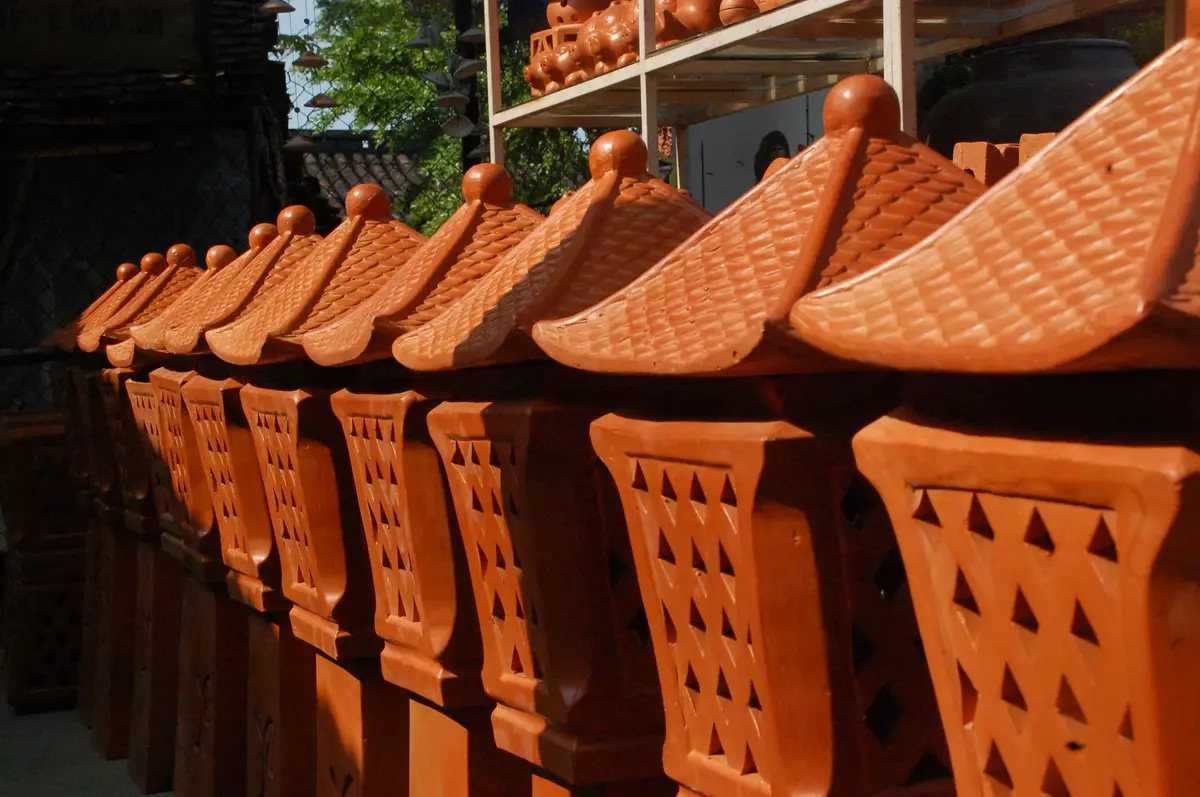
Fresh from the kiln, Thanh Ha ware is a typical red and rings when tapped, a sign of quality. It is lighter than ware from other regions. Everyday pieces include bowls, cups, jars, vats, flower vases, bonsai pots and animal models.
What about glaze? Older potters had their own glaze but used it only on stoneware jars, bricks and tiles. Glazed Thanh Ha ware is recent. One family rebuilt a glaze recipe made from clam shell, ash, chemicals and leaves.
A village that nearly died
By the 1930s only a few dozen households still made pottery. Silting and erosion on the Thu Bon took away nearly one third of the village.
One older potter points to a sandbank in the river. In the 1940s it was still joined to the village and held 3 large kilns.
A second blow followed. As the economy grew, modern ceramics, aluminium, steel and plastic flooded in and crushed the village’s pots, stoves, bowls and jars. By 2001, when Hoi An began running a visitor route through the village, only 8 workshops with 24 workers remained.
The revival: old town and visitors
UNESCO listed Hoi An old town as a World Heritage site in 1999. The pottery village then received a fresh wave of tourism. In 2004 Quang Nam province approved a project to restore the village alongside tourism for 2004 to 2007. The Nam Dieu ancestral temple and the Xuan My communal house joined the visitor route.
The numbers show the result. The village now has 32 workshops and 68 workers directly involved in its tourism. In 2023 it received nearly 600 thousand visitors, 93% of them international. That ranks third among Hoi An’s sights, behind only the old town and the Bay Mau coconut forest.
Pottery is also a key element of Hoi An’s place in the UNESCO Creative Cities network. The village has about 320 households and about 1,000 residents, and 105 of those households make pottery.
Souvenirs and zodiac whistles
Nam Dieu villagers now make whistle figures of the 12 zodiac animals, mould-cast art pottery, masks, statues and kitchen-god figures for tourism and the market. Visitors can knead clay by hand and make a souvenir of their own.
The families that keep the craft
Nguyen Viet Lam, 25, and his wife Tran Thi Tuyet Nhung work at the family’s own kiln. Counting Lam, his family has made pottery for at least 6 generations. His mother, Pham Thi My Dung, is a potter famous across the region.
Lam rebuilt the family’s own glaze recipe and applied it to souvenirs and decorative pieces. His family’s kiln sells hundreds of items a month across the country.
The ancestral temple and the festival
The village keeps two rites each year at the Nam Dieu ancestral temple. The spring rite opens the production year and the autumn rite closes it. A separate ancestor festival, held by the Nam Dieu villagers, falls in the middle ten days of the seventh lunar month.
In 2024 the festival followed old rites, including the procession of the ancestor palanquin and the main sacrifice. In 2025 it ran on 31 August and 1 September.
The palanquin procession starts from the Lum Ba Dang temple. It ends at the Nam Dieu temple, where the sacrifice takes place. The fair includes boat racing on the Thu Bon.
Before you go
The village lies 3 km west of the old town, by the Thu Bon River. You can walk between the workshops, watch potters shape clay, visit the Nam Dieu temple and Xuan My communal house, and knead your own souvenir.
Nearby is the Thanh Ha Terracotta Park. It covers 6,000 square metres, displays pottery and rebuilds famous buildings in terracotta. Come during the ancestor festival and you may see the procession, the rites and the boat racing together.
What should you buy? Bowls, cups, flower vases, bonsai pots or a zodiac whistle. Thanh Ha ware is lighter than the same kinds of pieces from other regions.
For a deeper read, the Hoi An heritage centre compiled and published the book “Làng Thanh Hà - Hội An” in 2024. It includes a chapter on the village’s Han-Nom documents. Afterwards, continue to the Hoai River in the old town.
Photo credits
- Photos and clips uploaded to Google Maps (Thanh Ha Pottery Village on Google Maps (opens in a new tab)) by T P, Pottery Tour.
Common questions
How old is Thanh Ha pottery village?
The village formed around the sixteenth to seventeenth century, when craftsmen from Thanh Hoa and Nghe An settled and brought the craft. The name Thanh Ha already existed before 1626.
What clay does Thanh Ha pottery use?
Brown clay taken along the Thu Bon River, which is plastic and sticky. Potters mix, tread and rest it until it is as fine as cake flour.
How is Thanh Ha pottery different from Bat Trang?
Bat Trang uses white clay, Tho Ha green clay and Phu Lang yellow-brown clay; Thanh Ha uses brown Thu Bon clay. Thanh Ha ware is lighter and is shaped without a mould or glaze.
When is the pottery ancestor festival?
The Nam Dieu villagers hold it every year in the middle ten days of the seventh lunar month. In 2025 it ran on 31 August and 1 September.
How far is the village from Hoi An old town?
About 3 km to the west, on the Thu Bon River. Since the merger of Quang Nam into Da Nang it belongs to Hoi An Tay ward.
Can visitors try making pottery?
Yes. Visitors can knead clay by hand and make their own souvenirs.
When did Thanh Ha pottery become national heritage?
In 2019 the Ministry of Culture, Sports and Tourism added Thanh Ha pottery to the national intangible cultural heritage list.
Read next
- Hoi An History: The Faifo Trading Port and Old TownVerified 18 October 2026
- Hoi An Old Town: Heritage, Assembly Halls, TicketsVerified 18 October 2026
- Hoai River, Hoi An: History, Lanterns and Boat RidesVerified 18 October 2026
- Kim Bong Carpentry Village, Hoi An: History, Guilds, VisitVerified 18 October 2026
General information checked against the sources listed above, not legal advice for your situation. Rules and office practice change; confirm with the relevant office or a licensed adviser before you act. See how guides are checked.
Spotted an error? Report it.