Kim Bong Carpentry Village, Hoi An: History, Guilds, Visit
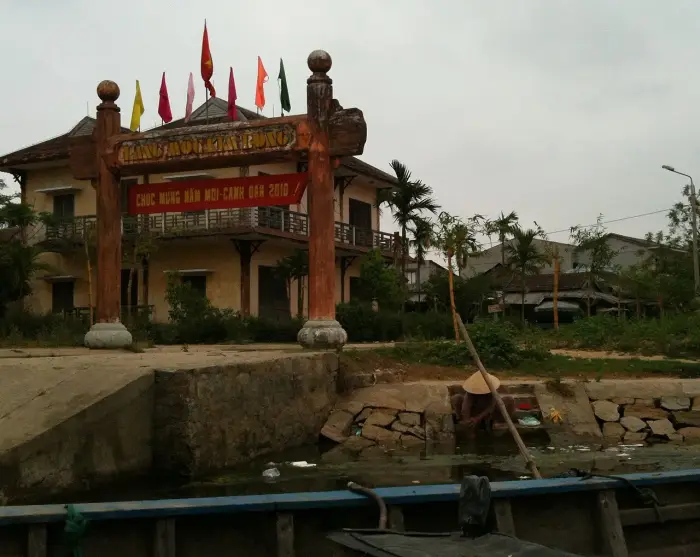
Kim Bong carpentry village lies across the Thu Bon river, 1.31 km from central Hoi An as the crow flies. Tradition says the craft's founder came from Thanh Hoa in the sixteenth century. Its carpenters played the main role in building Hoi An's houses, chapels and pagodas. Ancestor day is the sixth of the first lunar month.
In this guide
- Which village is Kim Bong
- Where the carpenters came from
- Four branches, one speciality per hamlet
- The guilds: how the craft is organised
- The carpenters and the old town of Hoi An
- From Kim Bong to Hue
- Building a timber house in Kim Bong
- Ghe bau and fishing boats
- The Tien Hien communal house: home of the craft ancestor
- Ancestor day on the sixth of the first month
- Recognition
- Visiting the village
- Read on
- Common questions
Which village is Kim Bong
Kim Bong (Kim Bồng) sits across the Thu Bon river, facing the Hoi An ancient town to the north. As the crow flies it is 1.31 km south-west of central Hoi An. Water wraps the village on three sides, right beside the international trading port.
That is a good spot for a village of craftsmen: a river to float timber in and a busy port to sell to. The village now belongs to Hoi An ward, Da Nang city, formerly Cam Kim commune in the old Quang Nam province. In the old days Kim Bong was a chau, a small district, of Duy Xuyen.
This page follows the craftsmen: where they came from, how they organised the trade and what they built in Hoi An. It ends with the ferry and the ticket. The wider setting is in the history of Hoi An. The buildings the carpenters restored are in the Hoi An assembly halls and the Japanese Bridge.
Where the carpenters came from
Tradition among the Nguyen, Phan, Huynh and Truong families of Cam Kim holds that the craft’s founder came from Thanh Hoa and settled here in the sixteenth century.
The founding is placed more precisely around the end of the fifteenth and start of the sixteenth century. Ancestors of the four clans were among the settlers opening new land. They chose Kim Bong as the place to found a village. The Huynh and Truong lines have since passed through fifteen to sixteen generations.
The first carpenters began with traditional thatch-and-bamboo houses and moved on to ordinary timber-frame houses. Hoi An prospered fast from the late sixteenth to the seventeenth century, and the village craft grew with the port.
The craftsmen kept learning from their neighbours. They took boat-building techniques from the Cham, and civil and religious architecture and household-goods making from the Chinese and Japanese. Folk tales speak of Thay Thiem, a Cham sorcerer couple who built ghe bau, sea-going trading boats, for the Viet. That is a folk tale, not history.
Four branches, one speciality per hamlet
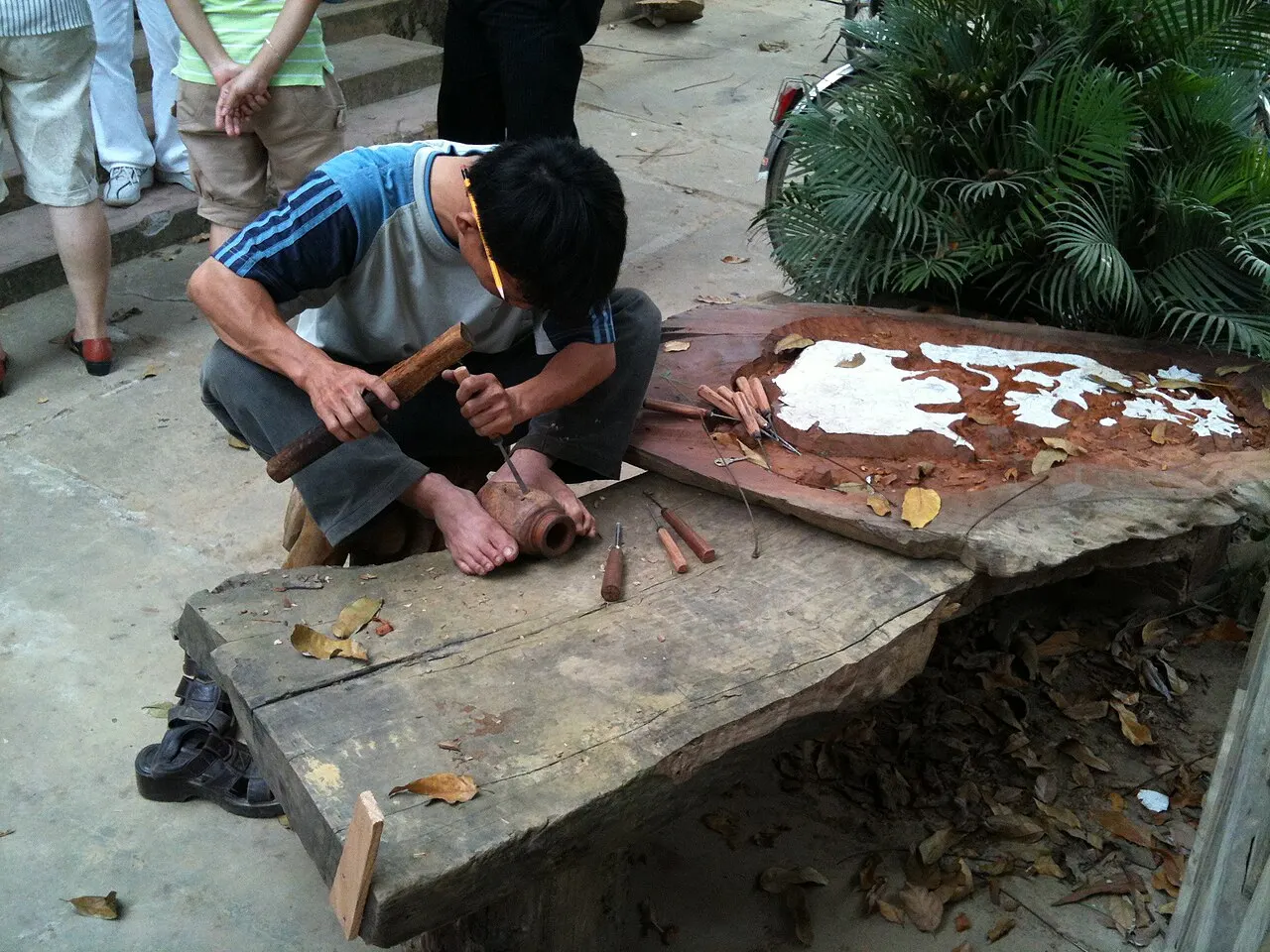
Kim Bong carpentry has four branches: building carpentry, household furniture, art carving and boat building. Each hamlet leans toward one.
Trung Chau and Phuoc Thang specialise in art carving and building. Dong Ha and Ngoc Thanh lean toward boat building. Trung Ha and Vinh Thanh are the home of household furniture.
Besides carpentry the village weaves bamboo, makes clogs, weaves sedge mats and grows mulberry for silk. So a walk through the village brings you to carvers as well as mat weavers and basket makers.
The guilds: how the craft is organised
The word “guild” (hiep tho) sounds ancient, but it is real here. The guilds of the village gather at the Tien Hien communal house to honour the craft ancestor on the sixth day of the first lunar month.
Day to day, carpenters work in two ways: as independent craftsmen, or in a workshop, a trai. Small workshops have 2 to 5 people, large ones 15 to 50.
In a workshop the owner is the master carpenter. He handles the money, the deals and the contracts, and pays the workers. Newcomers start with simple jobs such as sharpening saws, planing and chiselling. Apprentices get no wage, only meals from the owner.
It usually takes 3 to 5 years to become a skilled carpenter. Becoming an artisan takes 15 to 20 years of honing the craft. The work is heavy and dangerous, so almost only men do it. A few workshops have women, mostly for finishing and polishing.
The idea of boat-carpenter guilds has old roots too. The Binh Nam map, drawn in the seventeenth century under the Nguyen lords, marks a place called Chu Tuong. Chu Tuong can be read as a boat yard where guilds of boat carpenters lived and worked.
In the eighteenth century Le Quy Don counted 10 communes, 11 hamlets, 40 phuong (guild wards) and 1 clan specialised in boat building in Duy Xuyen district. Kim Bong belonged to that district.
The carpenters and the old town of Hoi An
Look up at the roof frame of an old house or an assembly hall in Hoi An and you are looking at Kim Bong skill. Kim Bong carpentry played the main role in building the town houses, clan chapels, communal houses, pagodas and temples of Hoi An.
The restorations on record include the Thien Hau shrine in the Ngu Bang (Five Congregations) hall. They also include Chuc Thanh and Phuoc Lam pagodas, the Pham clan chapel, the Minh Huong Tuy Tien Duong and the Confucius temple.
Keep these addresses in mind in the old town. The story of each hall is in the Hoi An assembly halls and the streets are in the old town guide.
The Japanese Bridge is a familiar subject for the village too. A relief of the bridge by Kim Bong carvers won a national bronze medal in 1987. Models of the bridge, old houses, rong houses and ghe bau are village art products.
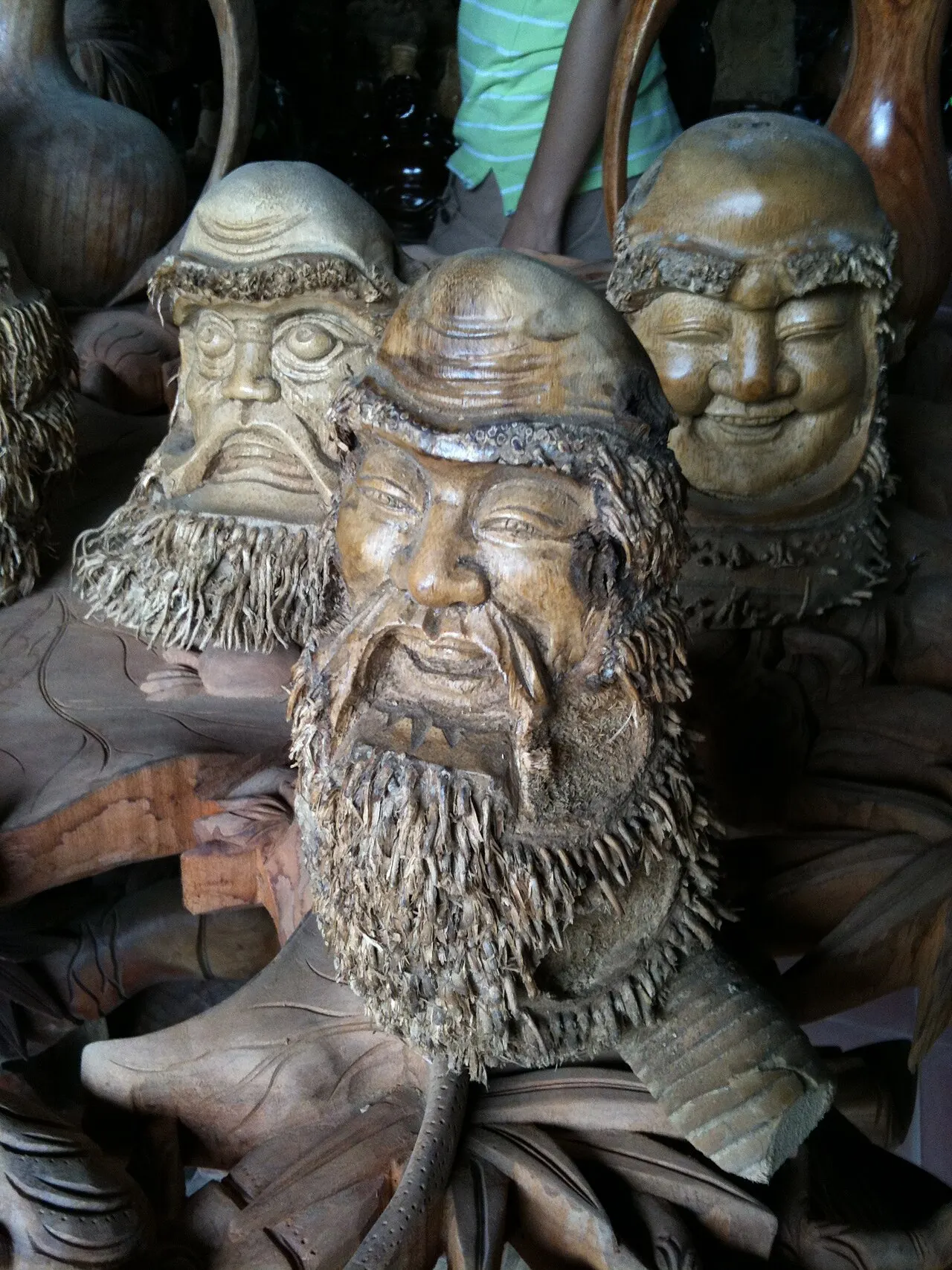
Kim Bong carving did not stay in town. Together with Thanh Ha pottery, carved Kim Bong wood was bought in large quantities by Western traders and resold to Japan and Malaya. Some art products still go to Europe, North America and Australia today.
From Kim Bong to Hue
The skill travelled further than Hoi An. Many carpenters of the village were recruited by the Nguyen court to Hue to build palaces and royal tombs. They were given the title Cong Tuong and the ranks of eighth and ninth grade. For a village craftsman it was a great honour.
Building a timber house in Kim Bong
Building carpentry is the branch that gives the Kim Bong brand its own identity. Its method includes rituals.
The carpenter has the timber sawn according to each part of the house. Then comes the first-plane ritual, le phat moc. He planes the ridge beam smooth and keeps some shavings for the closing ritual, le dua dam tong moc.
Lim and kien kien are the most used woods for houses. The timber is bought upriver on the Thu Bon, in places such as Tra My and Tien Phuoc. It is tied into rafts and floated down to the village landings.
On beams and rafters the carpenters carve motifs of the eight treasures, the four seasons, fortune, prosperity and longevity, crab-shell rafters and carp. When you look at an old house, look up at those carvings.
Ghe bau and fishing boats
Kim Bong also builds boats. Boat carpenters keep their own rituals: first cut, pinning, laying the beam, covering, dotting the eyes, launching and sending off the shavings. A boat ends with caulking the gaps with bamboo fibre mixed with resin, then the eyes are dotted and the boat is launched.
Boat timber is left as whole logs under water for one to two months to get used to water. Long thick timbers are bent through fire at high temperature to form the curve of the hull. Ghe bau building in Kim Bong absorbed European, Chinese and Cham elements.
Boats built in Kim Bong earned a name for durability and wave resistance, with a lifespan of more than 20 years. In the seventies and eighties of the last century, boat owners from Quang Nam, Quang Ngai, Khanh Hoa and Binh Dinh came to Kim Bong to order large fishing boats. Today the yards also build tourist boats.
The Tien Hien communal house: home of the craft ancestor
The Tien Hien communal house (Đình Tiền Hiền) stands next to Kim Buu pagoda. It was built by the hands of village carpenters. Going by the dated beams, it was built in the sixth year of Tu Duc (1853).
It was restored in the eighth year of Duy Tan (1914) and under Bao Dai (1941). It was ranked a provincial architectural-art monument in 2008. The Phan Xuan clan chapel of the village was ranked a national monument in 1991.
The house faces south, with a three-gate screen and four pillars in front of the yard. The main building has three bays, two inner halls and a veranda. In the middle hall stands a wooden altar about 1.2 m high, red-lacquered and gilded.
Behind the altar, high up, hangs a board with three Chinese characters, Thanh To mieu. The front hall also holds an altar dated 1827.
The house honours the pioneering founders of four clans: Nguyen, Huynh, Phan and Truong. On the twentieth of the twelfth lunar month villagers gather here for a year-end meeting combined with the memorial of the founders.
Ancestor day on the sixth of the first month
This is the day of the whole craft village. On the sixth day of the first lunar month the craft-ancestor ceremony is held at the Tien Hien house. Offerings go also to the village guardian, the founders and wandering souls.
Carpenters who work far away come home for Tet and all lend a hand. Offerings usually include a pig’s head and a whole boiled chicken with its feet.
The ceremony includes the custom of marking the first measuring line of the year, that is, measuring timber to start the working year. After the offering, people read the shape of the chicken feet to foretell the village’s luck for the year. The day also counts as the day the work crews open for business.
On the altar side, Kim Bong carpenters have no ancestor of their own. They worship Lo Ban and Lo Boc together. Every carpenter’s house has an altar to the craft ancestor in a place of honour. The festival side has included boat racing, sack races, pot smashing, bai choi calling and a food fair.
Recognition
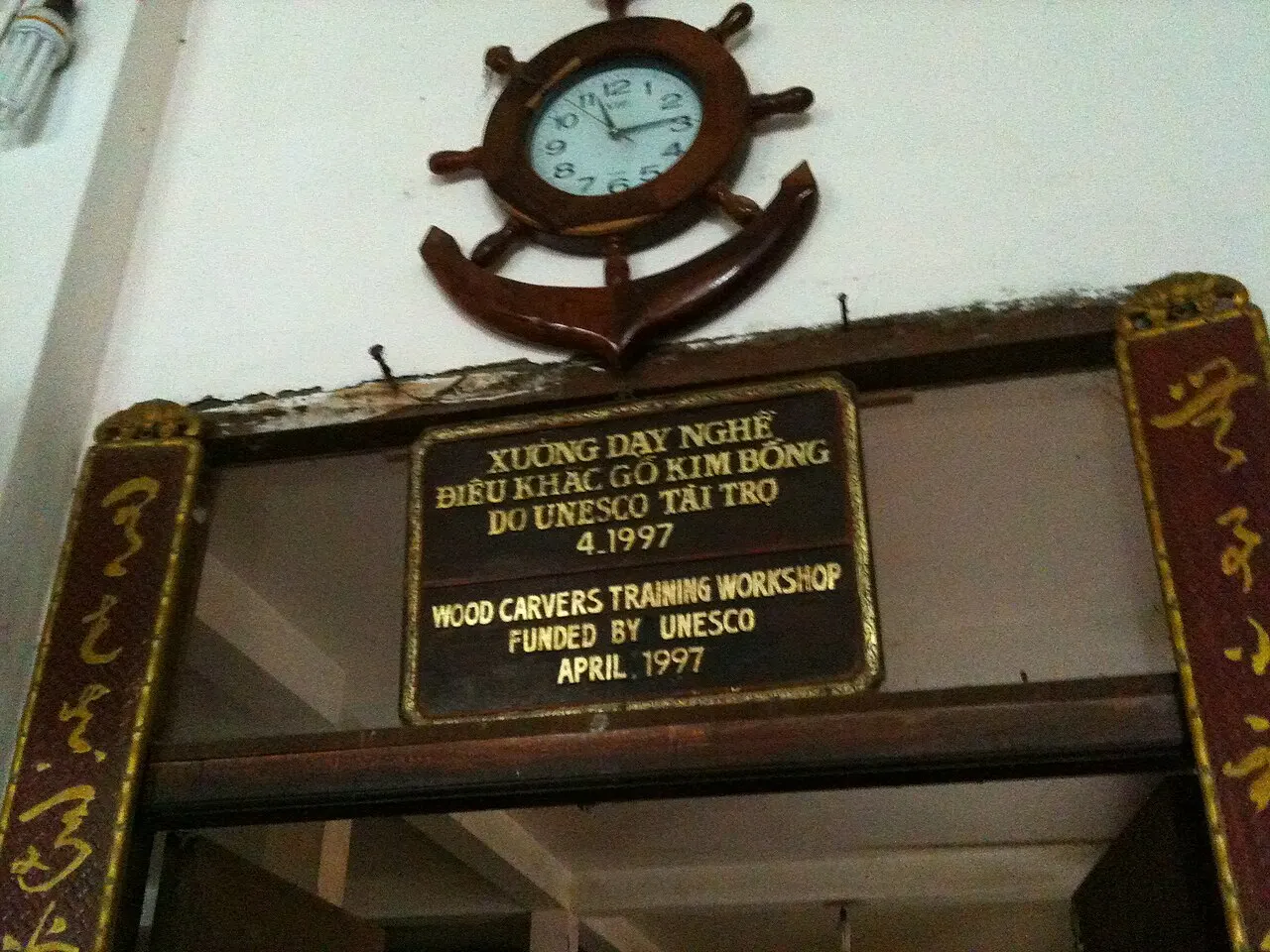
In 2000 the Asia-Pacific office of UNESCO gave an award for outstanding cooperation in old-town conservation. In 2001 the same office gave a Special Achievement award for the conservation of Kim Bong carpentry village.
In 2005 Kim Bong was recognised as a traditional craft village. In June 2016 the Ministry of Culture, Sports and Tourism recognised Kim Bong carpentry as national intangible cultural heritage.
Visiting the village
Getting there. From the Hoi An ferry landing, a boat across the Thu Bon takes about 15 minutes to reach the craft area. You can also come by river or by road to the craft village centre.

What to see. The guided visit covers an introduction to the village’s history and culture and a display house of traditional crafts. At the display house, crafts of the old village are demonstrated, such as mat weaving and basket weaving. You can also watch the boat repair yards and walk to Cam Kim market, where daily life goes on.
Tickets. When the guided visit was launched the adult ticket was 35,000 dong. A group of 15 gets one ticket off. Children living in Hoi An go free and children from elsewhere pay half.
Ticket holders receive a souvenir made in a traditional Cam Kim craft. Ask at the craft village centre before you go, because the 35,000 dong price was set when the visit opened.
When to go. The start of the year has the ancestor day and the festival. In 2026 the Kim Bong Traditional Craft Village Festival opened at the Kim Bong Craft Village Centre. The Tien Hien ceremony took place on the morning of 28 February at the Tien Hien house.
The festival showed carpentry, bamboo carving, boat building, basket weaving, noodle sheets, sedge splitting and mat weaving. It also had a village market and cross-river boat racing.
Kim Bong is the right stop for a morning. At lunch, back in the old town, a bowl of cao lau carries on the port story you have just walked through.
Read on
The history of Hoi An sets the port scene. The Hoi An assembly halls and the Japanese Bridge are buildings that Kim Bong carpenters laid their hands on. The Hoai River is the water that fed the whole port.
Photo credits
- The gate of Kim Bong village, seen from the river: Wikimedia Commons — Dragfyre (opens in a new tab) (CC BY-SA 3.0)
- A carver at work in Kim Bong: Wikimedia Commons — Dragfyre (opens in a new tab) (CC BY-SA 3.0)
- Carved heads, a typical art-carving product of the village: Wikimedia Commons — Dragfyre (opens in a new tab) (CC BY-SA 3.0)
- A sign at a carving training workshop funded by UNESCO: Wikimedia Commons — Dragfyre (opens in a new tab) (CC BY-SA 3.0)
- The ferry across the Thu Bon between Hoi An and Kim Bong: Wikimedia Commons — Dragfyre (opens in a new tab) (CC BY-SA 3.0)
Common questions
Where is Kim Bong carpentry village and how far is it from Hoi An old town?
It lies on the lower Thu Bon river, 1.31 km south-west of central Hoi An as the crow flies. From the Hoi An ferry landing, a boat across the river takes about 15 minutes.
How old is Kim Bong carpentry village?
The oral tradition of the Nguyen, Phan, Huynh and Truong clans says the founder of the craft came from Thanh Hoa and settled here in the sixteenth century. Ancestors of these four clans chose Kim Bong to found a village around the end of the fifteenth and start of the sixteenth century.
Which Hoi An buildings did Kim Bong carpenters work on?
Kim Bong carpentry played the main role in building the town houses, clan chapels, communal houses, pagodas and temples of Hoi An. The carpenters restored the Thien Hau shrine in the Ngu Bang hall, Chuc Thanh and Phuoc Lam pagodas, the Minh Huong Tuy Tien Duong and the Confucius temple.
When is the Kim Bong ancestor day?
On the sixth day of the first lunar month at the Tien Hien communal house. The day also counts as the day the work crews open for business.
How much is the ticket to visit Kim Bong?
When the guided visit was launched, the adult ticket was 35,000 dong and ticket holders received a souvenir made in a traditional Cam Kim craft. Children living in Hoi An go free and children from elsewhere pay half.
When did Kim Bong carpentry become national heritage?
In June 2016 the Ministry of Culture recognised Kim Bong carpentry as national intangible cultural heritage. In 2005 the village had been recognised as a traditional craft village.
Do Kim Bong craftsmen only make furniture?
No. The craft has four branches: building carpentry, household furniture, art carving and boat building. The village also has bamboo weaving, clog making, mat weaving and silk-mulberry growing.
Read next
- Hoi An History: The Faifo Trading Port and Old TownVerified 18 October 2026
- Hoi An Assembly Halls: Five Chinese CongregationsVerified 18 October 2026
- Japanese Bridge in Hoi An (Chua Cau): History, Design and LegendsVerified 18 October 2026
- Hoi An Old Town: Heritage, Assembly Halls, TicketsVerified 18 October 2026
General information checked against the sources listed above, not legal advice for your situation. Rules and office practice change; confirm with the relevant office or a licensed adviser before you act. See how guides are checked.
Spotted an error? Report it.