My Son Sanctuary: History, Towers, Tickets and Transport
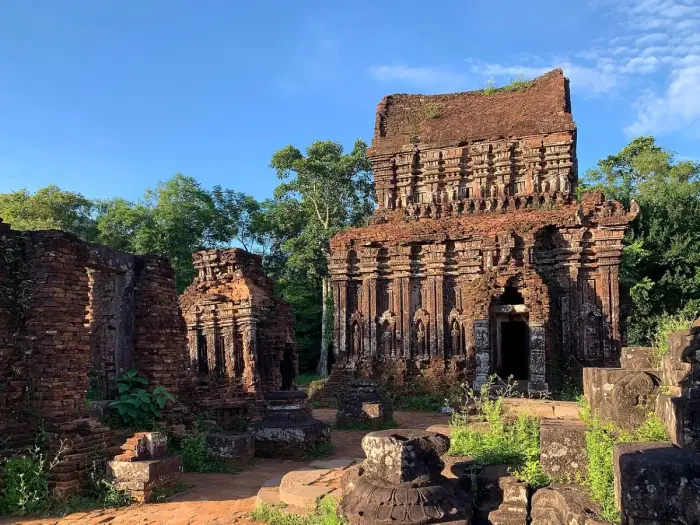
My Son is the sanctuary of the Champa kingdom, its religious and political capital for most of the kingdom's existence. The towers date from the fourth to the thirteenth century, and UNESCO listed the site in 1999. It lies in Thu Bon commune, Da Nang, about 40 km from Hoi An. The posted ticket is VND 150,000 for foreigners.
In this guide
- What My Son is
- From a wooden temple to brick towers: the history of My Son
- Brick towers with no glue and no mortar
- How a tower group is laid out
- The ancient paved road
- Forgotten for centuries
- Tower A1, a lost masterpiece
- War, conservation and what remains
- What to see inside
- Tickets and opening hours
- Getting there from Hoi An or Da Nang
- When to go and what to bring
- What to eat around My Son
- Common questions
What My Son is
My Son (Mỹ Sơn) is a complex of Champa temple towers in Thu Bon (Thu Bồn) commune, Da Nang city. The whole site is only about 2 km across, enclosed in a valley among mountains. It is a sanctuary and also the religious and political capital of the Champa kingdom for most of its existence.
The valley is the source of the Thu Bon river, which flows toward the Hoi An area.
UNESCO listed My Son in 1999.
The first reason is that it is an exceptional example of cultural interchange: an indigenous society adopted Hindu art and architecture from India. The second is that the Champa kingdom was an important part of the political and cultural history of South-East Asia, and My Son is its clearest witness. In Vietnam, My Son became a National Site in 1979 and a Special National Site in 2009.
From a wooden temple to brick towers: the history of My Son
Construction began in the fourth century under King Bhadravarman (reigned 349 to 361). According to the surviving inscriptions, that first temple was wooden, and a great fire burned it down more than two centuries later.
In the early seventh century King Sambhuvarman rebuilt it in brick. Later kings kept adding towers until the late thirteenth or early fourteenth century, under King Jaya Simhavarman III.
The Cham worshipped Hindu gods such as Krishna and Vishnu, but above all Shiva. So the main temples here hold a Linga or an image of Shiva.
The whole site has just one temple built of stone, which is also the only stone temple among all Cham monuments. An inscription records its last restoration in stone in 1234, left unfinished.
Brick towers with no glue and no mortar
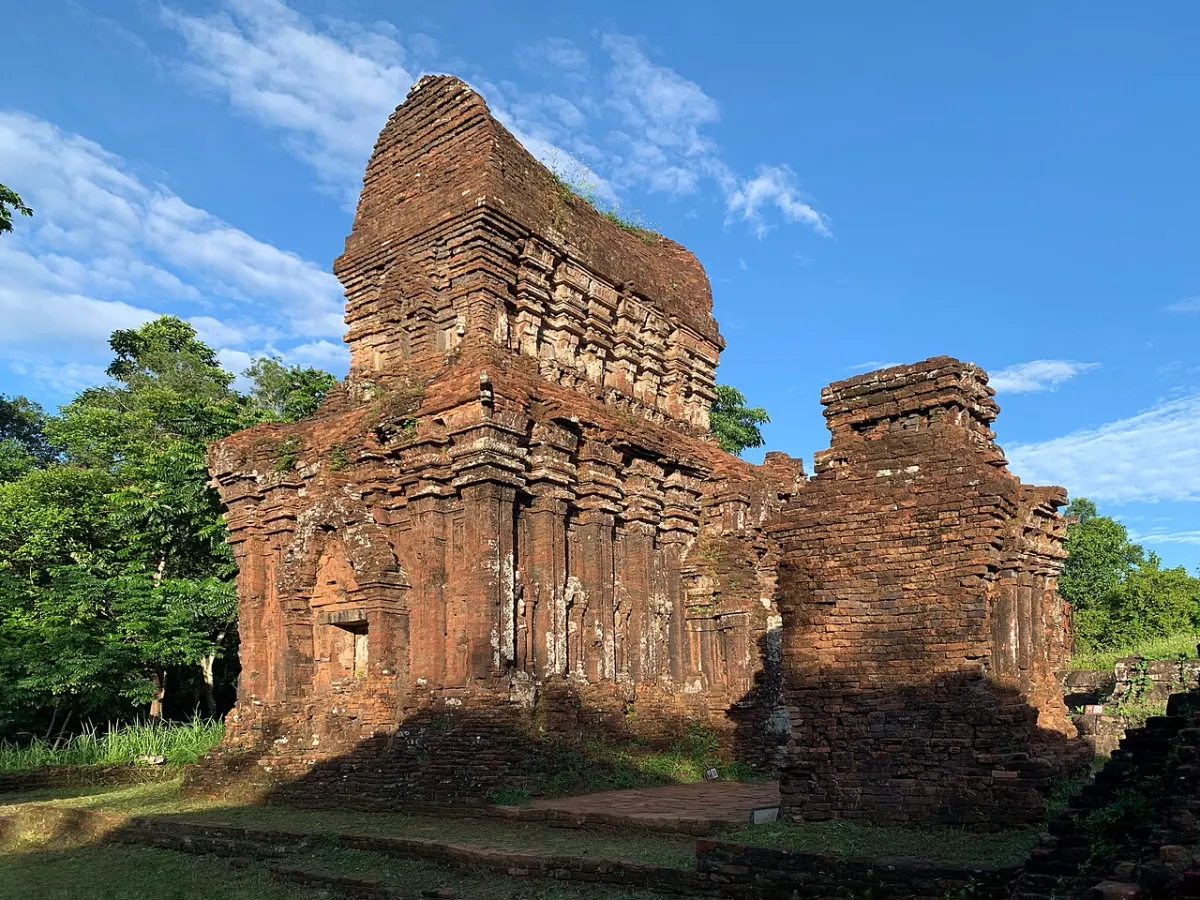
The towers are fired brick with stone pillars, decorated with sandstone bas-reliefs telling scenes from Hindu mythology. What people remember most is the bricklaying. Each brick was fired and cut into a precise block, then stacked without any adhesive. After centuries of sun and rain the towers still stand, and the secret has never been explained.
Each tower is a temple whose design symbolises Mount Meru, the mythical mountain home of the Hindu gods.
How a tower group is laid out
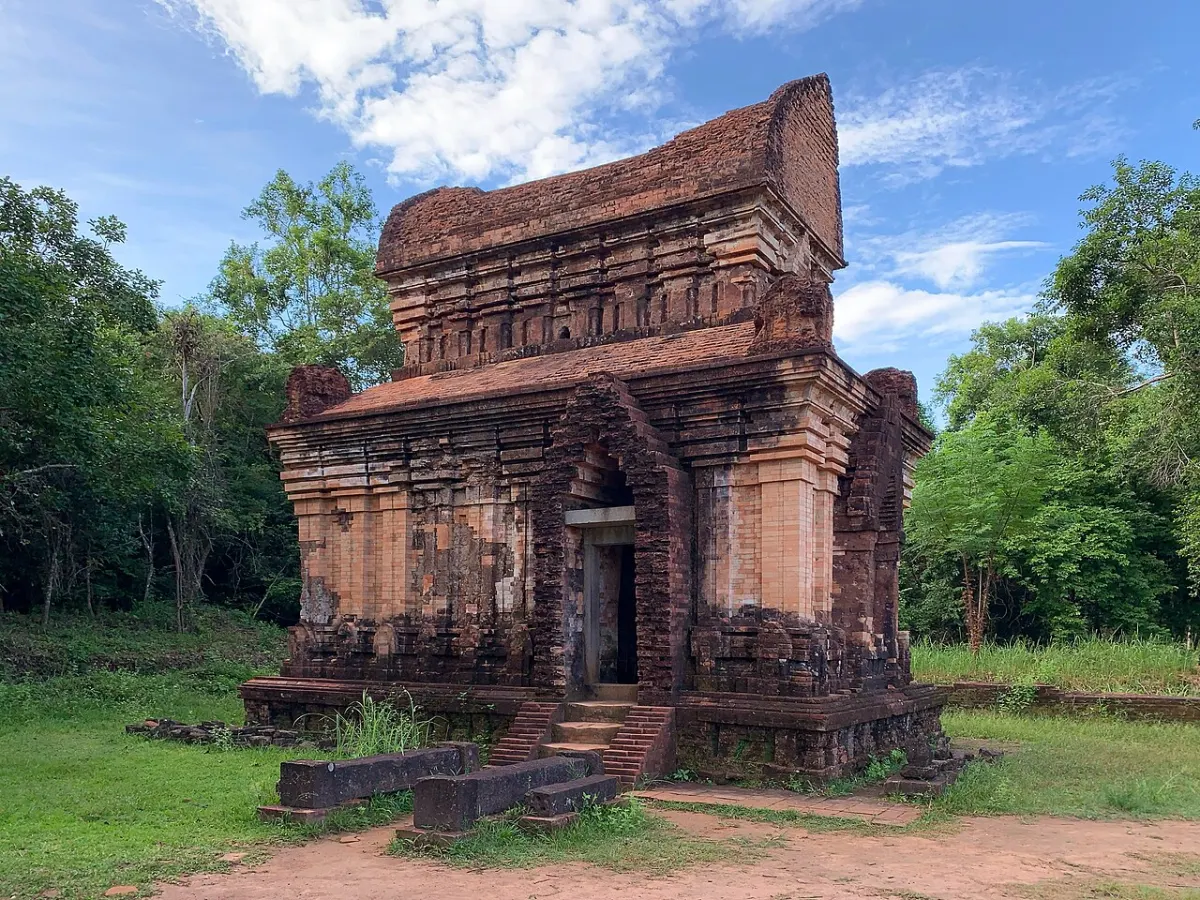
Every group at My Son follows the same pattern. In the middle stands the main tower, the kalan, surrounded by several small towers. In front of each group is a gate tower (gopura), then a vestibule (mandapa). Tower doors usually face east to receive the sun.
Worshippers once walked clockwise around the tower on a small path.
Group B, facing group A, is the central group of the sanctuary. Groups B, C and D are the most prominent and centre on the worship of Shiva.
The ancient paved road
Few visitors notice that My Son also has an ancient paved road, up to 8 m wide, linking the main temple areas. Kings and ritual processions once walked this road during great ceremonies. Standing in the valley, try to picture such a procession. It is the easiest way to see why this place is called a sanctuary.
Forgotten for centuries
After the Champa kingdom declined, My Son sank into oblivion for centuries and was only found again in 1885.
French scholars then went step by step. In 1898-1899, Louis Finot and Launet de Lajonquière read the inscriptions. In 1901-1902, Henri Parmentier studied the art of the towers, and an archaeological excavation followed in 1904. By Parmentier’s count, My Son then had 68 structures.
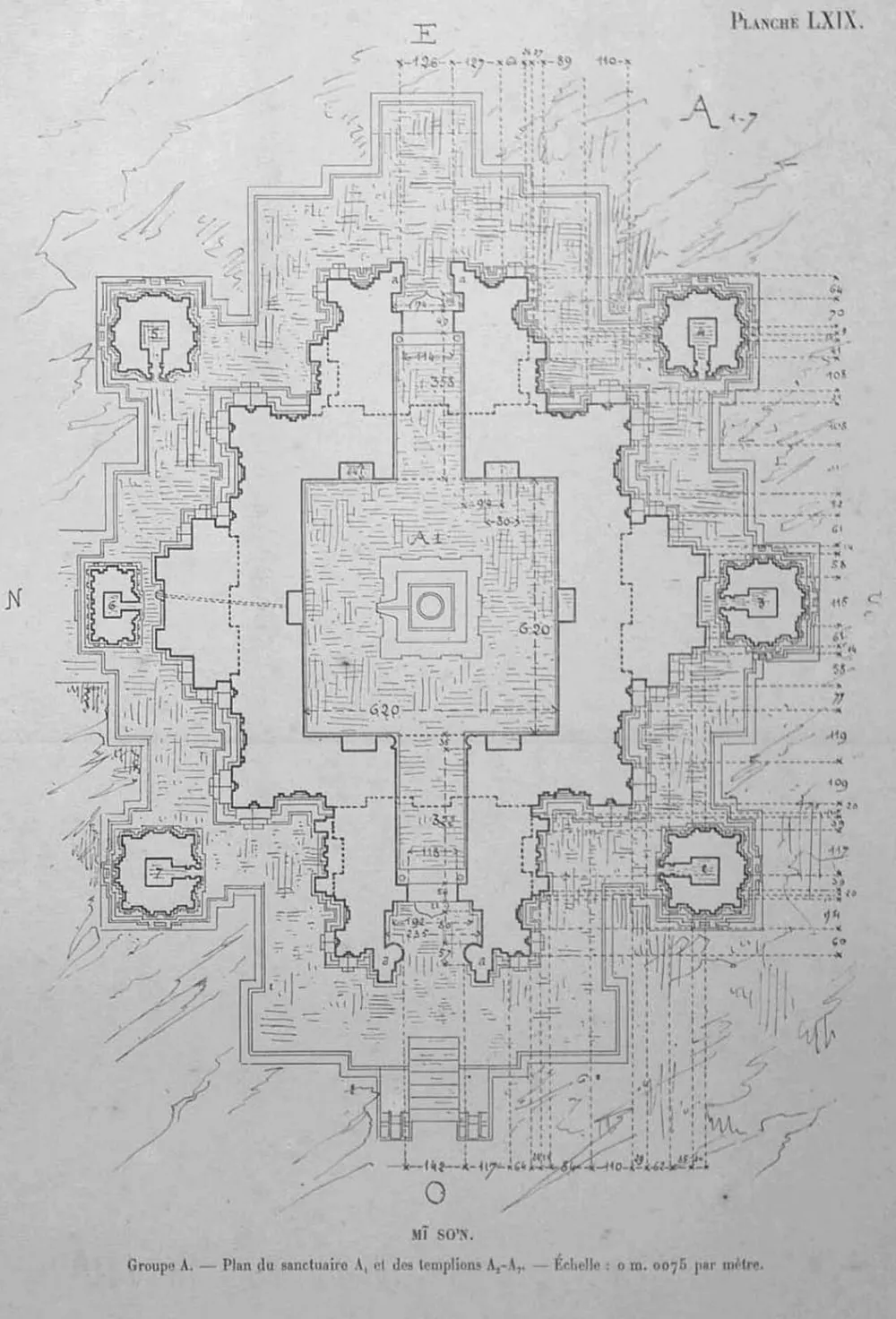
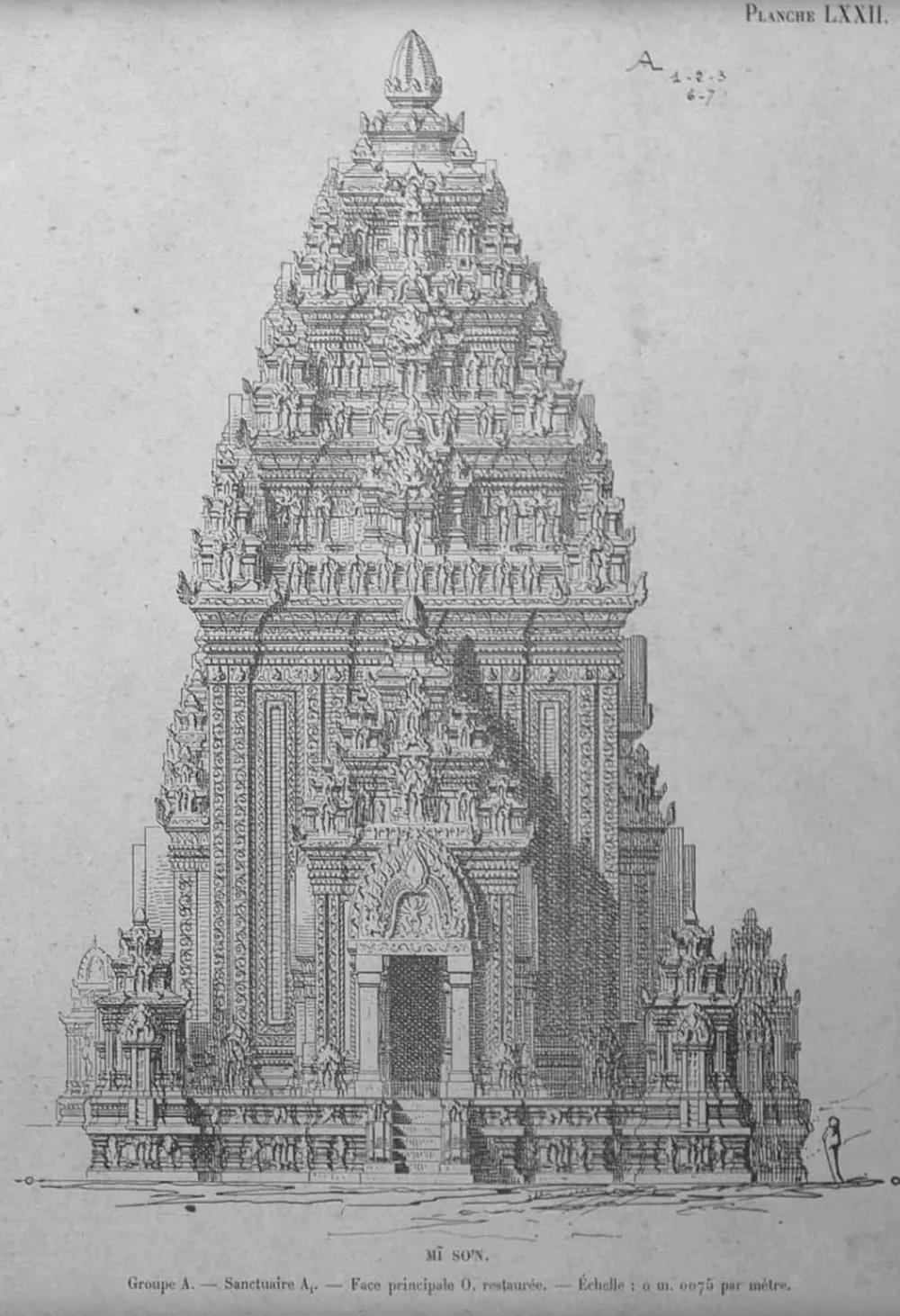
Today’s understanding of My Son still rests largely on Parmentier’s work in the early twentieth century. His group A drawings, shown below, come from that study of the site.
Tower A1, a lost masterpiece
Group A was once the most magnificent complex on the site: the 24 m main tower A1 with 6 small towers around it. The My Son A1 style, named after this temple, is often called the masterpiece of Cham architecture. The whole complex was destroyed in 1969.
Parmentier’s reconstruction drawing of the front of A1 survives. Look at the roofs shrinking tier by tier toward the top and you see why the builders wanted the tower to symbolise Mount Meru.
War, conservation and what remains
The first conservation came in 1937, by French scientists; temple A1 and the small temples around it were restored in 1937-1938. Many towers were damaged in World War II, the First Indo-China War and above all the Second Indo-China War. After the unification of Viet Nam in 1975, conservation work began again in earnest, with national and international teams on site.
Today eight groups with 71 standing monuments survive, plus extensive buried remains. Many statues, altars and linga were taken to France in the colonial period, and others moved to museums such as the Da Nang Museum of Cham Sculpture. Of the 1,800 artifacts found at My Son, over 1,600 have been digitised. On 24 March 2005 Quang Nam inaugurated the exhibition house here.
Excavation goes on. In 2026 the next phase of excavating the path leading to Group K is under way.
What to see inside
From the main entrance a 1 km path leads to the central site. Electric shuttle cars run for anyone who prefers not to walk. Every section has QR codes and automated audio guides in six languages: Vietnamese, English, French, Korean, Japanese and Chinese.
Besides the towers, the site has its own performances. The hall has five shows a day, the first at 9:45 and the last at 16:00. The Apsara dance recalls the celestial maidens of Cham myth, moving to drum beats. Cham folk singing is held at the slope of Group H on Mondays, Wednesdays and Fridays.
The “Echoes of My Son” show runs at Groups B, C and D on the 15th of each solar month. Around the seventh lunar month each year comes the Kate festival, the most important Cham festival.
A full visit takes over 2 hours, counting the museum and the shuttle.
Tickets and opening hours
The posted price is VND 150,000 for foreign visitors and VND 100,000 for Vietnamese visitors. Children under 5 enter free. Tickets can be bought online at mysonticketonline.vn, in Vietnamese and English.
In February 2026 the My Son management board said it planned to raise the ticket to VND 250,000 in the first quarter of 2026, for Vietnamese and foreign visitors alike. That is a plan, not the posted price. Prices can change over time and show clearly at the booking step, so check again before you pay.
Ticket sales run from 6:00 to 17:30, and the site receives visitors from 6:00 to 18:00. It is open all week, including public holidays.
Getting there from Hoi An or Da Nang
My Son is about 40 km from Hoi An old town and about 70 km from Da Nang. From Da Nang, take Highway 1A south, turn right at Nam Phuoc (Nam Phước) onto Highway 545, then drive about 20 km more. From Hoi An, also take Highway 1A, then turn onto Highway 545.
Many people stay in Hoi An and combine My Son with the old town, Cua Dai beach and Cu Lao Cham. See also Hoi An Ancient Town and Cu Lao Cham.
When to go and what to bring
Go early in the morning to avoid the harsh sun and enjoy cooler air. February to August is the ideal season, dry with clear skies. In 2025 My Son received nearly 432 thousand visitors, of whom over 392 thousand were foreign.
Bring a hat, water and sports shoes, because the grounds are large and involve a lot of walking.
What to eat around My Son
After the visit, the food of Quang awaits. Phu Chiem (Phú Chiêm) noodles have soft white noodles, a golden broth and rich shrimp and pork, served with crispy grilled rice cracker; see also Mi Quang. Banh dap is a crisp grilled rice cracker over a soft wet rice cake, dipped in spicy mam nem.
Be thui Cau Mong (Bê thui Cầu Mống) is famous across Quang, with tender sweet veal, golden crisp skin, herbs and mam nem.
Banh beo is small white cups of rice cake topped with crispy shrimp and pork crackling; see Banh Beo. Banh to is a traditional cake for Tet and festivals of the Quang Nam people. Banh xeo wrapped with herbs and dipped in sweet-sour fish sauce is a good way to end the day.
Photo credits
- Tower groups B, C and D, the best-known cluster at My Son: Wikimedia Commons — Chainwit. (opens in a new tab), Chainwit. (CC BY 4.0)
- Plan of group A: the main tower A1 in the middle, small towers A2-A7 around it (Parmentier): Wikimedia Commons — scan by Ismoon (original drawing 1909, public domain). (opens in a new tab), Henri Parmentier (1909); digitised by Ismoon (CC BY-SA 4.0)
- Temple A1 as reconstructed by Henri Parmentier in a drawing. The tower was destroyed in 1969: Wikimedia Commons — scan by Ismoon (original drawing 1909, public domain). (opens in a new tab), Henri Parmentier (1909); digitised by Ismoon (CC BY-SA 4.0)
- Kalan E7, a brick tower standing alone in a grassy clearing: Wikimedia Commons — Chainwit. (opens in a new tab), Chainwit. (CC BY 4.0)
- Weathered brick towers at My Son, one with many tiers still standing and one fallen: Wikimedia Commons — Chainwit. (opens in a new tab), Chainwit. (CC BY 4.0)
Common questions
What is My Son Sanctuary and where is it?
My Son is a complex of Champa temple towers in a valley ringed by mountains, in Thu Bon commune, Da Nang city. The towers date from the fourth to the thirteenth century.
Why is My Son important, and why did UNESCO list it?
UNESCO listed it in 1999 for two reasons. An indigenous society adapted Hindu art and architecture from India. And My Son is the clearest witness of the Champa kingdom in South-East Asian history.
Is My Son worth visiting, and how long does a visit take?
A visit takes over 2 hours, counting the museum, the shuttle and the hands-on experiences. Go early in the morning to avoid the sun.
How much is the My Son ticket?
The posted price is VND 150,000 for foreign visitors and VND 100,000 for Vietnamese visitors. Children under 5 enter free. Prices can change over time.
What time does My Son open?
Ticket sales run from 6:00 to 17:30. The site receives visitors from 6:00 to 18:00, including public holidays.
How far is My Son from Hoi An and Da Nang?
My Son is about 40 km from Hoi An old town and about 70 km from Da Nang. The route runs along Highway 1A, then turns onto Highway 545.
What happened to the A1 tower at My Son?
The 24 m tower A1 and the 6 small towers around it were destroyed in 1969. What remains is Henri Parmentier's reconstruction drawing.
When is the best time to visit My Son?
February to August is the ideal season, dry with clear skies. Around the seventh lunar month, the Cham hold the Kate festival here.
Read next
- Hoi An Old Town: Heritage, Assembly Halls, TicketsVerified 18 October 2026
- Cu Lao Cham: History, Monuments, Boats and Calm SeasonVerified 18 October 2026
- Mi Quang: Origins, Phu Chiem Village, How It Is Made and Three ShopsVerified 18 October 2026
- Banh Beo of Quang Nam: From Hue Bowls to Hoi An and Da NangVerified 18 October 2026
General information checked against the sources listed above, not legal advice for your situation. Rules and office practice change; confirm with the relevant office or a licensed adviser before you act. See how guides are checked.
Spotted an error? Report it.